Unitree Unveils GD01: 2.7-Meter Manned Mecha Priced at $650K
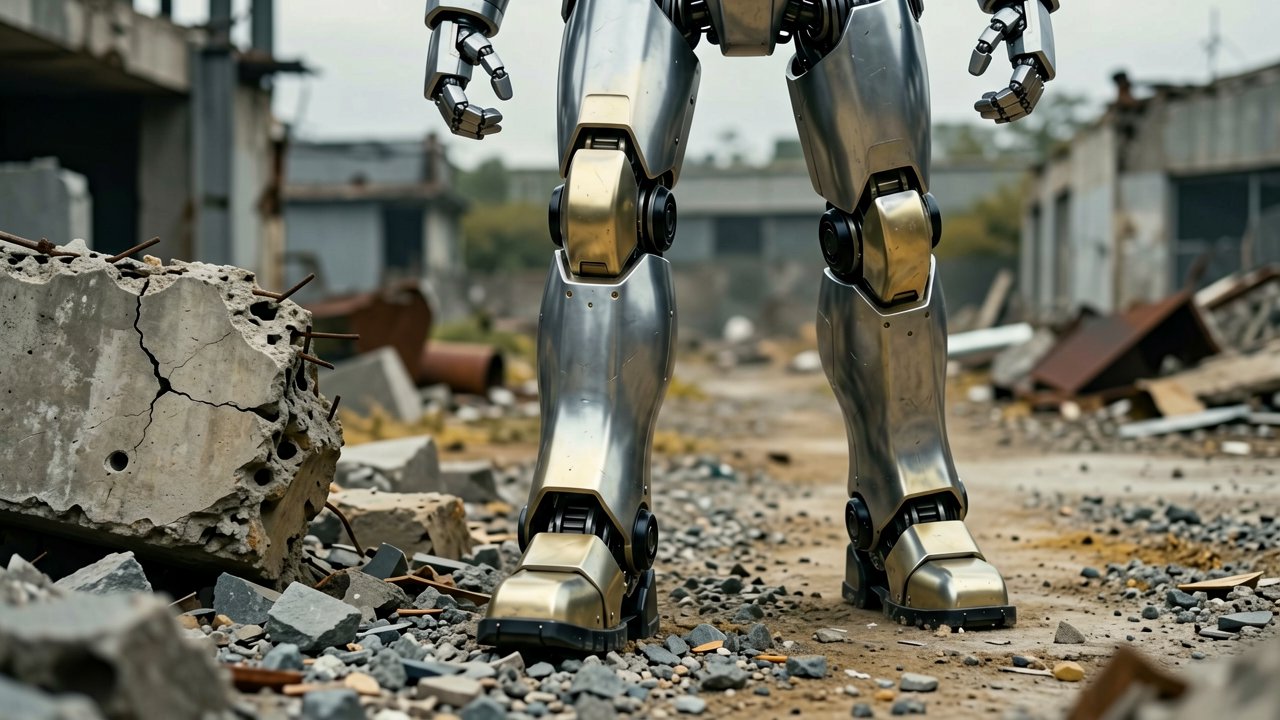
The Chinese robotics manufacturer Unitree Robotics has unveiled the GD01, a 2.7-meter tall piloted humanoid robot that the company describes as the world's first production-ready manned mecha. The machine weighs approximately 500 kilograms with a pilot on board and carries an initial price of 3.9 million yuan, roughly US$ 650,000.
During the launch event, CEO Wang Xingxing personally entered the robot's cabin and operated the mechanical arms to demolish walls in front of the audience. The demonstration immediately went viral on Chinese and international social networks, with viewers comparing the scene to Marvel's Iron Man or the Gundam franchise. The difference is that the GD01 is not a suit worn by the operator, but a robotic vehicle controlled from inside a cockpit in the torso.
According to Global Times reporting, the machine can transform between walking upright on two legs and moving on four legs for rougher terrain. This dual-mode capability positions the GD01 for environments where conventional machinery cannot operate—narrow corridors, staircases, collapsed buildings, or spaces accessible only through freight elevators.
The physical experience of piloting the GD01 involves translating human movement into machine action. The operator sits inside the armored structure, their skills and perception multiplied by the strength and resistance of the mechanical frame. It is less an autonomous robot making decisions on its own and more an enhanced exoskeleton where the human remains the decision-maker (which is probably the only reason the CEO was willing to climb inside).
Marketing staff member Huang Jiawei told Global Times that the $650,000 figure is a preliminary reference price. The final production version may be adjusted depending on performance optimization. While Unitree has the capacity for large-scale production, functional optimization and cost reduction will take time after the initial launch. The acknowledgment that the price is high indicates Unitree is currently targeting corporate and governmental buyers, not individual consumers.
For context, a medium-sized excavator costs between US$ 100,000 and US$ 400,000. The GD01 is more expensive than traditional demolition equipment, but it can climb stairs and operate in spaces where excavators cannot enter. The question is whether that capability justifies the premium for rescue forces, specialized demolition companies, or military operations.
Chen Jing, vice president of the Technology and Strategy Research Institute, noted that the GD01 shows China has crossed a key engineering threshold in embodied AI. It is no longer just a proof-of-concept machine confined to laboratories, but a product with a clear price tag and commercialization roadmap. But its weaknesses are mainly related to real-world usability, including difficulties getting in and out of the machine, battery-life concerns, limited comfort, regulatory uncertainty, and maintenance complexity.
The company spokesperson highlighted that use scenarios focus on high-risk environments. Rescue operations in collapsed buildings, work in areas contaminated by radiation or chemicals, maintenance in hazardous industrial facilities, and interventions in natural disaster areas are some of the applications Unitree envisions. The logic is simple: placing a human inside an armored robotic structure allows them to operate in situations where entering unprotected would be too risky or impossible.

Unitree is the Hangzhou-based company best known for its agile robot dogs and is now one of the top humanoid robot makers in the world. For now, the GD01 is a China-only release, with no regulatory path announced for the US or Europe. Whether Western governments will approve a manned mecha for domestic use remains an open question.
Wang Peng, an associate research fellow at the Beijing Academy of Social Sciences, said Unitree's mecha represents not only the success of a single product, but also a concentrated breakthrough built on years of industrial-chain accumulation. From high-performance motors and batteries to carbon-fiber materials, China's mature supply-chain network allows companies to rapidly launch such products.
Whether users actually pay for it remains the real question. The market for pilotable humanoid robots is unproven, and the industrial learning curve is steep. If the GD01 finds buyers among rescue forces and specialized demolition companies, order volume may enable future versions at more competitive prices. If not, it will remain a viral curiosity with a price tag that only governments can afford.
The robot can punch through walls, but it still can't punch through the regulatory red tape required to sell it outside China.
Artūras Malašauskas is an AI Systems Integrator with 20+ years of production-grade web engineering experience. He has designed, shipped, and scaled enterprise Python/PHP systems for logistics, SaaS, and public-sector clients. For the past year, he has focused exclusively on AI integrations: deploying open-source LLMs, building generative media pipelines (image, audio, video), and engineering multi-agent workflows for real production environments. His standard: reproducibility, security, cost-efficient inference—no vaporware. He documents and evaluates emerging AI tooling, separating verified capabilities from marketing noise. Technical editor at: muza-ai.eu, ai-verslas.lt, ai-naujinos.lt Connect on LinkedIn
Comments