Chinese AI Labs Turn Sanctions Into Efficiency Advantage
American export controls intended to slow Chinese artificial intelligence development have produced an unintended consequence: they have forged a ruthlessly efficient competitor. Field research from Beijing, Hangzhou, and Shanghai reveals that despite operating with compute capacity two to three years behind the United States, Chinese open-source models trail the American frontier by only six to eight months.
The exponentialview.co investigation documents this paradox through direct observation of fourteen labs including DeepSeek, MoonshotAI, MiniMax, Z.ai, ByteDance, 01.AI, Alibaba, Ant Group, Xiaomi, AInnovation, Galbot, Unitree, ModelScope, and RWKV. Researchers across these facilities report the same constraint: insufficient access to advanced chips.
The hardware gap is stark. American hyperscalers are ordering systems by the gigawatt. Anthropic alone has signed deals totaling over 10 gigawatts of capacity with Amazon, Google, Microsoft, Nvidia, and SpaceX. OpenAI committed to 10 gigawatts of Nvidia systems last September, backed by up to $100 billion in investment. These orders target the latest silicon: Nvidia's Blackwell series (B200, B300, BG200) and the next-generation Vera Rubin platform.
Chinese labs cannot access these systems at scale. Supply isn't entirely dry—some Nvidia H100s, B200s, and B300s reach China through Singapore via shell companies where shipments are relabelled as tea or toys. But quantities remain at least an order of magnitude below American rivals. A single GB300 NVL72 rack delivers 30x faster real-time inference than the equivalent H100 cluster from three years earlier, with 3.6x more memory per chip and 25x lower energy per inference.
Domestic alternatives exist but lag. Huawei's Ascend 950PR, launched in March, is roughly on par with the H100 from 2022. Nvidia is estimated to have shipped 7 million Hopper and Blackwell GPUs through October 2025 alone. Huawei plans to ship 750,000 Ascend 950PR chips this year—around a tenth of what Nvidia shipped last year.
The result is a compute disparity that widened from threefold in 2023 to eightfold by early 2026. By the end of 2025, Chinese labs could likely access roughly the same scale of compute that the United States enjoyed two years earlier. The difference lies in how that compute is used.
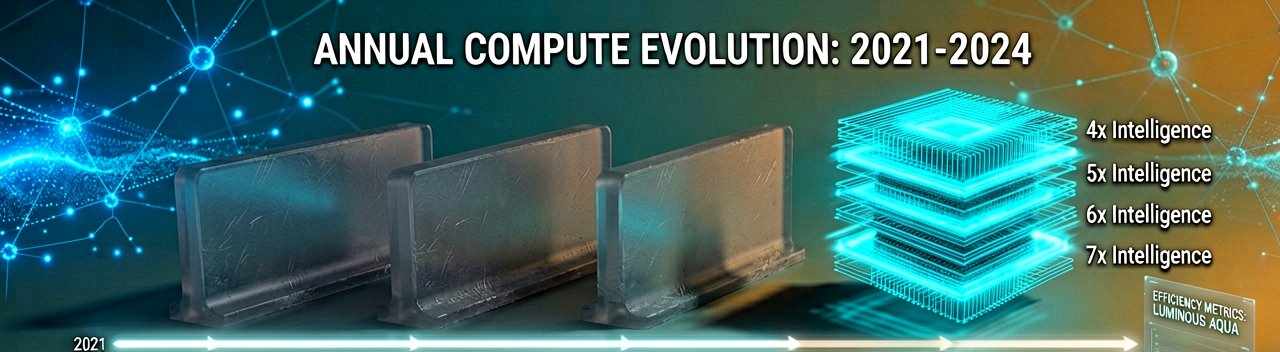
Chinese labs are extracting 4-7x as much intelligence per unit of compute as naive scaling predictions would suggest. This efficiency advantage stems from architectural innovations forced by necessity. Mixture-of-experts architectures activate only a subset of parameters for each token, reducing compute at inference while maintaining the capacity of much larger models. DeepSeek developed a novel architecture called DeepSeek Sparse Attention to reduce the computational and memory costs of the original transformer attention mechanism—an approach adopted by other Chinese AI labs such as Z.ai.
Moonshot AI, maker of the Kimi foundation models, developed a hybrid linear attention architecture supporting context lengths up to 1 million tokens while dramatically reducing compute and memory costs. Quantization techniques compress models using less precise data formats. Alibaba pushed aggressively in 4-bit quantization for its Qwen model series. Moonshot AI's Kimi-K2-Thinking model is a natively INT4-quantized model, greatly improving deployment efficiency.
Distillation campaigns represent another efficiency pathway. This technique uses outputs from more advanced models to train and improve less capable models. In February 2026, three leading American AI companies disclosed industrial-scale campaigns to extract capabilities from their proprietary AI models. Anthropic and OpenAI publicly named specific Chinese AI firms behind the campaigns. By early April 2026, the three companies agreed to share intelligence through the Frontier Model Forum.
The IISS analysis notes that the White House issued NSTM-4, a memorandum directing federal agencies to treat China's distillation attacks as a national-security concern. The performance gap between proprietary closed-source models and open-weight alternatives has narrowed. An MIT paper from November 2025 concluded that open models achieve 90% of the performance of closed models upon release and can close the gap quickly.
Chinese open-weight models have lagged US frontier models by an average of only seven months since 2023. As of November 2025, Chinese open-weight models from Alibaba, Z.ai, Moonshot, and MiniMax have become the de facto standard among US startups looking to build and train their own models at lower cost. In technology contests, superior innovation may lose if mass adoption establishes a market standard.
The capital disparity is equally pronounced. China's AI startups raised $12.4 billion in 2025 compared to $285 billion in the US. Alibaba, one of China's largest AI players, plans to invest over $53 billion in AI over three years. Microsoft spent approximately $80 billion on AI capital expenditures in 2025 alone. America's main hyperscalers—Alphabet, Amazon, Meta, and Microsoft—have plans to spend a total of $650 billion just this year.
Despite these constraints, the researchers encountered during the field research were humble, welcoming, and focused purely on technical priorities. At one lab in particular, the average age was 25. Every lab is obsessed with ByteDance's Doubao, and respectful of DeepSeek's scientific process. Claude is the model of choice for coding, universally rated as the best thing out there.
The Brookings Institution analysis contextualizes this within broader strategy. China is pursuing a full-stack approach to AI development, from chips and compute infrastructure to foundation models and applications. The goal is not to achieve AGI, but to leverage AI as a powerful, general-purpose technology that will turbocharge a wide range of sectors and services.
Chinese policymakers and China's AI industry as a whole are more focused on running several different AI races. They prioritize model efficiency, AI adoption, and the integration of AI into the physical world. This focus is the result of industry constraints—particularly access to large-scale compute and capital—as well as Beijing's policy priorities.
China holds only 14% of global AI compute, compared to the 74% held by the US. The compute cost for training a leading frontier model is significantly higher than the cost of systematically querying a publicly accessible model and collecting its outputs. This makes distillation an attractive pathway for compute-constrained actors.
Reports indicate that DeepSeek's V4 model, released in April 2026 and advertised as being adapted for Huawei AI chips, may have been trained using advanced Nvidia AI chips and illicitly distilled models from US firms. Ever since DeepSeek released its R1 reasoning model in January 2025, OpenAI has continued to allege that the Chinese firm has trained successive models using increasingly sophisticated distillation attacks.
The physical reality of these constraints shows up in longer pre-training runs and iterative cycles. Researchers wait for compute slots. They optimize code to squeeze every percentage point of efficiency from limited hardware. The friction is measurable in hours of waiting, in the texture of servers humming in cramped data centers, in the careful allocation of every token processed.
Whether this efficiency advantage translates to sustained competitive advantage remains uncertain. American labs have the capital and compute to iterate faster on raw capability. Chinese labs have the discipline to extract maximum value from constrained resources. The question isn't which approach is superior—it's which approach survives the next cycle of sanctions, countermeasures, and technological breakthroughs.
Time will tell if efficiency alone can overcome the hardware gap. For now, the sanctions have created exactly the conditions that will matter most in the coming years: a competitor that knows how to do more with less. Whether users actually pay for it remains the real question.
Artūras Malašauskas is an AI Systems Integrator with 20+ years of production-grade web engineering experience. He has designed, shipped, and scaled enterprise Python/PHP systems for logistics, SaaS, and public-sector clients. For the past year, he has focused exclusively on AI integrations: deploying open-source LLMs, building generative media pipelines (image, audio, video), and engineering multi-agent workflows for real production environments. His standard: reproducibility, security, cost-efficient inference—no vaporware. He documents and evaluates emerging AI tooling, separating verified capabilities from marketing noise. Technical editor at: muza-ai.eu, ai-verslas.lt, ai-naujinos.lt Connect on LinkedIn
Comments