Vadzo Imaging Unveils Bolt-2020CRS 20MP MIPI Camera Module
The embedded vision hardware market received another high-resolution option this week when Vadzo Imaging announced the Bolt-2020CRS, a 20MP color rolling shutter camera module built around Onsemi's Hyperlux LP AR2020 sensor.
Announced May 13, 2026 from Fort Worth, Texas, the camera targets robotics, autonomous mobile robots, UAV payloads, medical imaging, and industrial inspection systems. The press release positions the module as a direct MIPI CSI-2 solution that eliminates USB bridge overhead for lower latency and power consumption.
Technical specifications run the gamut of what embedded developers expect from modern CMOS sensors. The AR2020 delivers 5120 × 3840 pixel resolution with 1.4 µm backside-illuminated pixels on a 1/1.8-inch optical format. Line-interleaved HDR reaches 100 dB dynamic range without motion artifacts, while single-exposure eDR mode provides 73 dB. The sensor also supports enhanced near-infrared response at 850nm and 940nm wavelengths for low-light and night-vision applications.
Physical integration is straightforward enough for most engineering teams. The module measures 38mm × 38mm (reducible to 32mm × 32mm) and weighs 18 grams without the lens. An S-Mount (M12) lens holder accepts standard threaded optics, and the camera ships with a default 74° diagonal field-of-view lens. Operating temperature spans -30°C to +85°C, which covers most industrial deployment environments.
Four-lane MIPI CSI-2 outputs uncompressed data with sub-10ms latency. That's the kind of number that matters when you're running real-time visual servoing on a pick-and-place robot (nobody wants their automation system stuttering through a production cycle). The camera supports binning, skipping, and summing modes that push up to 240 fps at VGA resolution for high-speed edge AI inference.
Power management features include Super Low Power Mode and Wake-on-Motion capture. These capabilities matter for battery-constrained deployments like drone payloads or wearable medical devices where every milliwatt counts toward flight time or operational duration.
Driver support covers the usual embedded Linux suspects: Raspberry Pi 4/5, NVIDIA Jetson Orin series, and NXP i.MX8M Plus platforms. Vadzo's product page notes that driver porting assistance is available for other SoCs like STM and MediaTek, though that likely comes with additional engineering time and cost.
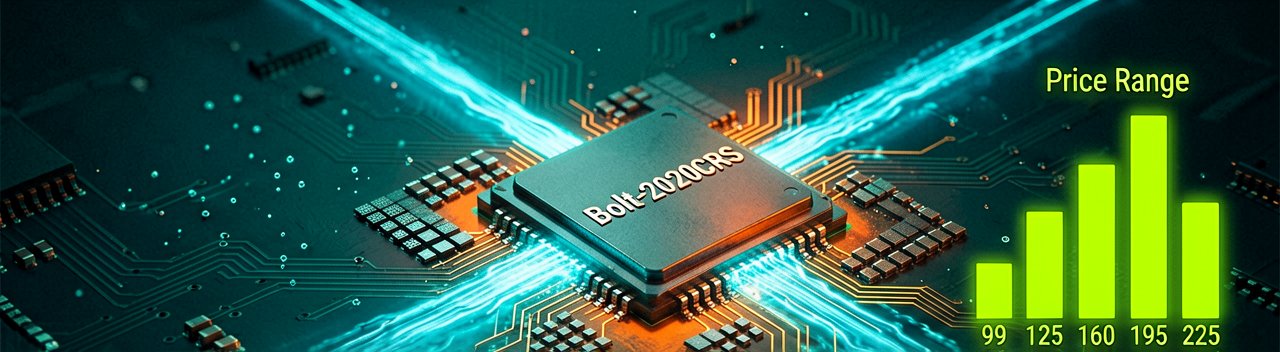
Pricing tiers reflect typical embedded hardware volume discounts. Single units run $225, dropping to $140 at 250-999 quantities and $99 at 1000-4999 units. The lens and cable are included in these prices, which is worth noting since some competitors quote camera-only pricing and tack on optics separately.
Vadzo's official product documentation details customization options including firmware modifications, enclosure design, and integration of additional sensors like ToF, mmWave radar, or IMU units. The company also offers enclosure manufacturing for both IP-rated and non-IP-rated deployments.
Alwin Vincent, Product Manager at Vadzo Imaging, emphasized the combination of the AR2020 sensor's color sensitivity with built-in auto exposure control. His quote in the press release notes that many fixed-focus MIPI cameras struggle with changing light conditions, and the Bolt-2020CRS addresses this with intelligent exposure adjustment through a single MIPI connection.
The Newswire press release lists applications spanning autonomous mobile robots, UAV inspection systems, medical endoscopy, smart surveillance, industrial machine vision, and agricultural robotics. That's a broad portfolio, but the common thread is embedded systems needing high-resolution color imaging without the overhead of USB-to-MIPI bridge chips.
The rolling shutter architecture introduces the usual caveats for fast-moving subjects. Rolling shutter cameras can produce skew or wobble artifacts when capturing rapidly moving objects or when the camera itself experiences vibration. Global shutter alternatives exist in the market, but they typically come with higher noise floors or reduced resolution at the same price point.
Whether the Bolt-2020CRS gains traction depends on how well Vadzo's driver support holds up across different embedded platforms. Pre-validated drivers for Raspberry Pi and Jetson are a good start, but enterprise deployments often require NXP or custom SoC support that may need additional engineering validation.
At $99 per unit in volume, the camera competes with other 20MP MIPI modules from established players. The differentiator here is the combination of HDR performance, NIR sensitivity, and the compact form factor. Whether users actually pay the premium for these features remains the real question.
For now, the module represents another option in a crowded embedded vision market. Engineers will need to test whether the promised sub-10ms latency and 100 dB HDR performance translate to real-world reliability under production conditions.
Artūras Malašauskas is an AI Systems Integrator with 20+ years of production-grade web engineering experience. He has designed, shipped, and scaled enterprise Python/PHP systems for logistics, SaaS, and public-sector clients. For the past year, he has focused exclusively on AI integrations: deploying open-source LLMs, building generative media pipelines (image, audio, video), and engineering multi-agent workflows for real production environments. His standard: reproducibility, security, cost-efficient inference—no vaporware. He documents and evaluates emerging AI tooling, separating verified capabilities from marketing noise. Technical editor at: muza-ai.eu, ai-verslas.lt, ai-naujinos.lt Connect on LinkedIn
Comments