Tvasta and 14Trees Launch Cedar AI-Ready 3D Concrete Printer
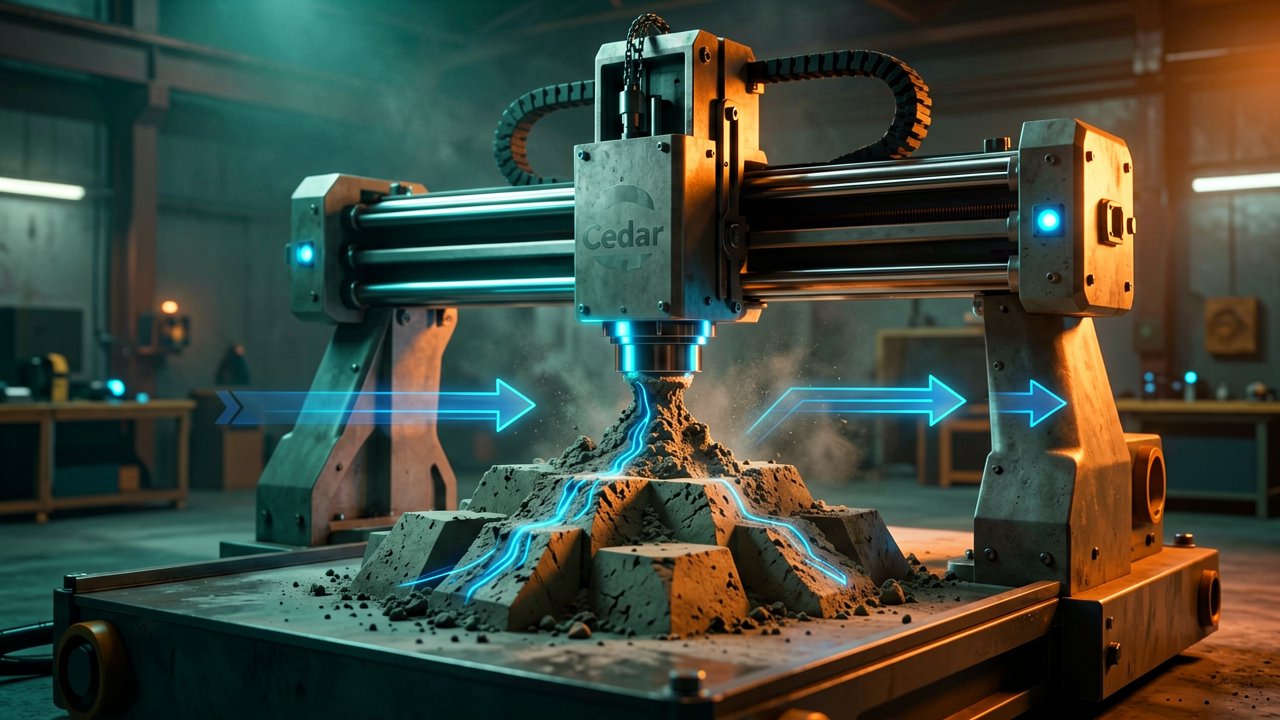
The Chennai-based deep-tech startup Tvasta Manufacturing Solutions has partnered with global construction technology firm 14Trees to launch Cedar, an AI-ready 3D concrete printer positioned for international deployment across housing, infrastructure, and commercial construction segments.
Founded in 2016 by IIT Madras alumni, Tvasta has focused on robotics-driven construction automation as an alternative to conventional building methods. The Cedar system represents a joint engineering effort combining Tvasta's industrial manufacturing capabilities with 14Trees' expertise in design optimization and material science.
According to the DT Next announcement, Cedar's primary innovation lies in its ability to print using standard concrete formulations rather than specialized mortar mixtures typically required by construction 3D printing systems. The companies claim this approach can reduce material costs by up to five times while enabling the use of locally sourced materials.
Most 3D concrete printers on the market demand proprietary material blends that limit flexibility and increase expenses. Cedar's portal-frame architecture is designed to work with conventional concrete, which means contractors can source materials from local suppliers rather than waiting for specialized shipments (a logistical headache that has plagued the industry for years).
The system features a print height of up to 10 meters with an extendable footprint reaching 240 square meters. This build volume positions Cedar for applications ranging from residential housing to industrial facilities and infrastructure components. The companies state the printer requires approximately half the capital investment of comparable large-format construction printers.
Francois Perrot, CEO of 14Trees, emphasized the economic imperative behind the technology. "Construction 3D printing has already proven its technical viability. For the technology to scale across the global construction industry, it must also make strong economic sense for developers and contractors," Perrot said in the official announcement.
A key component of the Cedar ecosystem is the 14Trees AI Companion, a digital platform designed to optimize material performance using locally available resources. The platform leverages AI-driven analysis of thousands of mix designs to help project teams balance cost efficiency, structural performance, and environmental impact.
Tvasta CEO Adithya V S stated the system was engineered for deployment across diverse construction environments globally. "By combining advanced manufacturing capabilities with cutting-edge robotics and software, Cedar delivers a robust and reliable system built for deployment across highly diverse construction environments," Adithya said.
The companies report Cedar has already been deployed for projects across the United States, Europe, the Middle East, Asia, and Africa. Tvasta's project portfolio includes Tamil Nadu's first 3D printed bus shelter for GCC, a security cabin for Godrej Enterprises Group, a sanitary block for the Indian Air Force, and a research installation at IIT Madras.
The IIT Madras house project serves as a notable proof-of-concept. The 500 square foot structure was printed in modules at Tvasta's Chennai facility and assembled on-site. The entire project was completed in 21 days and inaugurated by Finance Minister Nirmala Sitharaman.
14Trees provides end-to-end support services for Cedar deployments, including design optimization, materials development, operational training, and on-site project delivery. This service model aims to lower the barrier for construction firms seeking to adopt 3D printing technology at scale.
The physical reality of operating Cedar involves managing a portal-frame structure that requires significant site preparation and power infrastructure. Unlike desktop 3D printers that sit on a workbench, this system demands industrial-grade electrical connections, material batching equipment, and trained operators who understand both robotics and concrete behavior.
Whether construction firms actually adopt this technology at meaningful scale remains the real question. The economics look compelling on paper, but the construction industry moves slowly and favors proven methods over novel solutions. Whether users actually pay for it remains the real question.
For now, Cedar represents another attempt to make automated construction commercially viable. The technology works. The materials cost less. The question is whether developers will trust it enough to build their next project on it.
Artūras Malašauskas is an AI Systems Integrator with 20+ years of production-grade web engineering experience. He has designed, shipped, and scaled enterprise Python/PHP systems for logistics, SaaS, and public-sector clients. For the past year, he has focused exclusively on AI integrations: deploying open-source LLMs, building generative media pipelines (image, audio, video), and engineering multi-agent workflows for real production environments. His standard: reproducibility, security, cost-efficient inference—no vaporware. He documents and evaluates emerging AI tooling, separating verified capabilities from marketing noise. Technical editor at: muza-ai.eu, ai-verslas.lt, ai-naujinos.lt Connect on LinkedIn
Comments