Automated Tire Unveils SmartBay AI Tire Change Platform
Automated Tire, Inc. has emerged from stealth to reveal SmartBay, an AI-powered robotic platform designed to automate tire changes, wheel balancing, and vehicle inspections. The announcement, made on May 12, 2026, marks the company's first public disclosure of its core technology after operating in development mode.
According to the official press release, SmartBay represents the first major technological leap in vehicle servicing bays in decades. The platform uses advanced robotics, computer vision, and machine learning to execute physical tasks with precision rather than relying on pre-programmed routines that require manual intervention for real-world variables.
CEO Andy Chalofsky, a fourth-generation tire industry entrepreneur, framed the launch around three critical industry problems: technician shortage, workplace injury, and margin compression. Electric vehicles wear through tires up to 30% faster than conventional vehicles, creating more service opportunities while the labor pool shrinks. The National Automotive Dealers Association reports the industry faces a shortage of at least 37,000 new technicians annually.
SmartBay's operational model is semi-automated in this first generation. A human operator removes the used tire and positions the new tire in the machine. The robotic system then executes the tire change and wheel balancing process while the vehicle remains on the lift. The operator returns to connect the air line for pressurization and mounts the balancing weights at the proper position. This approach leaves the wheels attached to the vehicle throughout the process, eliminating the labor-intensive task of removing and reinstalling wheel lug nuts.
The machine changes two tires simultaneously (front or rear), approaching the vehicle from underneath. It fits entirely within a standard 12-foot service bay, maintaining full bay functionality for other services when needed. The precision wheel-weight tool dispenses the exact amount of weight composite required for what the company claims is the industry's most accurate balance.
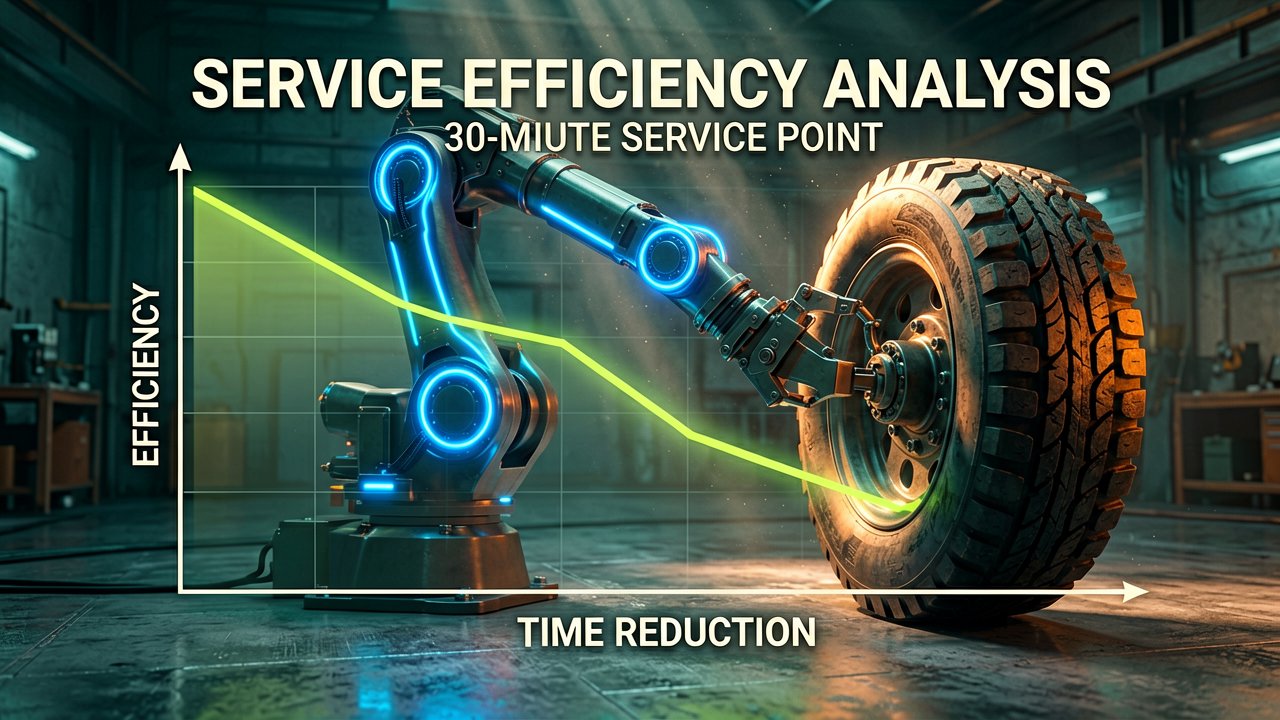
Independent reporting from The Robot Report corroborates the throughput claims. Manual tire replacement typically requires an hour for one operator to replace and balance four tires. SmartBay reduces total time to 30 minutes with one operator, who can manage three bays simultaneously. At a major tire center, this means a single operator managing three bays can replace 24 tires or six vehicles in the same time as a single manual technician in one bay.
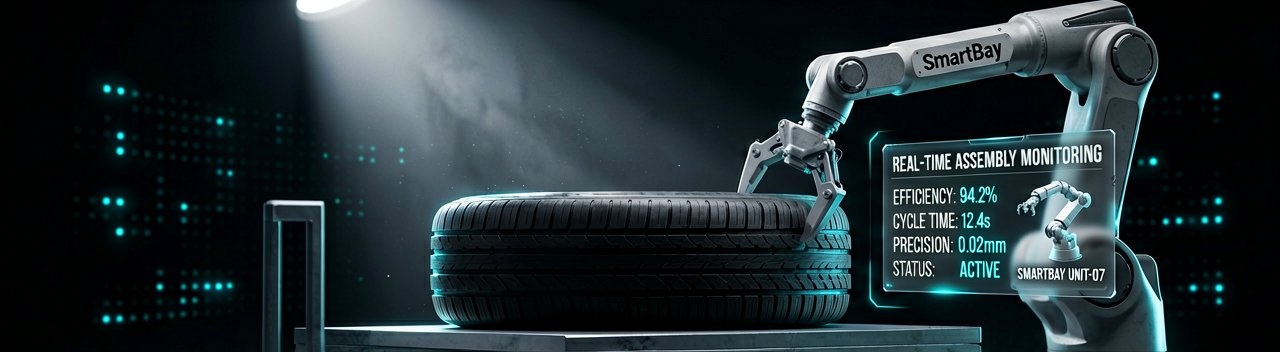
Throughout the process, SmartBay continuously collects and analyzes data, generating real-time insights and customer-facing reports. The integrated service includes BrakeWise brake insights, combining automated inspection, tire handling, balancing, and data intelligence into a single workflow.
The leadership team brings decades of experience across automotive service and robotics. Chalofsky founded multiple tire businesses including Network Tire, Traction Tire, United Tire, and SimpleTire (acquired by DealerTire). President and COO Eran Frenkel brings robotics operations experience from Kiva Systems/Amazon Robotics, 6 River Systems, and Third Wave Automation. CFO Faron Schonfeld holds past roles at Citadel and Accenture.
Chalofsky acknowledged the failure of RoboTire, a similar company that went bankrupt after raising $7.5 million in Series A funding in 2022. He said SmartBay is designed to solve real labor issues with measurable ROI, though he noted a future version might completely automate the entire mounting, airing, and balancing process.
The physical reality of using SmartBay involves less strain on technicians' backs and hands. No more wrestling 80-pound truck tires onto rims with a pry bar while your knuckles bleed. The machine handles the heavy lifting, the precision work, and the dangerous positioning. Operators still need to be present, but their role shifts from manual labor to system oversight (which is a welcome change for anyone who's spent a decade in a grease-stained shop).
Leasing options for SmartBay are available through the company's website. Whether dealerships actually adopt the technology at scale remains the real question. The automotive service industry has historically been slow to embrace automation, and the upfront cost of robotic systems often outweighs short-term labor savings. Time will tell if SmartBay can prove its ROI in real-world conditions rather than controlled demonstrations.
Artūras Malašauskas is an AI Systems Integrator with 20+ years of production-grade web engineering experience. He has designed, shipped, and scaled enterprise Python/PHP systems for logistics, SaaS, and public-sector clients. For the past year, he has focused exclusively on AI integrations: deploying open-source LLMs, building generative media pipelines (image, audio, video), and engineering multi-agent workflows for real production environments. His standard: reproducibility, security, cost-efficient inference—no vaporware. He documents and evaluates emerging AI tooling, separating verified capabilities from marketing noise. Technical editor at: muza-ai.eu, ai-verslas.lt, ai-naujinos.lt Connect on LinkedIn
Comments