Cryptorefills Enables x402 Payments for AI Agents

Cryptorefills has enabled x402 payments at checkout, allowing AI agents to purchase gift cards, mobile top-ups, and eSIMs using USDC on the Base network. The Amsterdam-based company announced the launch alongside an open-source operations reference for the merchant layer of agentic commerce.
The protocol, developed by Coinbase and Cloudflare, lets autonomous software settle stablecoin transactions programmatically without human intervention. For Cryptorefills, checkout becomes a programmable endpoint that agents can call directly.
x402 reactivates the long-dormant HTTP 402 Payment Required status code. An agent makes a request, the server responds with 402 plus a machine-readable payload containing price, accepted asset, and target address. The agent signs a payment authorization and retries with an X-PAYMENT header. No account creation, no OAuth, no prefunded API key.
This launch adds a second agent-payment rail to the platform. Cryptorefills released its Model Context Protocol server in October 2025, allowing agents to discover products, build orders, and complete purchases through MCP. x402 addresses a different pattern: the agent calls a Cryptorefills endpoint, receives payment terms, settles in USDC, and completes the request in one round trip. The two rails serve different agent contexts and run in parallel.
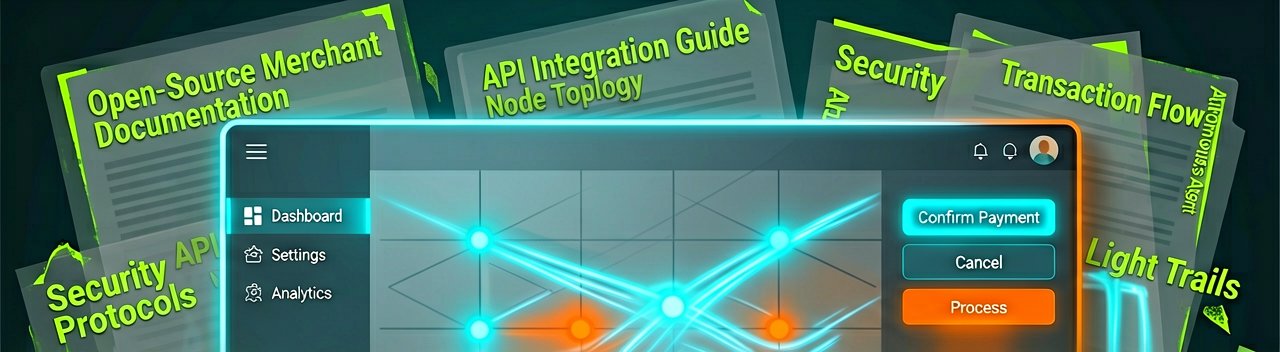
"We shipped x402 and open-sourced our merchant operations work in the same week on purpose. One is a payment rail, while the other is what a merchant needs around it to accept agent traffic. Agentic commerce is happening, and very little about the second part has been written down," said Massimiliano Silenzi, CEO of Cryptorefills.
The reference repository, available at github.com/Cryptorefills/agentic-commerce, covers the operations surface that surrounds the protocol stack. Topics include catalogue discovery for agent buyers, settlement reconciliation across chains, quote-and-pricing handling, and delivery confirmations. Documentation is released under CC0; example code is Apache 2.0.
"In the repository we just open-sourced there are nine playbooks, the TypeScript schemas behind them, and five runnable examples. Two of them connect to our live MCP and x402 endpoints, so a developer can clone the repository and watch the agent-merchant exchange execute against production," said Simonluca Landi, CTO of Cryptorefills.
Here's what a complete purchase looks like in practice. An AI agent buying a $50 Amazon gift card with USDC on Base, using Claude Desktop with the Cryptorefills MCP server installed, follows a specific sequence. The agent adds the MCP server to claude_desktop_config.json, calls searchProducts to get matching products and available denominations, then calls getProductPrice for the USDC equivalent at current rates. Pricing is just-in-time, so the agent never pays against a stale rate (developers will appreciate this, since rate volatility has been a nightmare for automated systems).

The agent calls validateOrder, then createOrder. Validation runs first to catch delivery or availability issues before committing funds. Payment lands at the returned address within the expiry window, order status moves to completed, voucher is delivered. The agent can stream status updates via /track-order-stream or fall back to polling.
According to The AI Journal, Cryptorefills serves AI agents through three of the field's emerging standards: MCP for context, Agent Skills for capability publishing, and x402 for stablecoin settlement.
Gift cards fit well here: digital, instantly issuable, no shipping, no identity verification on the buyer's side. Most APIs assume a human is somewhere in the loop. Pre-issued keys, OAuth flows, checkout UIs built around the idea that someone, eventually, clicks confirm. That assumption is cracking.
Wallet marketplace bots quote, execute, and stream delivery status within the wallet interface. Telegram mini apps handle brand search, denomination selection, and payment validation conversationally. DAO rewards agents issue vouchers autonomously from a treasury wallet for on-chain contributions. Treasury spend helpers automate gift card procurement without manual fiat off-ramp steps.
Cryptorefills enables people in over 180 countries to spend cryptocurrency on everyday products and services. Categories include gift cards from over 6,600 brands, mobile top-ups across 600 operators, eSIMs, flights across 300 airlines, and stays at over 1 million hotels and properties. The platform supports stablecoin checkout across Base, Ethereum, Tron, Solana, Polygon, and other major networks, alongside Bitcoin and Lightning.
Operating publicly since 2018 and headquartered in Amsterdam, Cryptorefills is a member of the Holland Fintech Association and Blockchain Netherlands Foundation.
Whether merchants actually adopt this infrastructure at scale remains the real question. The technical pieces are there, but convincing businesses to accept autonomous payments without human oversight is a different challenge entirely. Time will tell if agents actually buy more than just gift cards.
Artūras Malašauskas is an AI Systems Integrator with 20+ years of production-grade web engineering experience. He has designed, shipped, and scaled enterprise Python/PHP systems for logistics, SaaS, and public-sector clients. For the past year, he has focused exclusively on AI integrations: deploying open-source LLMs, building generative media pipelines (image, audio, video), and engineering multi-agent workflows for real production environments. His standard: reproducibility, security, cost-efficient inference—no vaporware. He documents and evaluates emerging AI tooling, separating verified capabilities from marketing noise. Technical editor at: muza-ai.eu, ai-verslas.lt, ai-naujinos.lt Connect on LinkedIn
Comments