China Unveils Humanoid Robot for 2029 Moon Mission
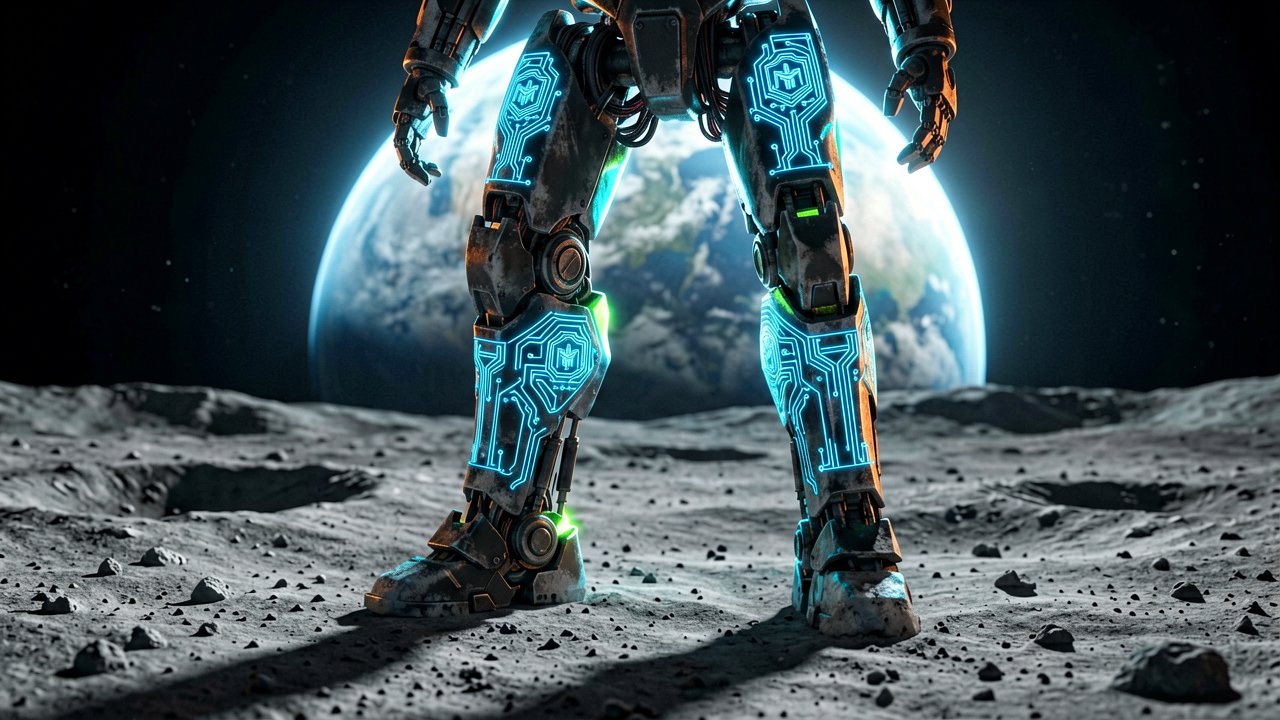
China has unveiled an AI-powered humanoid robot designed for deployment on the Moon as part of its 2029 Chang'e-8 mission. The 100-kilogram (220-pound) machine, developed by the Hong Kong University of Science and Technology (HKUST), will function as a robotic porter to transport and install scientific instruments at various lunar locations ahead of a planned crewed landing.
The design combines a humanoid upper body with two manipulator arms mounted atop a four-wheeled mobility module equipped with solar panels. This hybrid architecture prioritizes reliability over pure anthropomorphism—the wheels handle rough lunar terrain while the arms provide dexterity for tool manipulation. It's a pragmatic engineering choice rather than an attempt to replicate human form for its own sake.
According to HKUST professor Gao Yang, the robot's onboard artificial intelligence will identify and trace objects, allowing it to formulate strategies before executing tasks. "This will be a novel demonstration of humanoid robotics on the Moon and by China," she told the South China Morning Post. The robot will deploy after the Chang'e-8 probe lands, carrying out tasks like placing sensors in specific locations and collecting lunar surface samples.
Chang'e-8 represents a shift in mission objectives from pure observation to on-site engineering. The robot symbolizes this transition—moving from passive data collection to active infrastructure preparation. Future missions will see limited infrastructure setup and deployment of sensor networks, serving as a test-bed for long-term habitation and preparatory work for permanent bases.
China is targeting the lunar South Pole, where craters likely contain ice deposits. These resources could provide potable water, breathable oxygen, and raw materials for rocket fuel production. The area also tends to see near-continuous sunlight, making it ideal for solar-powered operations. Teams of robots could theoretically build infrastructure to tap these resources and perform maintenance on future moon bases.
The timeline places China's crewed lunar landing by 2030, while NASA aims to return astronauts to the surface by 2028 as part of the Artemis IV mission. The American timeline has shifted multiple times due to technical hurdles and development delays. At a Senate Committee hearing in September, former NASA administrator Jim Bridenstine warned that the complexities of SpaceX's Starship Human Landing System could see the US fall behind China's projected timeline.
Our complicated architecture requires a dozen or more launches in a short time frame, Bridenstine noted. It relies on challenging technologies yet to be developed, like cryogenic in-space refueling, and still needs human-rating certification. The massive spacecraft requires orbital refueling to land and return safely—something never achieved at this scale (a problem that has plagued users for years, frankly).
The physical reality of this robot involves navigating regolith-covered terrain while manipulating tools designed around human ergonomics. Most existing space program tools are built for astronauts' arms and hands, so producing robots that can use them without redesign makes practical sense. The robot will handle equipment installation, potentially help build infrastructure, and collect lunar soil samples.
Whether this technology translates to sustained lunar operations remains unproven. The Chang'e-8 robot serves as a proof-of-concept, but actual deployment under lunar conditions will reveal whether the design holds up. China's space program has pursued ambitious goals over recent decades, yet execution often differs from announcement timelines.
The real question isn't whether the robot works in a lab—it's whether it survives the radiation, temperature extremes, and communication delays of actual lunar operations. Whether users actually pay for it remains the real question.
Artūras Malašauskas is an AI Systems Integrator with 20+ years of production-grade web engineering experience. He has designed, shipped, and scaled enterprise Python/PHP systems for logistics, SaaS, and public-sector clients. For the past year, he has focused exclusively on AI integrations: deploying open-source LLMs, building generative media pipelines (image, audio, video), and engineering multi-agent workflows for real production environments. His standard: reproducibility, security, cost-efficient inference—no vaporware. He documents and evaluates emerging AI tooling, separating verified capabilities from marketing noise. Technical editor at: muza-ai.eu, ai-verslas.lt, ai-naujinos.lt Connect on LinkedIn
Comments