Minisforum M2 Mini PC Brings 128GB RAM and 90 TOPS AI to 5-Inch Chassis
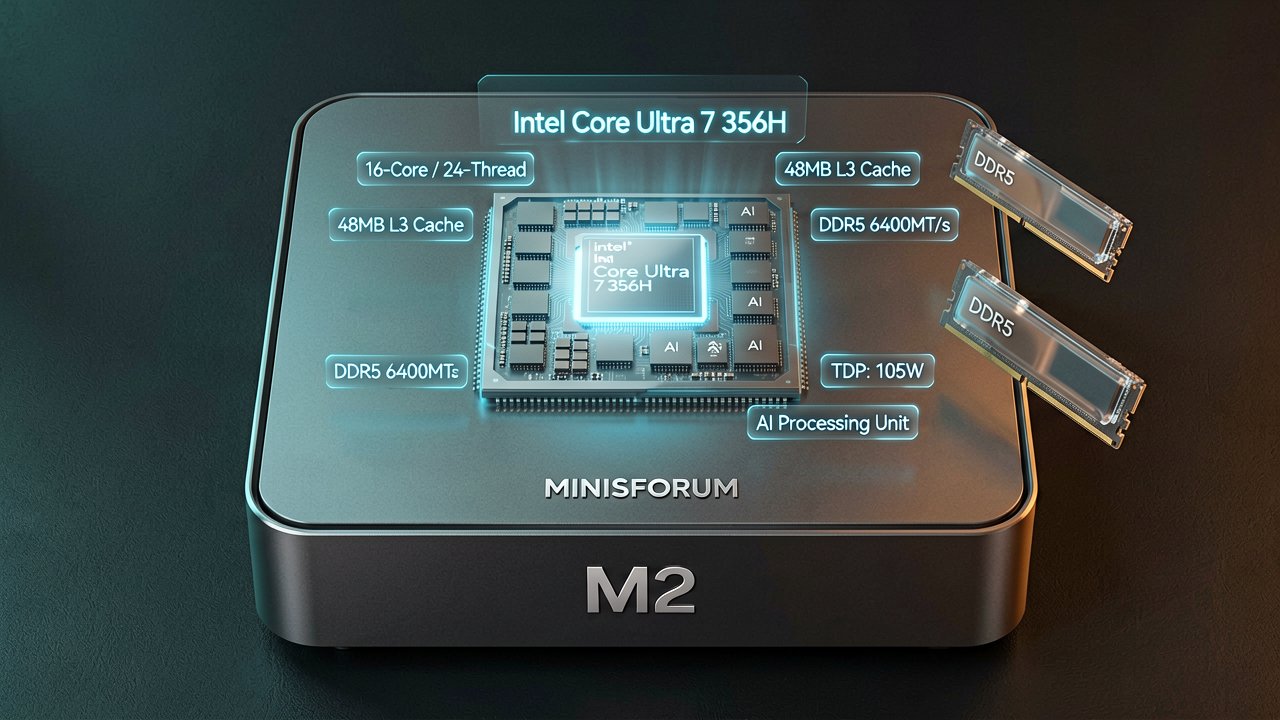
The mini PC market just got more crowded, and Minisforum is pushing hard into the AI workstation segment with its new M2. The device fits Intel's Core Ultra 7 356H processor into a 130×127×50mm chassis that weighs in at 520 grams. For context, that's roughly the size of a large coffee mug (which you'll need to keep nearby while you wait for local LLMs to load).
According to the official Minisforum product page, the M2 runs on Intel's Panther Lake architecture. The Core Ultra 7 356H is a 16-core, 16-thread chip with a 45W thermal design power rating. Minisforum is marketing this device specifically toward AI tasks, pointing to the combined 90 TOPS of processing power—50 from the NPU and 40 from the integrated GPU.
Independent reporting from VideoCardz confirms the specifications and pricing structure. The barebones model starts at $575 without memory or storage, while a pre-configured version with 32GB of RAM and a 1TB SSD costs $1,039.
Running local AI models requires substantial memory, and the M2 supports up to 128GB of DDR5-5600 RAM across two SO-DIMM slots. This is a critical differentiator from many competitors that solder memory directly to the motherboard. For storage, it includes two M.2 2280 PCIe 4.0 slots, which can hold up to 8TB of NVMe storage. The dual-channel memory configuration isn't optional for AI workloads—it's where the system's real performance begins.
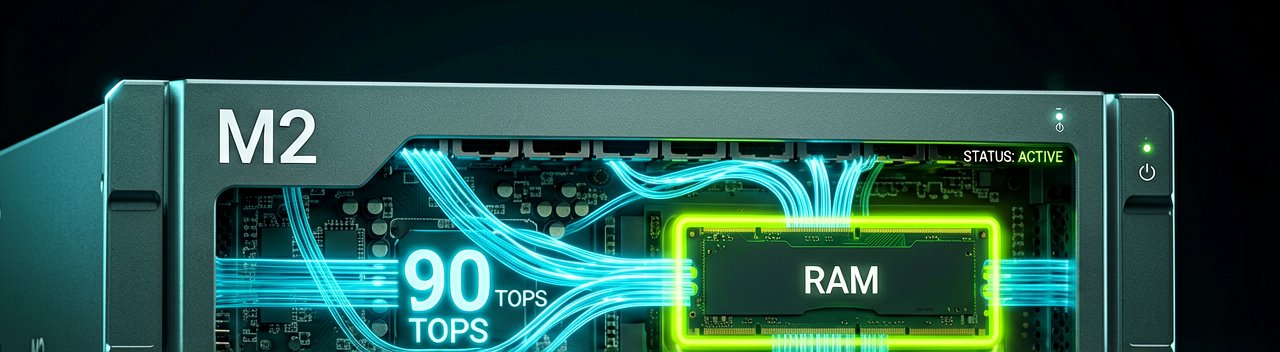
The port selection is practical for a home lab setup. The back of the device has two 2.5 Gigabit Ethernet ports, making it easy to configure as a soft router or a network-attached storage device. It also supports Wi-Fi 7 and Bluetooth 5.4. For video output, it has HDMI 2.1, DisplayPort 1.4, and a front-facing USB4 port that supports data, video, and power delivery. You can connect up to three 4K monitors at once.
Thermal management uses a dual heat pipe cooler and a standard centrifugal fan. According to the manufacturer's testing, the CPU reaches about 78 degrees Celsius under full load, generating around 42.5dB of noise. That's audible but not obnoxious—roughly the sound of a quiet conversation happening three feet away.
In practical terms, this hardware allows users to run open-source large language models like Qwen3.5-35B locally. Minisforum claims it tested Qwen3.5-35B-A3B at 22.1 tokens per second on the system. This is a useful feature if you want to test AI tools without relying on cloud services, though the inference speed will depend heavily on quantization levels and model complexity.
The chassis comes with a VESA mount so you can attach it to the back of a monitor. Physical interaction with the device is straightforward—there's a power button, reset hole for clearing CMOS, and a Kensington lock slot. The 120W power adapter is included, which is adequate for the 45W TDP but leaves headroom for peripheral power delivery through USB4.
This isn't the first Panther Lake mini PC from Minisforum. They already unveiled the MS-03, another Panther Lake system using the same Core Ultra 7 356H processor. The M2 appears to target a smaller desktop footprint while retaining dual DDR5 memory, dual SSD storage, and dual 2.5GbE networking. Competitors like Chuwi have recently launched the AuBox X Mini PC with an Intel Core Ultra 7 256V processor, while Dell introduced the Pro 5 Micro Mini PC powered by Intel Panther Lake CPUs.
Whether the 90 TOPS marketing claim translates to meaningful real-world AI performance remains to be seen. The NPU handles specific workloads efficiently, but general-purpose AI tasks still lean heavily on the GPU and available RAM. Users expecting cloud-like inference speeds on local hardware should adjust their expectations accordingly.
The M2 positions itself as a legitimate workstation for developers who need local AI capabilities without the bulk of a full tower. Whether users actually pay the premium for this configuration over cheaper alternatives remains the real question.
Artūras Malašauskas is an AI Systems Integrator with 20+ years of production-grade web engineering experience. He has designed, shipped, and scaled enterprise Python/PHP systems for logistics, SaaS, and public-sector clients. For the past year, he has focused exclusively on AI integrations: deploying open-source LLMs, building generative media pipelines (image, audio, video), and engineering multi-agent workflows for real production environments. His standard: reproducibility, security, cost-efficient inference—no vaporware. He documents and evaluates emerging AI tooling, separating verified capabilities from marketing noise. Technical editor at: muza-ai.eu, ai-verslas.lt, ai-naujinos.lt Connect on LinkedIn
Comments