Nvidia and Corning Announce U.S. Manufacturing Partnership for AI Infrastructure
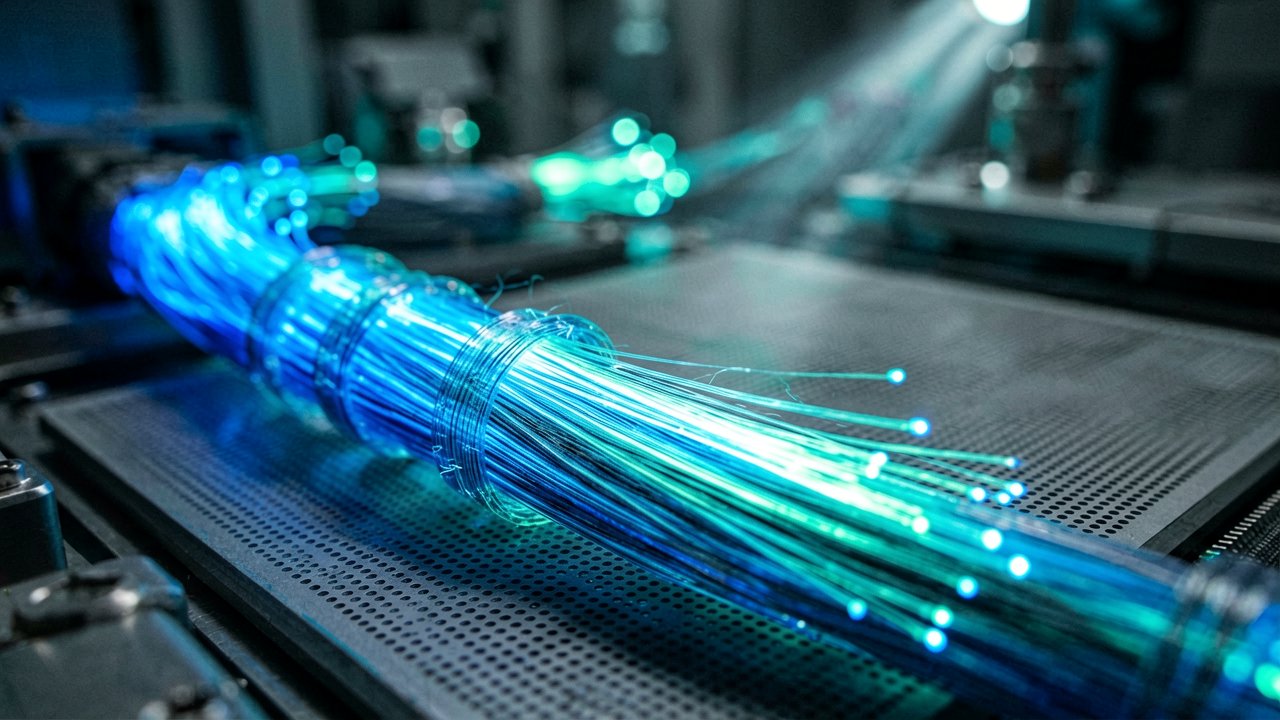
Nvidia and Corning announced a multiyear commercial and technology partnership to dramatically expand U.S.-based manufacturing of optical connectivity solutions for AI infrastructure. The companies said the deal will increase Corning's U.S. optical connectivity manufacturing capacity by 10x and expand fiber production by more than 50%.
According to the official press release, the expansion includes construction of three new advanced manufacturing facilities in North Carolina and Texas. The partnership will create more than 3,000 new high-paying American jobs.
Modern AI workloads require thousands of Nvidia GPUs, demanding unprecedented volumes of high-performance optical fiber and photonics to move data at extraordinary speed. As AI factories grow larger, optical connectivity becomes a critical component of the infrastructure stack.
Investment terms vary across reporting. CNBC reports the arrangement gives Nvidia rights to invest up to $3.2 billion in Corning, including options to buy up to 15 million shares and a pre-funded warrant for up to 3 million shares. Fierce Network cites a Corning 8K filing with the SEC stating Nvidia is investing $500 million with rights to purchase up to 15 million shares at $180 per share.
Jensen Huang, founder and CEO of Nvidia, called AI infrastructure "the largest infrastructure buildout of our time" and framed the partnership as a once-in-a-generation opportunity to reinvigorate American manufacturing and supply chains.
Wendell P. Weeks, chairman, CEO, and president of Corning, said the commitment is directly fueling expansion of the company's U.S. manufacturing footprint. He emphasized that AI is not just a technology story but a manufacturing story happening in the United States.
Market reaction was immediate. Corning stock rose about 12% and Nvidia stock gained roughly 6% on the announcement, according to CNBC reporting.
Optical connectivity, high-performance fiber, photonics, and connectors represent a key throughput layer for hyperscale AI systems. These components move large volumes of data between GPUs and racks with low latency and power overhead. Companies supplying optical interconnects scale differently than silicon fabs: ramping glass, fiber drawing, and assembly lines requires distinct capital expenditure and manufacturing lead times.
At a Wall Street investor event, Weeks explained the deal underpins Corning's photonics market access platform to create optical technology that interacts with switch ASICs and Nvidia's GPUs. "That gives you deep insight as to what has to happen to the overall system to deliver the light between those pieces," he said.
The partnership reflects two simultaneous themes: infrastructure scaling for large AI models and onshoring of critical supply chains. The deal combines a hyperscale compute vendor with a legacy materials and manufacturing company, a pattern seen across recent AI infrastructure deals.
For system architects and investors, the financial elements convert a commercial supply agreement into a deeper strategic supplier relationship with capital exposure. Whether the investment rights are fully exercised remains to be seen (and frankly, that's where the real risk sits).
Separately, some reporting mentions Jensen Huang announcing an open-source quantum AI model family called Nvidia Ising. This claim appears in secondary coverage but lacks corroboration from primary Nvidia channels or technical releases. If real, an open-source quantum AI model family would represent a separate, longer-horizon development for quantum-classical co-design research.
Observed patterns to watch include actual capacity ramp timelines, yield and qualification rates for optical components, and whether the new facilities supply hyperscale data-center customers within expected timeframes. The physical reality of this deal involves glass drawing towers, fiber spools, and assembly lines that take months to qualify before shipping.
Production milestones from Corning's three new plants will matter more than press releases. Public technical specifications and qualification metrics for optical components used in Nvidia-accelerated systems will clarify whether the capacity expansion matches demand.
Regulatory filings or investor disclosures clarifying the terms and timing of the reported investment rights will provide additional clarity. Confirmation or technical documentation from Nvidia regarding Nvidia Ising beyond secondary reporting remains pending.
This is a commercially significant infrastructure move with near-term implications for optical supply chains and longer-term implications if the reported investment rights are exercised. The announcement combines manufacturing expansion, potential capital deployment, and separate reports of quantum AI development, each with different technical and timing risks.
Whether the 3,000 jobs actually materialize on schedule and whether the optical components meet Nvidia's performance requirements will determine if this partnership delivers on its promises. For now, the glass is being poured, but the data centers won't wait forever.
Artūras Malašauskas is an AI Systems Integrator with 20+ years of production-grade web engineering experience. He has designed, shipped, and scaled enterprise Python/PHP systems for logistics, SaaS, and public-sector clients. For the past year, he has focused exclusively on AI integrations: deploying open-source LLMs, building generative media pipelines (image, audio, video), and engineering multi-agent workflows for real production environments. His standard: reproducibility, security, cost-efficient inference—no vaporware. He documents and evaluates emerging AI tooling, separating verified capabilities from marketing noise. Technical editor at: muza-ai.eu, ai-verslas.lt, ai-naujinos.lt Connect on LinkedIn
Comments