Pentagon Launches Public UAP Database With 160 Declassified Files

The United States Department of Defense has launched a public portal hosting hundreds of declassified records related to unidentified anomalous phenomena. The release marks a shift from decades of classified archives to searchable public data accessible without security clearance.
More than 160 files are now available on the official Department of War UAP portal. The documents span from 1948 through 2024, including military footage, field reports, and historical mission transcripts. Officials describe the move as part of a broader push for transparency following growing political pressure in Washington.
President Donald Trump directed the release earlier this year via Truth Social. He told the public they can now "decide for themselves, 'WHAT THE HELL IS GOING ON?'" The Defense Department said it will continue releasing materials on a rolling basis, with new tranches posted every few weeks as records are discovered and declassified.
Defense Secretary Pete Hegseth stated the files have "long fueled justified speculation" and it's time the American people see them. Director of National Intelligence Tulsi Gabbard called the action "the first in what will be an ongoing joint declassification and release effort."
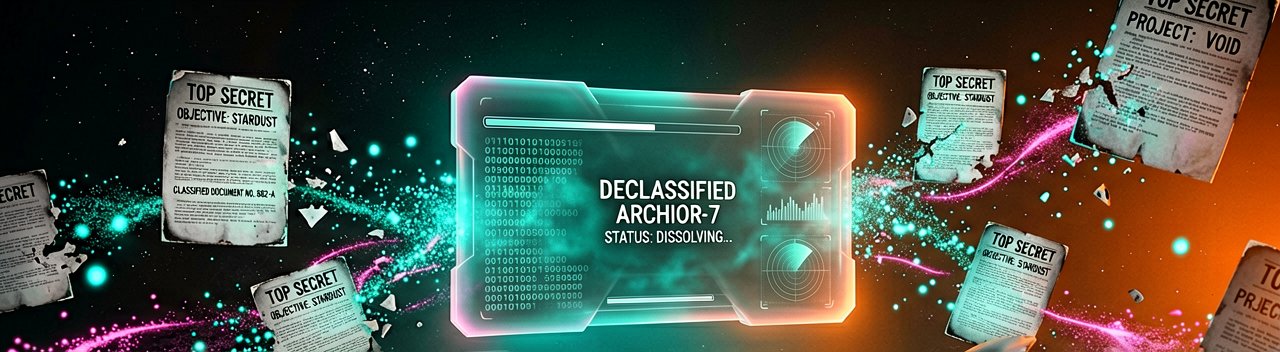
The physical reality of accessing these files is straightforward: users navigate to the portal, scroll through thumbnails of documents and videos, and click to view PDFs or video files. There's no complex authentication process. No clearance required. Just a browser and patience for loading older scans (some of the 1940s-era documents are grainy, as you'd expect from paper that's been sitting in archives for eighty years).
One of the oldest files dates to November 1948. The U.S. Air Force Directorate of Intelligence report is marked Top Secret and notes recurring instances of unidentified objects spotted over Europe. The document states officers consulted Swedish intelligence, who reportedly said "these phenomena are obviously the result of a high technical skill which cannot be credited to any presently known culture on earth."
More recent entries include a September 2023 sighting reported by a woman with deep experience in U.S. military aircraft and drones. The report describes an ovaloid metallic object floating above a treeline with a bright light at one end. Multiple witnesses in at least two cars corroborated the sighting. The document notes several of her co-workers made fun of her due to her report, hinting at the stigma that remains a challenge to collecting eyewitness accounts.
Apollo mission reports are included in the release. One document cites unusual phenomena from the Apollo 11 technical crew debriefing in July 1969, attributing three observations to astronaut Buzz Aldrin: an object on the way to the Moon, flashes of light inside the cabin, and a bright light on the return trip tentatively assumed to be a laser. Apollo 12 astronaut Alan Bean reported seeing flashes "sailing off in space" that "really haul out of here and just press off at the stars."
Recent military memos describe "one possible small UAP" in Iraq in 2022 and "multiple glares or light from an unknown origin" observed in Syria in 2024. U.S. troops were stationed in both locations during ongoing operations against ISIS. There are also reports from troops in the United Arab Emirates and Greece.
According to NPR's coverage, the Pentagon website includes a disclaimer that descriptive language in military memos reflects the "subjective interpretation" of the report writer and "should not be interpreted as a conclusive indication" of what actually happened. That tension between openness and uncertainty is what makes the release significant.
Some materials were previously released by the FBI, but the versions made public had fewer redactions. A large FBI file contains hundreds of pages describing eyewitness testimonies and public reports about UFOs between 1947 and 1968. The 1955 case involving then-Senator Richard Russell and a group that reported seeing "flying disc aircraft" from a train window in the former Soviet Union was previously released by the CIA but appears partially redacted in this version.
Experts continue to caution that many sightings may have conventional explanations. Coverage from Associated Press noted that while the newly released files include striking imagery—glowing objects, unusual flight patterns, and unexplained infrared signatures—many cases could ultimately be balloons, drones, sensor anomalies, or classified military technology. The government's own disclaimer acknowledges this ambiguity.
For years, UFO disclosure was shaped by leaks, secrecy, and conspiracy theories. A public database changes that dynamic. Researchers, journalists, and the public can now review the same raw material, compare records, and draw their own conclusions. In the age of AI, searchable archives, and open-source investigation, the Pentagon's biggest disclosure may not be what is in the files. It may be that the files are finally open.
Whether users actually pay attention to these documents remains the real question. The portal is live, the files are accessible, and the government has done its part. But transparency doesn't necessarily mean answers. People will scroll, click, and speculate. The documents themselves won't change. What changes is who gets to see them—and whether anyone actually reads past the first page.
Artūras Malašauskas is an AI Systems Integrator with 20+ years of production-grade web engineering experience. He has designed, shipped, and scaled enterprise Python/PHP systems for logistics, SaaS, and public-sector clients. For the past year, he has focused exclusively on AI integrations: deploying open-source LLMs, building generative media pipelines (image, audio, video), and engineering multi-agent workflows for real production environments. His standard: reproducibility, security, cost-efficient inference—no vaporware. He documents and evaluates emerging AI tooling, separating verified capabilities from marketing noise. Technical editor at: muza-ai.eu, ai-verslas.lt, ai-naujinos.lt Connect on LinkedIn
Comments