Hyundai Unveils IONIQ V Production Model at Auto China 2026
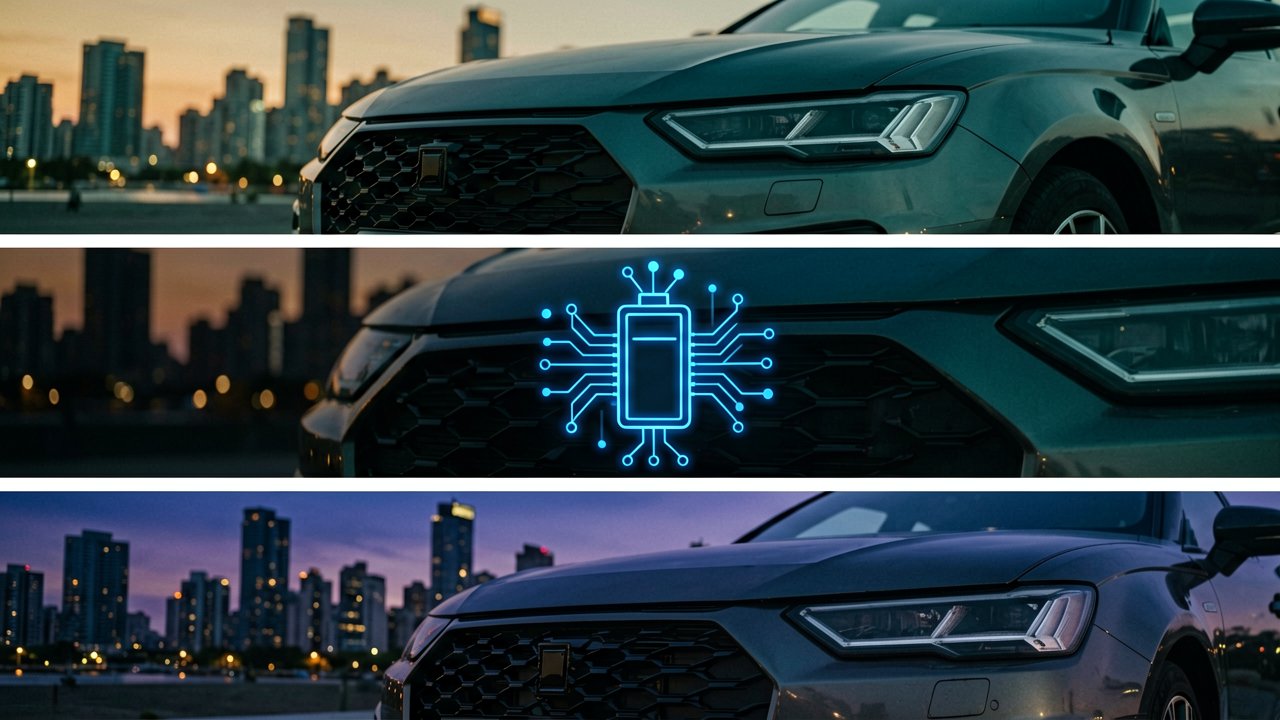
Hyundai Motor Company officially unveiled the IONIQ V at Auto China 2026 in Beijing, transforming the Venus Concept into a production vehicle designed specifically for Chinese consumers. The sedan represents the first dedicated IONIQ brand model for the Chinese market and serves as the spearhead for Hyundai's renewed "In China, For China, To Global" strategy.
According to the official press release from Hyundai Motor, the automaker is committing 8 billion yuan to its joint venture with BAIC Group (Beijing Automotive Group) to support a plan launching 20 new models over the next five years. The target: 500,000 annual vehicle sales by 2030.
The IONIQ V introduces Hyundai's new "The Origin" design language, featuring a single-curve silhouette, frameless doors, and floating side mirrors intended to reduce aerodynamic drag. It measures 4,900 mm in length with a 2,900 mm wheelbase that delivers class-leading legroom—1,078 mm in the front and 1,019 mm in the rear. That's roughly Sonata-sized, though the proportions feel more like a stretched doorstop than anything currently in Hyundai's global lineup.
Inside, the cabin prioritizes what Chinese buyers demand: space and technology. A 27-inch 4K panoramic display stretches across the dashboard, powered by a Qualcomm Snapdragon 8295 chipset running an LLM-based AI assistant for voice control. There's no separate instrument cluster—just a head-up display and the massive screen. Physical controls are restricted to the steering wheel (which feels like a bold choice for a market that still values tactile feedback).

Performance specs remain partially undisclosed, but Hyundai claims over 600 kilometers of range on the CLTC standard. That translates to roughly 450-480 km on WLTP or 280-300 miles EPA—competitive but not exceptional by global standards. The vehicle rides on an 800V platform with CATL batteries, enabling fast charging capabilities that matter in a market where charging infrastructure varies wildly by region.
Independent reporting from Electrek corroborates the technical specifications and adds important context: this is a rescue mission. Beijing Hyundai sold just 125,726 units in China in 2025, a fraction of what local competitors like BYD, NIO, and Xpeng move annually. Nearly half of all vehicles sold in China in the first half of 2025 were EVs, and most came from Chinese brands.
The IONIQ V isn't the first vehicle Hyundai has developed for China, but it is the first China-specific IONIQ model. The company has already launched the ELEXIO electric SUV and the budget EO SUV priced under $20,000. An additional SUV based on the Earth Concept is planned for the first half of 2027, with both BEVs and EREVs in the pipeline—a smart move given how quickly extended-range vehicles are gaining traction in China.
Safety features include a nine-airbag structure and advanced driver assistance systems developed in collaboration with Momenta, a local tech leader. The "One Price" transparency policy aims to address consumer frustration with opaque pricing structures common in the Chinese EV market.
Li Fenggang, President at Beijing Hyundai Motor Company, stated: "Today, we are not just launching a new car; we are expressing our profound respect for the Chinese market." Whether that respect translates to market share remains to be seen.
For global buyers, the IONIQ V is unlikely to reach markets outside China. The design language might influence future models, but the vehicle itself is a China-specific product. That's the reality of modern automotive development: regional customization has become the norm, not the exception.
Hyundai has been planning this counterattack since 2024, calling China a "must-fight place" and "the core of Hyundai Motor's global strategy." The question isn't whether the IONIQ V looks good—it's one of the more attractive EVs to emerge from a Chinese auto show in recent memory. The question is whether it can compete against local brands that have spent years perfecting the formula: aggressive pricing, rapid software updates, and charging networks that actually work.
Whether users actually pay for it remains the real question.
Artūras Malašauskas is an AI Systems Integrator with 20+ years of production-grade web engineering experience. He has designed, shipped, and scaled enterprise Python/PHP systems for logistics, SaaS, and public-sector clients. For the past year, he has focused exclusively on AI integrations: deploying open-source LLMs, building generative media pipelines (image, audio, video), and engineering multi-agent workflows for real production environments. His standard: reproducibility, security, cost-efficient inference—no vaporware. He documents and evaluates emerging AI tooling, separating verified capabilities from marketing noise. Technical editor at: muza-ai.eu, ai-verslas.lt, ai-naujinos.lt Connect on LinkedIn
Comments