Collapsing the Stack: How RegattaDB Solves the Agentic AI Action Gap with a Unified Data Engine

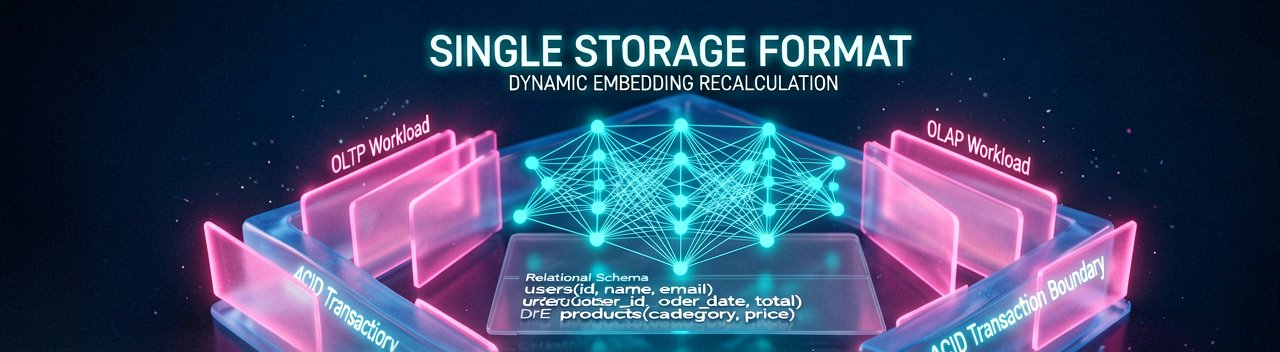
The traditional enterprise data architecture is under fire, and the culprit is the rise of autonomous AI agents. For years, we have accepted a fragmented reality where transactional updates (OLTP), analytical queries (OLAP), and vector searches live in isolated silos, stitched together by fragile data pipelines. When a human worker encounters a five-minute replication lag between systems, it is a mild inconvenience; when an autonomous AI agent faces that same delay, it hallucinates, miscalculates, and fails to execute live transactions against systems of record. To bridge this structural divide, startup database vendor Regatta Data has officially launched RegattaDB, a distributed SQL database built from the ground up to collapse these three core workloads into a single, cohesive engine.
By offering an integrated platform, the architecture systematically targets the infrastructure gaps that have paralyzed early agentic workflows. Instead of constantly syncing state across a complex web of relational databases, cloud data warehouses, and specialized vector stores, developers can now provide their AI agents with a single, universally consistent source of truth. The underlying magic relies on a patented, unified concurrency control protocol. This protocol allows fundamentally different workload types to run natively across node boundaries with serializable cross-node consistency, ensuring that real-time transactional updates, deep analytical aggregations, and semantic similarity reasoning never compromise one another's performance.
Breaking the Tradeoffs of Legacy Infrastructure
For decades, combining transactional integrity with analytical depth was considered a database engineering impossibility. Traditional systems typically prioritize one at the expense of the other, requiring data engineering teams to replicate operational data to an external data warehouse before running any meaningful analytics. RegattaDB challenges this status quo by executing real-time analytics directly against live operational data. For instance, an autonomous inventory agent using this engine can simultaneously manage live stock reservations via the OLTP layer, while concurrently calculating demand forecasting and trend analysis via the OLAP layer—all without waiting for a replication pipeline cycle.
The practical efficiency of this design reflects heavily in early deployment metrics, demonstrating that eliminating cross-system synchronization yields massive infrastructure savings. According to technical documentation detailed by Blocks and Files, RegattaDB supports up to 400 percent denser workloads per server compared to legacy single-node environments. By consolidating these computing requirements into a single engine, enterprise adopters can eliminate roughly 75 percent of traditional hardware, cooling, power, and physical space expenses.
Scalability and Raw Benchmark Performance
The performance metrics accompanying the launch show exactly what a pure scale-out, shared-nothing database can achieve when freed from the anchor of data replication lag. During scale testing on 50 commodity cloud nodes, RegattaDB managed to execute a distributed JOIN across 20 billion rows of data in just three minutes. Crucially, the engine maintained a steady throughput of 50,000 ACID-compliant transactional updates per second on the exact same dataset during the query, operating without any localized optimizations or predefined indexes. Industry analysts at The Futurum Group note that completing an identical sequence across a traditional multi-vendor stack would normally take hours due to the sheer latency of streaming data between operational boundaries.
Backed by a $68 million funding round from heavyweight investors like Lightspeed Venture Partners, Salesforce, and enterprise tech veterans like Frank Slootman, Regatta is positioning its engine to aggressively challenge entrenched players like Snowflake, Postgres, and Pinecone. The database is available as a fully managed cloud service or as a self-hosted option on-premises. As enterprise AI shifts from passive chat models to active, decision-making agents, the battleground is moving from the models themselves straight to the data layer, and RegattaDB has just drawn a distinct line in the sand.
Behind the Scenes: The Systems Engineering of a Zero-Lag Unified Engine
Behind the Scenes: To truly appreciate how RegattaDB eliminates the traditional replication wall, you have to look closely at its storage layout and distributed execution model. Standard HTAP architectures often rely on separate row-oriented and column-oriented storage spaces, using an internal background process to continually copy data between them. RegattaDB throws out this dual-copy approach entirely. Instead, it utilizes a single, unified storage format that leverages a shared-nothing distributed architecture to dynamically partition and execute queries across arbitrary node configurations. By storing data in a way that satisfies both transactional insertion speeds and analytical scanning efficiencies simultaneously, the engine prevents the split-second indexing delays that typically throw autonomous agents off course when they need to verify real-time state changes.
From a systems engineering perspective, the real challenge in running OLTP, OLAP, and vector search on the same dataset is memory and CPU contention. If an AI agent kicks off a massive vector similarity search across millions of embeddings, a traditional engine would choke, causing live transactional updates to time out. RegattaDB solves this bottleneck by implementing a highly sophisticated, hardware-aware resource isolation scheduler. This internal scheduler treats OLTP tasks as high-priority, low-latency operations, while dynamically streaming OLAP aggregates and heavy vector calculations through separate, sandboxed CPU rings. Because the engine is engineered to exploit modern NVMe drives and multi-core processor topologies directly, it completely avoids the lock contention that usually plagues multi-workload database clusters.
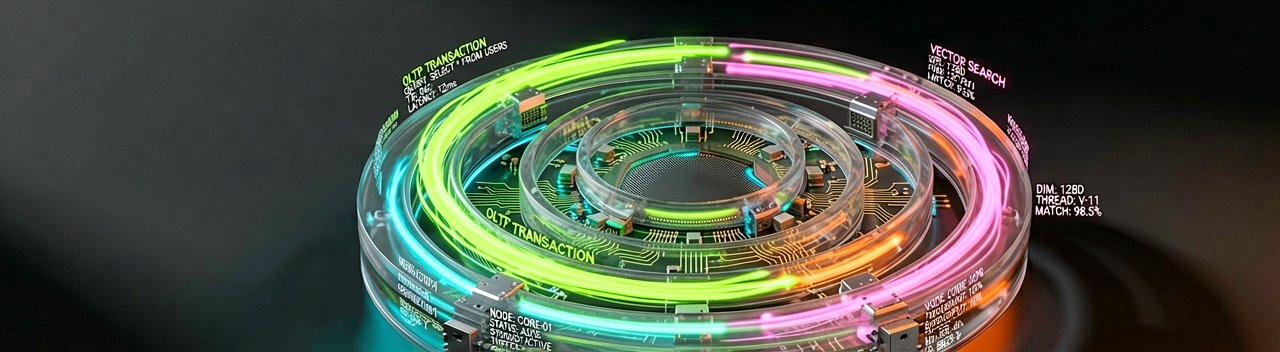
The vector search capabilities are integrated directly into this core execution pipeline rather than living as an isolated plugin. In most setups, vector embeddings are generated by an LLM and then shipped to a specialized vector database, creating a permanent synchronization delta with the primary relational database. RegattaDB treats vectors as a native data type within its relational schema, applying a customized, highly parallelized variant of Hierarchical Navigable Small World (HNSW) indexing directly on the live transactional data. When an agent updates a record, the corresponding vector index is recalculated in-memory as part of the same ACID-compliant transaction, guaranteeing that subsequent semantic queries reflect the absolute latest state of the system.
This deep integration completely changes the way autonomous agents interact with their underlying data layer. Instead of writing complex application-level logic to pull relational data from Postgres, fetch context from Pinecone, and manually join them together in Python memory, developers can express the entire agentic loop in a single SQL query. The database optimizer can simultaneously evaluate a relational WHERE clause, a high-dimensional vector similarity score, and a complex analytical aggregation in one unified execution plan. By pushing the heavy lifting down to the database kernel, systems engineers can drastically reduce the computational footprint of their agent frameworks, allowing AI agents to make decisions with sub-millisecond data freshness at a fraction of the traditional infrastructure overhead.
Reading Between the Lines: The Friction in the Convergence Utopia
Reading Between the Lines: The tech industry loves nothing more than a silver bullet, and RegattaDB is being positioned as exactly that for the AI era. But as any veteran systems architect will tell you, the laws of physics and compute are notoriously stubborn. The database world has spent thirty years segregating transactional and analytical workloads for a reason: they demand fundamentally opposed optimizations. To promise that an engine can deliver top-tier ACID performance while simultaneously chewing through massive, high-dimensional vector lookups and multi-billion-row OLAP joins requires a healthy dose of skepticism. While the early benchmark metrics are undeniably impressive, they are almost certainly achieved under highly controlled, optimized workloads that may not reflect the chaotic, unpredictable query patterns of real-world enterprise deployments.
There is also a glaring contradiction in the industry’s sudden rush toward total database consolidation. For the past five years, the prevailing architectural wisdom has championed the "best-of-breed" approach, where developers paired highly specialized tools like Postgres, Snowflake, and Pinecone to handle distinct data shapes perfectly. RegattaDB asks enterprises to undo that entire operational paradigm and trust a single startup with their entire data stack. It is a massive bet on a unified architecture that introduces a terrifying single point of failure. If the resource isolation scheduler slips up even slightly under an unexpected spike in vector queries, it won't just slow down an internal dashboard—it could completely paralyze live, customer-facing transactions.
Furthermore, the economic justification for this migration is not as clear-cut as the marketing suggests. Eliminating hardware costs and data pipeline complexity sounds wonderful on paper, but it ignores the immense human capital costs of migrating legacy enterprise systems onto an entirely new, unproven database engine. Developers and database administrators will have to learn a completely new set of performance tuning nuances and operational quirks. In practice, the companies most likely to adopt RegattaDB in the short term are greenfield startups building native AI agent frameworks from scratch, rather than the heavily siloed Fortune 500 enterprises that actually suffer the most from replication lag.
Ultimately, RegattaDB's long-term success will not be decided by its impressive raw processing density or its star-studded investor lineup, but by how well its architecture handles real-world operational degradation. As datasets grow and agentic workloads become more complex, the engine's ability to maintain true serializable consistency across hybrid nodes will face its ultimate test. If it succeeds, it could genuinely redefine database architecture for the next decade. If it falters under the weight of its own ambitious scope, it will join a long line of technically brilliant HTAP databases that promised to do everything, only to find that the market preferred specialized tools that did one thing exceptionally well.
"We seem destined to spend every decade in enterprise tech frantically consolidating everything into a single, omnipotent system, only to spend the following decade desperately ripping it apart into specialized pieces because the single system became too heavy to fly. If RegattaDB truly manages to break this endless cycle of architectural reincarnation, it won't just be a triumph of database engineering—it will be an unprecedented miracle of corporate compromise."
Artūras Malašauskas is an AI Systems Integrator with 20+ years of production-grade web engineering experience. He has designed, shipped, and scaled enterprise Python/PHP systems for logistics, SaaS, and public-sector clients. For the past year, he has focused exclusively on AI integrations: deploying open-source LLMs, building generative media pipelines (image, audio, video), and engineering multi-agent workflows for real production environments. His standard: reproducibility, security, cost-efficient inference—no vaporware. He documents and evaluates emerging AI tooling, separating verified capabilities from marketing noise. Technical editor at: muza-ai.eu, ai-verslas.lt, ai-naujinos.lt Connect on LinkedIn
Comments