ShamlaTech Launches Autonomous AI Agent Across Major US E-Commerce Storefronts

Global enterprise solutions provider ShamlaTech has officially entered the competitive agentic commerce landscape with the rollout of its new enterprise-grade AI Agent across the United States. Designed for native integration into major e-commerce ecosystems including Shopify, WooCommerce, and Magento, this specialized artificial intelligence tool aims to move merchants beyond rigid, rule-based customer interactions. By embedding advanced autonomous decision-making directly into existing storefront operations, the platform represents a critical shift in how online retailers manage customer lifecycles and day-to-day storefront operations without requiring complex architecture overhauls or costly migrations.
The strategic deployment comes at a pivotal moment as the broader retail industry transitions from backend predictive analytics toward consumer-facing, highly autonomous digital workflows. According to market coverage by Morningstar, ShamlaTech's technology acts as an intelligent shopping assistant that actively interprets customer intent rather than relying on predetermined scripts. This allows merchants to bridge the operational gap between frontline customer care and automated catalog indexing, streamlining resource allocation for brands scaling their operations across multiple channels simultaneously.
Contextual Reasoning Over Scripted Chatbots
Traditional e-commerce tools have historically struggled to maintain context across complex consumer journeys, frequently resulting in fractured interactions and elevated support overheads. The newly introduced AI Agent overcomes this limitation by leveraging natural-language shopping intelligence to process complex inquiries in real time. The platform seamlessly handles nuanced product discoveries, maps intent to real-time storefront inventory, and addresses customer pain points natively on the merchant's platform. This operational flexibility allows growing brands to scale their customer outreach 24/7, reducing repetitive support workflows while maintaining personalized engagement strategies for both B2C and B2B market sectors.
Unifying the Front-End and Back-End Retail Ecosystem
By bypassing the restrictive boundaries of standard plugins, ShamlaTech’s AI system operates directly alongside core business logic across diverse architectures. For open-source platforms like Magento and WooCommerce, as well as managed ecosystems like Shopify, the AI agent serves as an extensible operational layer. It synchronizes with dynamic product catalogs to provide tailored recommendations, which directly addresses the ongoing merchant demand for higher conversion rate optimization. The immediate financial and structural value lies in its frictionless deployment model, enabling companies to quickly unlock automated monetization strategies and advanced data processing capabilities without experiencing site downtime.
Strategic Imperatives in the Era of Agentic Commerce
The deployment highlights a deeper market reality where survival in digital retail hinges on continuous, conversational customer engineering rather than static pricing strategies. As e-commerce ecosystems shift toward comprehensive automation, autonomous tools are increasingly acting as specialized sales associates capable of executing multi-step logic on behalf of the customer. ShamlaTech's unified approach positions conversational commerce not merely as a customer service fallback, but as an essential driver of retention and operational scalability. For US enterprise operations, embedding these autonomous layers directly into storefront environments marks an essential milestone toward fully self-optimizing retail setups.
The Shift Toward Fully Autonomous Merchant Ecosystems
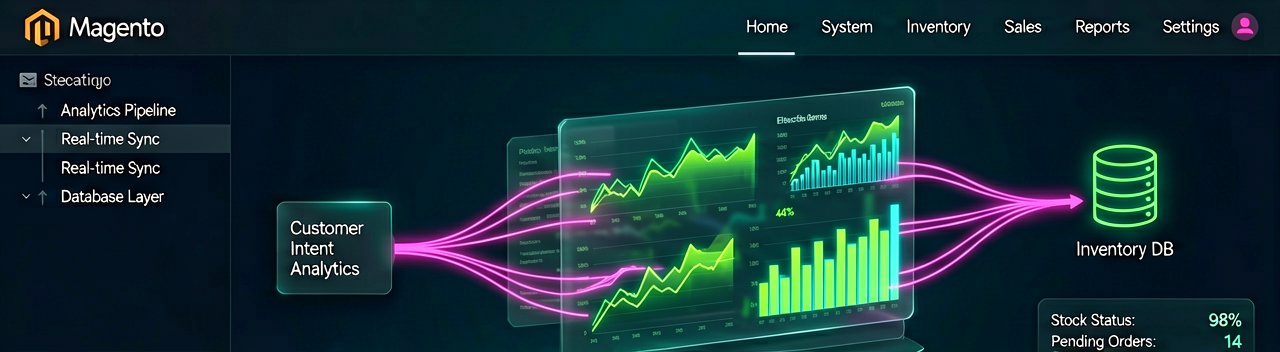
Beyond the Hype of Conversational Commerce: The true value of ShamlaTech's rollout lies not within the chatbot interface itself, but deep within the operational pipelines that connect front-end storefronts to complex back-end inventory databases. For years, major retail operations running heavily modified Magento configurations or agile Shopify stores have wrestled with the logistical nightmare of catalog synchronization. Every single product update, flash sale, or supply chain bottleneck traditionally demanded manual oversight to ensure automated workflows remained accurate. By shifting the workload to an autonomous agent capable of analyzing store data patterns, merchants are effectively eliminating the data lag that historically derailed automated customer support and product discovery tracks.
From a technical standpoint, this transition addresses a glaring operational challenge: the inherent rigidity of legacy e-commerce application programming interfaces (APIs). Traditional plugins function strictly on absolute conditional rules, which quickly break down during unconventional customer interactions or erratic shipping delays. Early adopters and platform engineers note that integrating an adaptive, context-aware layer allows the merchant's digital storefront to handle edge-case returns, complex product bundles, and multi-tier loyalty queries entirely on its own. This operational independence significantly drops support ticket volume, allowing engineers to focus heavily on product innovation rather than constantly debugging customer service logic.
This deployment also signals a major turning point for the competitive open-source commerce ecosystem, specifically regarding WooCommerce and Magento. Managed solutions have long dominated the user-friendly marketplace, but they often restrict deep programmatic customization. By deploying an enterprise-grade artificial intelligence solution that natively bridges both self-hosted and cloud-hosted architectures, open-source store operators can now achieve the same data processing speeds and automated marketing efficiencies as their massive corporate competitors. This levels the digital playing field, offering mid-market consumer brands the necessary architecture to scale operations without succumbing to cost-prohibitive licensing fees.

Ultimately, the long-term success of this automated commerce push will depend on how cleanly these systems handle data privacy and consumer trust. As digital agents take a more proactive role in managing transactions, storing user preferences, and processing order changes, the security standard for storefront plugins will naturally skyrocket. Brands that integrate these advanced autonomous systems early will likely establish a distinct edge, setting a modern standard where the digital retail experience is completely personalized, fast, and entirely predictive.
The Hidden Overhead of Agentic Autonomy
Reading Between the Lines: While the promise of an entirely hands-off retail operation makes for a compelling corporate narrative, the reality of deploying autonomous agents into complex, live e-commerce environments introduces a fragile web of operational liabilities. The industry frequently conflates autonomous decision-making with flawless execution, yet any engineer who has managed a high-volume Shopify or Magento storefront understands that edge cases are the norm, not the exception. Entrusting a system to independently interpret customer intent and modify orders, inventory states, or return parameters risks creating a feedback loop of automated errors that can easily alienate loyal consumers before human operators even notice the systemic drift.
Furthermore, a clear structural contradiction sits at the very heart of this automation wave. Platforms like WooCommerce and Magento are heavily celebrated for their open-source flexibility, yet it is precisely this deeply customized, heavily modified nature that makes them notoriously difficult for generalized AI agents to navigate reliably. A localized checkout plugin, a custom ERP integration, or a unique wholesale pricing tier can easily confuse an autonomous model trained on standardized retail architectures. Merchants may quickly discover that the time saved on frontline customer care is simply reassigned to backend debugging, shifting labor costs from support staff to highly paid software engineers who must continuously audit the agent's algorithmic decision paths.
The broader economic implications also demand a healthy dose of skepticism regarding true return on investment. E-commerce platforms frequently advertise these tools as instant revenue multipliers through automated cross-selling and conversational conversion rate optimization. However, over-automation carries the distinct risk of diluting a brand's unique voice into a sanitized, predictable customer journey that feels indistinguishable from any other store using the exact same underlying model. When every storefront relies on the same autonomous logic to predict consumer behavior, personalized commerce ironically risks becoming entirely homogenized, leaving brands with fewer distinct ways to stand out in an already hyper-competitive digital marketplace.
"We are rapidly approaching a digital retail landscape so incredibly optimized that autonomous store agents will spend their entire day seamlessly negotiating transactions with autonomous shopping bots, entirely unburdened by the messy, unpredictable intervention of actual human consumers buying actual things."
Artūras Malašauskas is an AI Systems Integrator with 20+ years of production-grade web engineering experience. He has designed, shipped, and scaled enterprise Python/PHP systems for logistics, SaaS, and public-sector clients. For the past year, he has focused exclusively on AI integrations: deploying open-source LLMs, building generative media pipelines (image, audio, video), and engineering multi-agent workflows for real production environments. His standard: reproducibility, security, cost-efficient inference—no vaporware. He documents and evaluates emerging AI tooling, separating verified capabilities from marketing noise. Technical editor at: muza-ai.eu, ai-verslas.lt, ai-naujinos.lt Connect on LinkedIn
Comments