How SensorHubb 3.0’s Native AI Agents Signal a Paradigm Shift in Enterprise Sensor Automation
The industrial landscape has long been burdened by the constraints of reactive data monitoring, where siloed architectures and high-volume telemetry force human operators into constant firefighting. Traditional Industrial Internet of Things (IIoT) platforms function predominantly as passive display dashboards, generating fragmented, threshold-based alerts that often inform teams of a hardware failure only after damage has occurred. With the official rollout of its unified sensor intelligence management platform, SensorHubb version 3.0 introduces native AI-agent access directly into the core data architecture, a structural shift that transitions industrial sensor networks from passive data aggregation tools into autonomous digital workforces.
This structural change marks a critical milestone in enterprise asset protection and operational intelligence. Rather than requiring distinct software layers, intermediate scripts, or custom integration pipelines to process telemetry, SensorHubb 3.0 establishes an active reasoning layer native to the data environment. These integrated AI agents are uniquely built to observe real-world signals continuously, analyze contextual operational history, and initiate immediate remediation workflows without human instruction. According to announcements detailed via Morningstar, this deployment eliminates the hardware installation overhead typical of enterprise upgrades, delivering automated functionality across complex, multi-location facility networks seamlessly.
The Architecture of Autonomous Reasoners Over Dashboard Visuals
The enterprise shift from standard IoT alert infrastructure to native agentic intelligence represents a fundamental evolution in software design. Traditional systems rely on deterministic limits, meaning an alarm triggers only when a variable like temperature or mechanical stress breaches a hard coded parameter. Conversely, native AI agents operate as autonomous digital workers with specific environmental goals and localized tools. They evaluate raw data, cross-reference trends against historical baselines, interpret systemic risks, and act independently. This closes the gap between anomaly identification and operational resolution, ensuring critical anomalies are mitigated before escalating into catastrophic infrastructure failures.
Eliminating Silos Through Unified Asset Intelligence
Modern industrial facilities frequently run into operations bottlenecks caused by disconnected software environments. Sensor telemetry, maintenance databases, regulatory compliance ledgers, and enterprise resource planning software typically exist in isolated operational silos. SensorHubb 3.0 addresses this friction by serving as a unified underlying fabric that integrates disparate systems into one contextual environment. By linking real-time sensor performance directly with compliance data and automated maintenance ticketing, the platform enables AI agents to orchestrate complex corporate workflows, such as self-generating repair orders or flagging supply risks based on consumption trends.
Enterprise Compliance and Governance in Agent-Driven Operations
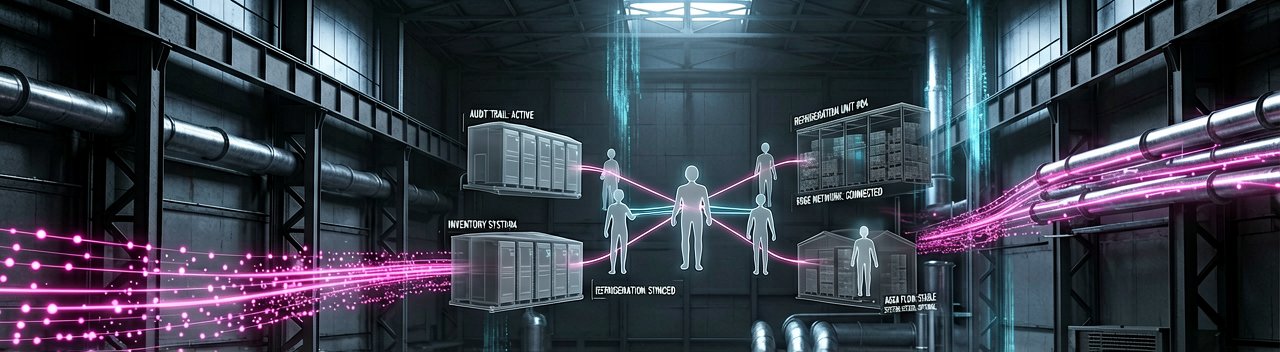
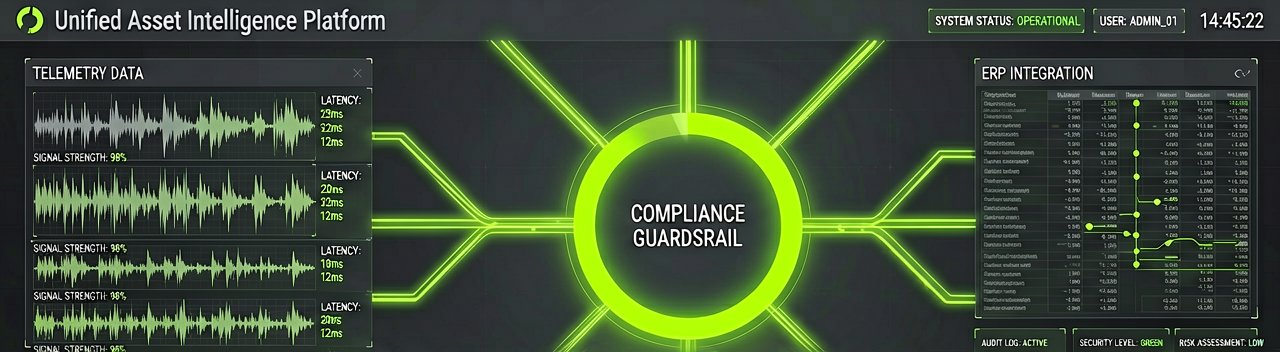
Deploying autonomous systems within regulated environments like pharmacies, clinical storage facilities, and advanced manufacturing plants demands rigorous data validation and auditability. To manage the compliance risks associated with automated asset changes, the platform includes specialized compliance guardrails. The architecture features tamper-proof electronic signatures designed to meet 21 CFR Part 11 requirements, ensuring every action orchestrated by an AI agent or human supervisor is logged in an unalterable audit trail. This integration of autonomous reasoning and strict data compliance illustrates how modern industrial platforms can safely offload repetitive cognitive tasks to software agents without sacrificing corporate transparency or regulatory integrity.
Unlocking Agentic Edge Coordination
What Most Reports Miss: The true disruption of SensorHubb 3.0 does not lie within the isolated capability of a single AI model, but in the underlying orchestration framework that allows disparate agents to communicate across a distributed enterprise fabric. In traditional manufacturing and cold-chain operations, a localized sensor spike typically triggers a centralized cloud alert, incurring latency and data transfer costs. By embedding agentic capability directly into the unified data platform, SensorHubb enables localized edge networks to autonomously negotiate operational shifts. If a refrigeration system in an pharmaceutical facility signals an imminent thermal breach, the native agent does not simply wait for a technician; it coordinates with inventory agents to dynamically re-route sensitive assets to adjacent, stabilized zones before the product spoils.
This dynamic shift redefines the relationship between front-line operators and their supervisory software. Engineering teams are transitioning from passive monitors of telemetry graphs into strategic orchestrators who define high-level system behaviors, compliance boundaries, and resource limitations. Veteran site managers note that the historical friction of industrial automation was never a lack of data, but rather an overwhelming surplus of uncontextualized noise that fatigued human teams. By delegating low-level diagnostic workflows and immediate containment protocols to native digital workers, enterprises can scale operations without a proportional increase in human headcount or administrative overhead.
From an architectural standpoint, this release bridges a long-standing chasm between operational technology and enterprise software logic. Historically, updating sensor logic meant rewriting firmware or deploying delicate middle-tier integrations that broke during routine updates. SensorHubb 3.0 bypasses these traditional bottlenecks by providing an abstract software layer where agents utilize natural language understanding to interpret machine states and translate them into standardized corporate workflows. This integration allows an enterprise to maintain a continuous, unalterable log of both human and machine interactions, laying the foundation for entirely autonomous facility management that adheres strictly to complex regulatory standards.
The Hidden Cost of Autonomy: Friction in the Agentic Industrial Era
Reading Between the Lines: The corporate enthusiasm surrounding agent-driven industrial automation frequently glosses over a fundamental contradiction in enterprise risk management. While the promise of an autonomous software workforce mitigating failures in real time is financially alluring, it directly collides with the deeply ingrained, risk-averse culture of heavy industry. For decades, plant managers have operated under the rigid doctrine that every machine action must be entirely deterministic, predictable, and traceable to a specific human command. Introducing non-deterministic AI agents into critical physical infrastructure requires a profound leap of faith that many compliance officers and safety engineers may simply refuse to take, regardless of theoretical efficiency gains.
Furthermore, the assertion that native AI agents will seamlessly eliminate data silos overlooks the deeply entrenched political realities of corporate software procurement. In any global enterprise, different departments—such as maintenance, finance, and regulatory compliance—jealously guard their respective software tools and data repositories. An AI agent is only as intelligent as the data boundaries it is permitted to cross. If a corporate legal team limits an agent's access to maintenance history due to liability fears, or if an operations team blocks an agent from writing directly to an ERP database, the unified platform effectively becomes just another expensive, isolated dashboard.
There is also the unaddressed operational vulnerability of agentic drift and cascade failures within interconnected systems. When multiple autonomous agents are given the authority to modify operational environments—such as adjusting valve pressures, re-routing inventory, or generating automated work orders—their actions inevitably begin to influence one another. Without hyper-rigid boundary conditions, a minor calibration error in a single sensor could trigger a chain reaction of automated remediations across multiple facilities, leaving human operators to untangle a web of algorithmic decisions after the system has ground to a halt. Enterprises must carefully weigh the speed of autonomous recovery against the chaotic unpredictable risks of unchecked software interactions.
"We are rushing toward an industrial future where machines will autonomously diagnose their own ailments, order their own replacement parts, and file their own compliance paperwork—leaving human operators with the vital task of figuring out why a sensor network in Ohio just accidentally ordered five thousand heavy-duty industrial gaskets to a corporate office in Delaware."
Artūras Malašauskas is an AI Systems Integrator with 20+ years of production-grade web engineering experience. He has designed, shipped, and scaled enterprise Python/PHP systems for logistics, SaaS, and public-sector clients. For the past year, he has focused exclusively on AI integrations: deploying open-source LLMs, building generative media pipelines (image, audio, video), and engineering multi-agent workflows for real production environments. His standard: reproducibility, security, cost-efficient inference—no vaporware. He documents and evaluates emerging AI tooling, separating verified capabilities from marketing noise. Technical editor at: muza-ai.eu, ai-verslas.lt, ai-naujinos.lt Connect on LinkedIn
Comments