Agentic Commerce Replaces Legacy SaaS: Why the Komrz Rebrand Signals a Shift in Cross-Border Trade
The strategic rebranding of Shahbandr into Komrz, accompanied by the debut of its autonomous AI agent Komi, marks a critical inflection point in how digital businesses scale internationally. Rather than relying on traditional software-as-a-service (SaaS) frameworks that require intensive human management, the company is pivoting toward agentic commerce. This movement allows merchants to handle intricate operational workflows through intuitive text commands, transforming AI from a passive analytical tool into an active, operational co-pilot capable of running a business across differing regulatory and geographic boundaries.
This market evolution comes at a time when the Gulf Cooperation Council (GCC) and European e-commerce corridors are seeking deep structural alignment. Emerging tech hubs are no longer content with localized dominance; instead, firms are engineering borderless infrastructure from inception. By deploying autonomous digital agents to automate day-to-day operations, logistics orchestration, and localized consumer engagement, tech providers are effectively lowering the capital expenditure traditionally required for multi-market expansion. This friction-free scaling mechanism represents the next phase of enterprise growth in the global digital economy.
The Architecture of Cross-Border Automation
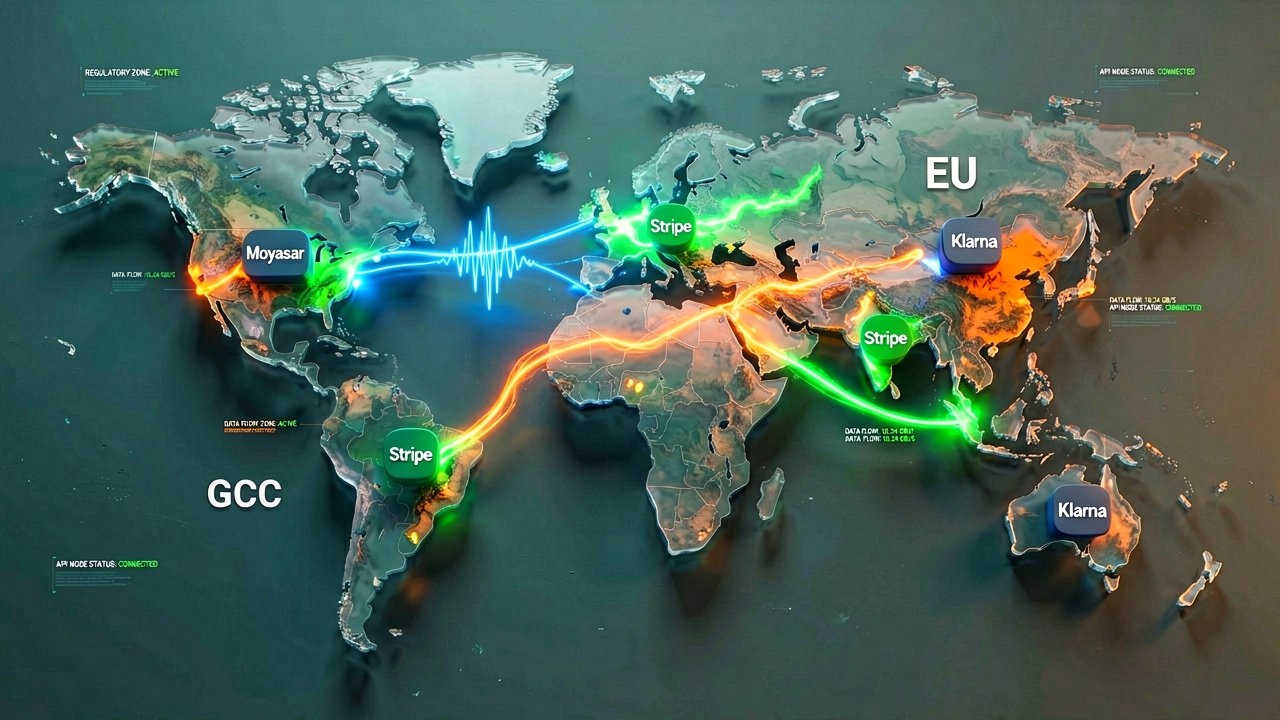
To support this ambitious cross-border expansion, the underlying infrastructure must manage diverse regulatory, logistics, and fintech realities. According to official documentation published on Zawya, Komrz achieves a frictionless operational pipeline by integrating with highly localized and global payment ecosystems, including regional players like Moyasar, Tabby, and Tamara, alongside European-facing networks like Stripe and Klarna. The simultaneous integration of automated fulfillment pipelines through international carriers ensures that the Komi AI agent can handle complex logistics logic from backend procurement to frontend delivery.
Expert Analysis: From Local Powerhouses to Global Enablers
From an industry analysis perspective, the trajectory of Komrz—which grew from its 2023 roots to manage over 20,000 merchants across Saudi Arabia and Egypt—highlights a broader trend among platforms shifting toward AI-native global models. As reported by TradingView, the shift underscores an industry-wide prioritization of autonomous software that directly addresses the complexities of managing multi-currency and multi-lingual storefronts. By replacing manual operations with natural language processing architectures, emerging tech platforms are disrupting legacy e-commerce vendors and redefining international trade mechanics between the Middle East and Europe.

Behind the Scenes of the Agentic Pivot
The Operational Reality: The transition from Shahbandr's legacy architecture to the Komrz infrastructure represents a calculated gamble on the maturity of large language models applied to enterprise logistics. Historically, cross-border retail between the GCC and European Union has been bottlenecked by fragmented regulatory compliance, varying VAT/customs frameworks, and highly regionalized payment preferences. While traditional enterprise resource planning tools required dedicated teams to manually reconcile these operational variables, the deployment of specialized AI entities is shifting the burden of compliance and systemic configuration entirely to autonomous code.
Industry insiders note that this structural overhaul addresses a persistent pain point for mid-market merchants who lack the capitalization to build custom localized infrastructure in every target territory. By consolidating diverse payment networks and automated shipping systems under a unified language interface, the platform neutralizes the technical debt that typically stalls mid-sized brands during regional migrations. The strategy relies on transforming natural language instructions into precise API calls, effectively turning a localized online storefront into an agile international enterprise overnight.
This paradigm shift also highlights a broader geopolitical alignment as Gulf-based tech platforms actively seek integration with Western consumer markets. Driven by aggressive regional digital transformation mandates, infrastructure developers are moving away from importing foreign software solutions in favor of exporting homegrown, AI-native platforms capable of competing on a global scale. As automated commerce continues to mature, the defining competitive advantage will no longer be the breadth of an engineering feature set, but the speed and reliability with which an autonomous digital agent can navigate shifting international market conditions.
Reading Between the Lines: The Friction in Frictionless Expansion
The Operational Reality: While the promise of an AI agent seamlessly bridging the regulatory chasm between the GCC and Europe makes for a compelling corporate narrative, it glosses over deep systemic friction points. The core assumption of agentic commerce is that software can indefinitely abstract away the complexities of international trade. However, AI agents do not operate in a vacuum; they must interface with physical supply chains, rigid customs authorities, and highly volatile compliance landscapes. When a shipment stalls at a European port due to minor data discrepancies, an automated platform's linguistic capability matters far less than regional legal counsel and physical logistical contingencies.

Furthermore, relying on a text-based interface to orchestrate cross-border merchant operations introduces unexpected institutional risks. Handing over payment routing, tax calculation, and automated inventory fulfillment to an autonomous entity like Komi requires an extraordinary degree of trust in deterministic AI outputs. In highly regulated financial corridors, edge cases are not merely algorithmic errors; they are potential legal liabilities. The contradiction lies in marketing an autonomous future to mid-market merchants who are precisely the demographic least equipped to absorb the financial shock of an AI hallucination within their supply chain logic.
The strategic pivot from a traditional SaaS model to an agentic framework may also reflect a broader, defensive market reality rather than pure technological opportunism. As standard e-commerce software becomes increasingly commoditized, platforms are forced to rebrand and realign with the prevailing generative AI hype cycle to sustain enterprise valuations. The true test for Komrz will not be its ability to onboard thousands of optimistic merchants with the promise of effortless international scaling, but whether its autonomous backend can reliably survive its first major multi-jurisdictional regulatory audit.
It turns out that eliminating human error in global commerce is surprisingly easy—provided you are comfortable replacing it with automated, multi-lingual hallucinations that can misroute an entire container of cargo across two continents at the speed of a single text command.
Artūras Malašauskas is an AI Systems Integrator with 20+ years of production-grade web engineering experience. He has designed, shipped, and scaled enterprise Python/PHP systems for logistics, SaaS, and public-sector clients. For the past year, he has focused exclusively on AI integrations: deploying open-source LLMs, building generative media pipelines (image, audio, video), and engineering multi-agent workflows for real production environments. His standard: reproducibility, security, cost-efficient inference—no vaporware. He documents and evaluates emerging AI tooling, separating verified capabilities from marketing noise. Technical editor at: muza-ai.eu, ai-verslas.lt, ai-naujinos.lt Connect on LinkedIn
Comments