Silicon Auto-Correction: Inside NVIDIA’s Self-Improving Robotics Architecture
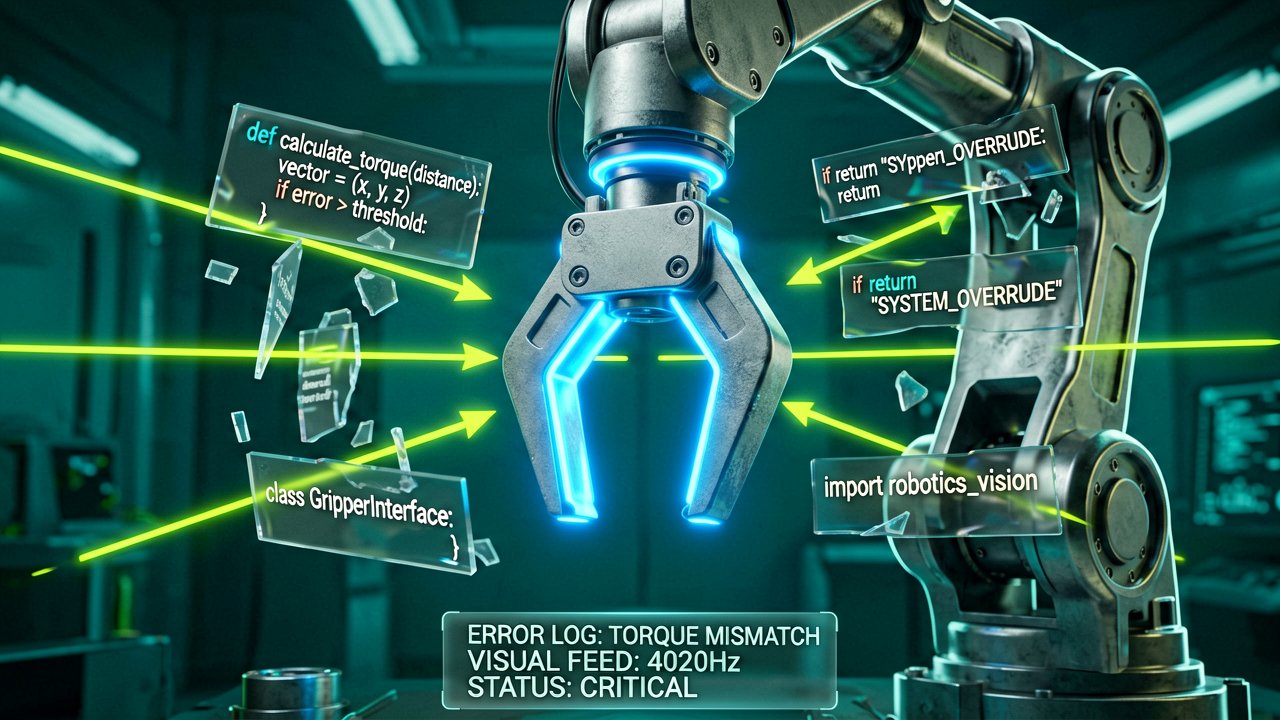
For years, the Achilles' heel of robotics has been the unexpected. You train a model on a thousand perfect trajectories, but a misplaced mug or a slight nudge in a new environment throws the system into a digital paralysis. Hardcoded logic fails, and retraining takes too long. NVIDIA’s GEAR lab is tackling this structural fragility head-on with a new framework called ASPIRE. Unveiled in a recent NVIDIA Research paper, ASPIRE is an autonomous loop that writes, critiques, and refines its own code-as-policy programs on the fly. It bypasses the traditional manual training pipeline entirely, giving machines a form of algorithmic intuition.
The system shifts the paradigm from static model training to an open-ended learning ecosystem. Instead of relying purely on fixed imitation data, ASPIRE utilizes LLM-driven agents that write control code, execute the physical actions, and carefully analyze the results. When a routine fails, a closed-loop robot execution engine inspects multimodal rollout traces to pinpoint exactly what went wrong. The platform then debugs its own scripts, validates the new behavior via trial and error, and permanently logs the successful outcome. Over time, these validated corrections are distilled into a dynamic, expanding skill library, meaning the robot actually gets smarter the more mistakes it encounters.
Breaking the Zero-Shot Bottleneck
The true litmus test for this self-correcting logic lies in long-horizon tasks—complex sequences requiring multiple sub-actions where errors compound fast. When tested on the rigorous LIBERO-Pro Long benchmark suite, a gauntlet of household tasks the system had never encountered during training, ASPIRE achieved an unprecedented 31% zero-shot success rate. While that number might sound modest in software engineering terms, it represents a massive jump over traditional baselines, which stagnate around a mere 4% success rate under identical conditions. According to technical documentation found on arXiv, these results were tracked across completely disjoint evaluation seeds, ensuring the system wasn't just overfitting to a predictable sim environment.
What makes this architectural leap so compelling is its sheer scalability across different complex environments. Beyond its long-horizon triumphs, ASPIRE demonstrated an impressive 77% gain on the standard perturbed LIBERO-Pro suite and a stunning leap from 20% to 92% on Robosuite’s bimanual object handover task solely through autonomous iterative debugging. An evolutionary search procedure ensures that exploration expands beyond a single failure trajectory, meaning the framework avoids getting stuck in localized loop errors. By building an internal, cross-embodiment memory of reusable strategies, NVIDIA isn't just teaching robots how to perform specific chores; they are engineering an architecture capable of teaching itself.
Under the Hood of Autonomous Self-Correction
Behind the Scenes: The architectural magic of ASPIRE lies in how it bridges high-level semantic reasoning with low-level execution loops without inducing significant runtime latency. At the core of this framework is a specialized multi-agent orchestration layer that treats robot control as an iterative software compilation problem. Rather than streaming raw neural network weights directly to joint actuators, the system relies on Large Language Models to generate expressive, modular Python scripts that interface with compliant control APIs. This decoupled approach allows the robot to separate physical dexterity from spatial logic, transforming physical execution failures into semantic debugging traces that the code-writing agent can readily parse and correct.
To prevent the system from getting trapped in infinite error loops, systems engineers implemented a strict hierarchical evaluation protocol. When a physical rollout fails—detected via multi-modal feedback such as torque anomalies or visual discrepancies—the closed-loop engine generates a structured execution trace. This trace details the exact API calls, cartesian coordinates, and visual state vectors leading up to the failure. An iterative feedback loop then passes this telemetry to a separate critique agent, which serves as an automated code reviewer. The critique agent isolates the specific code block responsible for the miscalculation, injecting tailored debugging advice into the prompt window for the next generation cycle.
Optimizing the Execution Path
Scaling this self-improvement loop across long-horizon tasks requires aggressive compute optimization, particularly when managing multi-step dependencies. ASPIRE mitigates the computational bottleneck of constantly prompting massive foundation models by introducing an evolutionary search procedure across its code generation paths. Instead of generating a single patch and waiting for a slow physical rollout to validate it, the architecture synthesizes parallel candidate programs simultaneously. These candidates are passed through a lightweight, simulated pre-check filter to eliminate syntactically invalid code before any physical joint commands are dispatched, saving valuable wall-clock time.
The final layer of this architectural pipeline is the skill distillation engine, which ensures that hard-won code corrections aren't lost after a task is completed. Once a generated program successfully navigates a perturbed environment, the validated execution trace is pushed to a centralized, cross-embodiment memory buffer. This memory doesn't just store static trajectories; it indexes parameterized code snippets and their environmental contexts. By distilling these successful routines into a dynamic skill library, subsequent tasks can skip the expensive LLM generation phase entirely, directly pulling optimized control primitives from the database to handle familiar obstacles instantly.

The Pragmatic Limits of Automated Intuition
Reading Between the Lines: It is easy to look at a 31% zero-shot success rate on LIBERO-Pro Long and declare the robotics problem solved, but a clear-eyed engineering perspective demands a closer look at what that metric actually reveals. In a vacuum, jumping from a baseline of 4% to nearly a third is an extraordinary leap, yet it also means the system still fails nearly 70% of the time on unfamiliar, long-horizon tasks. For an autonomous warehouse or a consumer household robot, a seventy-percent failure rate isn't an innovation—it is a liability. The real question is whether this self-improving loop hits a diminishing-returns wall as tasks scale in complexity, or if the architecture can truly bootstrap its way to industrial-grade reliability.
There is also a fascinating contradiction buried within the mechanics of autonomous iterative debugging. ASPIRE relies heavily on the premise that a critique agent can accurately diagnose why a physical action failed based on multimodal traces. However, simulator-to-reality gaps often introduce silent, unmodeled physics errors—like a subtle change in surface friction or a slightly warped plastic handle—that cannot be captured by semantic code analysis or visual state vectors alone. When the root cause of a failure is completely invisible to the LLM's world model, the system risks entering a hallucination cycle, rewriting perfectly good control logic to compensate for a physical anomaly it lacks the sensors to understand.
Furthermore, the long-term scalability of the skill distillation engine introduces an unseen computational tax. As the robot continues to explore, debug, and log successful routines, its cross-embodiment skill library will inevitably balloon. Managing, indexing, and correctly retrieving these parameterized code snippets requires its own architectural overhead. If the retrieval mechanism selects a slightly suboptimal primitive from its vast database, the resulting compounding errors could easily trigger the very failure loops the system was designed to avoid, turning a lean, adaptive framework into a bloated repository of highly specific edge-case fixes.
"We are rapidly approaching an era where your kitchen robot won't just refuse to do the dishes; it will write a beautifully optimized three-hundred-line Python script explaining exactly why the geometry of your new coffee mug makes the task fundamentally impossible."
Artūras Malašauskas is an AI Systems Integrator with 20+ years of production-grade web engineering experience. He has designed, shipped, and scaled enterprise Python/PHP systems for logistics, SaaS, and public-sector clients. For the past year, he has focused exclusively on AI integrations: deploying open-source LLMs, building generative media pipelines (image, audio, video), and engineering multi-agent workflows for real production environments. His standard: reproducibility, security, cost-efficient inference—no vaporware. He documents and evaluates emerging AI tooling, separating verified capabilities from marketing noise. Technical editor at: muza-ai.eu, ai-verslas.lt, ai-naujinos.lt Connect on LinkedIn
Comments