Under the Hood: How Palantir's Engine Optimizes Nemotron for Secure Sovereign Deployments
For defense agencies and critical infrastructure operators, wiring an app to a commercial third-party cloud API is an absolute non-starter. The risk of proprietary insights leaking into the weights of closed, hosted models presents a fundamental threat to data sovereignty. To bridge this gap, Business Wire reports that Palantir Technologies has launched an intelligent engine engineered explicitly to deploy NVIDIA's Nemotron open models within highly secure, sovereign environments. Rather than just shipping another large language model, the initiative focuses on providing the specialized software apparatus required to run, customize, and genuinely own generative AI where data cannot legally or operationally leave the physical premises.
This initiative represents a deepening collaboration between the two tech giants. It builds on their previously established Sovereign AI Operating System Reference Architecture, as documented by Constellation Research, which combines NVIDIA's accelerated hardware stack with Palantir's structural software platforms like AIP, Foundry, Apollo, and Ontology. By shifting the paradigm from consuming an external AI service to operating a fully contained local asset, government agencies can achieve absolute perimeter control while running mission-critical workloads.
The Architecture of Complete Model Ownership
At the center of this integration is the concept of a self-improving operational feedback loop. The engine is structurally broken down into three distinct engineering layers designed to give administrators granular control over the lifespan of their AI deployments. First, deployment engineering provides the baseline capability to host base and customized Nemotron variants inside air-gapped networks, classified facilities, and strictly isolated on-premise environments. Next, context engineering allows operators to fine-tune prompt structures, execution workflows, and real-time model behavior directly tailored to production tasks without breaking security constraints.
The most technically significant layer is model engineering. By collecting localized user telemetry and internal trace data, the platform empowers agencies to alter the weights of the open models themselves based on specific user actions, proprietary data assets, and in-platform evaluations. This architectural framework keeps everything under a zero-trust model, ensuring that explicit data authorization, customer-specific isolation, and data portability are enforced programmatically. According to coverage from The New Stack, this shifts the strategic goal from simply selecting an AI vendor to achieving permanent, localized ownership of the system's intellectual property.

Performance Metrics and Infrastructure Scale
Executing frontier-level AI locally requires immense computational backing and optimized software acceleration. The platform leverages the full enterprise-grade computing suite, integrating NVIDIA AI Enterprise software and NVIDIA NIM microservices to manage resource allocation efficiently. These software layers run natively on robust physical infrastructure, including advanced architectures like NVIDIA Blackwell Ultra systems equipped with eight interconnected GPUs and high-throughput Spectrum-X Ethernet networking. This combination provides the low latency required for real-time situational awareness and massive data token ingestion.
By bringing Nemotron open weights into an optimized execution harness, organizations can avoid the steep economic hurdles commonly associated with external token pricing and proprietary commercial API fees. Beyond the explicit security benefits of preventing data migration into public datasets, running optimized open models locally yields massive operational efficiencies, allowing defense and critical infrastructure providers to achieve high-performance throughput on localized hardware. This architecture effectively proves that strict compliance and state-of-the-art computational power do not have to be mutually exclusive.
Behind the Scenes: Deep-Dive Optimization Mechanics
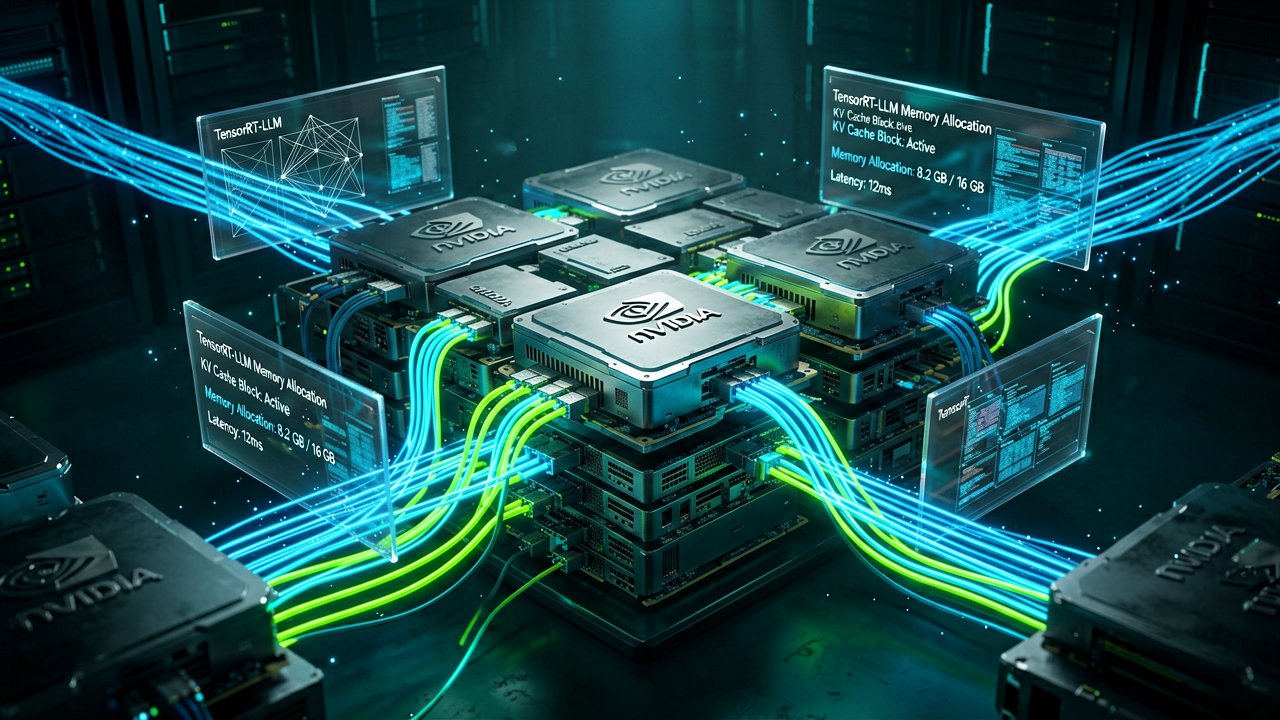
Behind the Scenes: Deploying open models like NVIDIA's Nemotron inside zero-trust, air-gapped perimeters requires fundamentally re-engineering the model execution path. Systems engineers cannot rely on traditional public cloud scaling, where elasticity solves inefficiency. Instead, Palantir's engine integrates directly with NVIDIA NIM microservices to optimize memory management at the bare-metal layer. By utilizing advanced TensorRT-LLM runtimes, the platform implements page-locked key-value (KV) caching, which dynamically allocates memory blocks for incoming tokens. This prevents memory fragmentation across VRAM pools during concurrent, multi-tenant reasoning operations, ensuring that compute nodes maintain peak hardware utilization without experiencing out-of-memory faults.
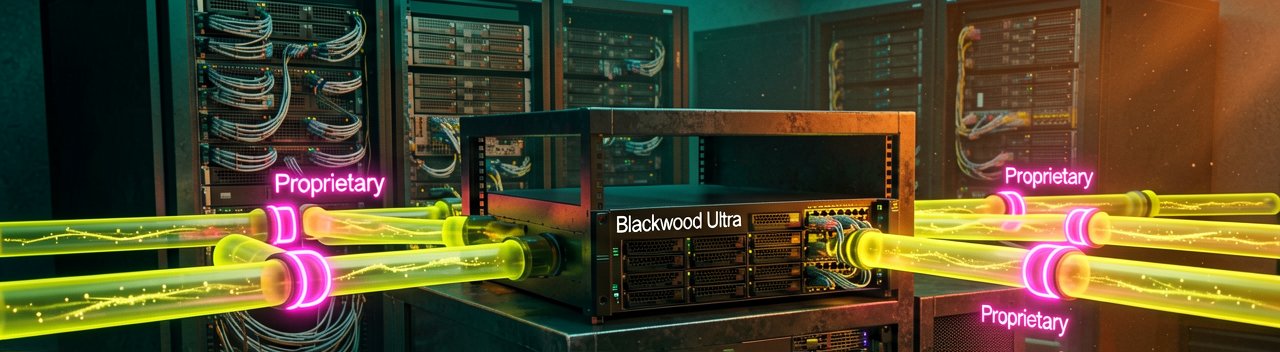
The core computational efficiency hinges on optimizing the physical data bus between adjacent processing units. Leveraging NVIDIA Blackwell Ultra architectures, the engine maximizes the bandwidth provided by high-speed NVLink interconnects to partition tensor workloads across multiple GPUs. Tensor parallelism splits the weight matrices of the Nemotron layers, executing simultaneous matrix multiplications before recombining the outputs via low-latency reduction operations. For workloads extending across separate server chassis, the system bypasses standard operating system networking bottlenecks by utilizing Remote Direct Memory Access (RDMA) over Converged Ethernet (RoCE) via Spectrum-X switches. This network pipeline allows GPUs to transfer token state data directly into the memory spaces of adjacent nodes, minimizing interconnect overhead and preserving sub-millisecond inference latencies.
Data privacy and governance are managed through a specialized orchestration layer that bridges Palantir's Ontology with local inference loops. When a user or system initiates a request, the engine intercepts the prompt to enforce context engineering rules, injecting real-time, permissioned telemetry from secure local databases. This ensures that the context window is populated only with information the specific user is explicitly authorized to view. Because the models run entirely within an isolated customer tenant, tracing data, intermediate logits, and prompt histories are captured locally by the Apollo platform, providing deterministic audit trails. These internal evaluation logs can then be used safely during offline training cycles to fine-tune the open weights without the risk of exposing sensitive national security data or proprietary operational intelligence to external infrastructure.
Reading Between the Lines: The Geopolitical Irony of Sovereign AI
Reading Between the Lines: The push for sovereign AI exposes a glaring contradiction in the tech sector's sudden obsession with "openness." For years, the proprietary model cartel insisted that massive, multi-billion-dollar closed systems were the only path to meaningful intelligence. Now, the narrative has flipped entirely, reframing open-weights architectures not as a budget alternative, but as the only option for national security and digital self-determination. Yet, this celebration of localized control ignores the heavy hardware dependency beneath the surface. True sovereignty is an illusion when the software required to manage local infrastructure is built on proprietary code, and the underlying silicon remains an exclusively controlled commodity manufactured by a handful of entities.
There is also an inherent tension in attempting to apply deterministic government compliance standards to inherently non-deterministic neural networks. Palantir promises that its governance frameworks can tame Nemotron within air-gapped environments. However, wrapping strict access policies and data tracing around an LLM does not magically solve the underlying fragility of generative systems. An AI model executing on a highly secure, sovereign GPU cluster can still hallucinate a tactical miscalculation or misinterpret a complex regulatory directive. The risk shifts from external data leakage to internal operational failure, raising critical questions about whether agencies are merely building highly secure, localized engines of error.
Ultimately, this convergence of accelerated hardware and data governance cements a new form of infrastructural lock-in for regulated sectors. While migrating to open models is intended to shield public and defense agencies from proprietary vendor traps, it swaps one form of dependency for another. Operating these intricate systems requires highly specialized talent and an endlessly capital-intensive hardware cycle. As defense budgets increasingly transform into permanent silicon procurement funds, the long-term sustainability of sovereign AI will depend less on the clever optimization of model weights, and far more on the unforgiving economic realities of maintaining private, cutting-edge data centers.
"We are witnessing a fascinating paradigm shift where nations willingly spend hundreds of millions of dollars to achieve total digital independence, only to realize that their hard-won sovereignty still requires a continuous supply of proprietary chips and a software patch from Silicon Valley to function properly."
Artūras Malašauskas is an AI Systems Integrator with 20+ years of production-grade web engineering experience. He has designed, shipped, and scaled enterprise Python/PHP systems for logistics, SaaS, and public-sector clients. For the past year, he has focused exclusively on AI integrations: deploying open-source LLMs, building generative media pipelines (image, audio, video), and engineering multi-agent workflows for real production environments. His standard: reproducibility, security, cost-efficient inference—no vaporware. He documents and evaluates emerging AI tooling, separating verified capabilities from marketing noise. Technical editor at: muza-ai.eu, ai-verslas.lt, ai-naujinos.lt Connect on LinkedIn
Comments