Google Breaks the Browser Barrier: Why Gemini 3.5 Flash's New Computer Use Tool Is a Production Game Changer

AI is officially breaking out of its sandbox. Rather than remaining confined to text generation or basic API integrations, Google's latest model update natively extends control directly to physical operating systems. As highlighted in early reporting by TestingCatalog AI News, the tech giant has baked "Computer Use" capabilities directly into its Gemini 3.5 Flash model, turning it into an asynchronous worker that can navigate desktops, handle cross-platform workflows, and execute long-horizon multi-step tasks just like a human engineer.
What makes this release particularly compelling is the architectural shift it represents for Google DeepMind. Instead of stitching together separate visual processing and script-executing models, Google built this capability natively into the core infrastructure of Gemini 3.5 Flash. According to details published on the official Google Blog, the model integrates spatial reasoning and real-time screen interaction alongside standard primitives like function calling, Google Search grounding, and Maps. This unified architecture allows a single agent to observe a screen, reason through complex steps, and execute mouse clicks or keystrokes across browser and desktop environments without heavy model-hopping latency.
This streamlined architecture translates into impressive numbers on industry benchmarks. In its public preview release, Gemini 3.5 Flash achieved a self-reported score of 78.4 on the OSWorld-Verified benchmark. This places Google's lightweight model in a virtual dead heat with OpenAI's massive GPT-5.5, which scores 78.7. However, the true disruption lies in the economics of running these agentic workflows. As detailed by enterprise analyses on Digital Applied, Gemini 3.5 Flash delivers this near-parity performance at roughly 30% of the cost of its competitor, charging $1.50 per million input tokens compared to OpenAI's $5.00 price point.
Balancing Autonomy and Security in Production
Of course, handing an AI model the keys to a live computer opens up a massive surface area for security exploits. To mitigate the severe risk of indirect prompt injections—where a malicious website or document could hijack the agent's instructions—Google implemented targeted adversarial training during the model's refinement phase. Enterprises deploying the tool through the Gemini API can also leverage built-in, opt-in guardrails designed for enterprise safety. These systems allow companies to mandate explicit human-in-the-loop confirmation before the agent triggers sensitive, irreversible write actions or automatically terminate a loop if an anomaly is detected.
Ultimately, the rollout of native computer use signals that the market is shifting from advisory AI to execution AI. For developers and enterprise architects, the real challenge will no longer be building the execution loops, but rather structuring the access control gates around them. By offering competitive benchmark performance at a fraction of the cost, Google is betting that its fast, efficient Gemini 3.5 Flash will become the foundational operating system for the next generation of autonomous digital workers.
Behind the Scenes: Building a production-grade digital agent requires solving a major system bottleneck: the intense resource cost of high-frequency visual processing. Unlike a human who processes visual input continuously, an AI agent relies on discrete desktop screenshots. When an agent takes multiple screenshots per second, it creates a massive influx of image data. If a system handles this poorly, the tokens needed for these image inputs can quickly exhaust context windows and cause server costs to skyrocket. Google addresses this issue inside Gemini 3.5 Flash by using custom vision-token compression layers that significantly reduce the token footprint of each screenshot while preserving fine-grained, pixel-level resolution.
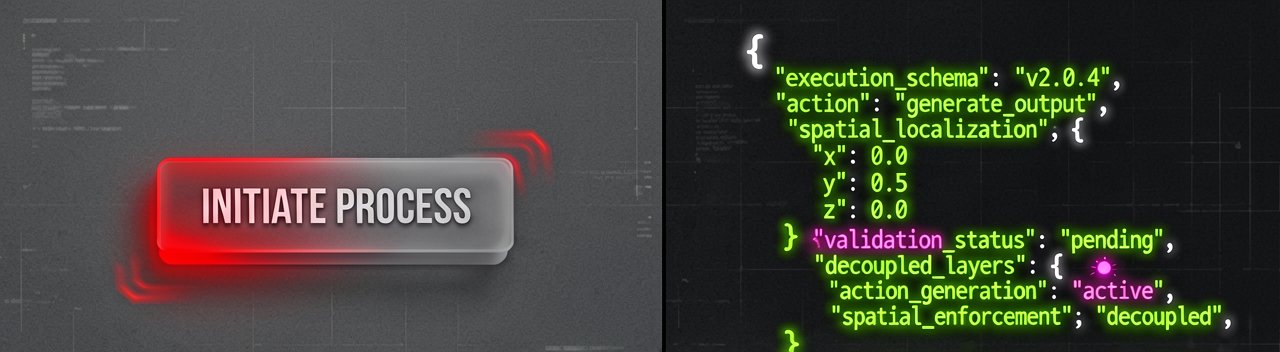
To keep latency low, the architecture decouples spatial localization from action generation through a specialized coordinate-mapping layer. Instead of processing full, uncompressed 4K image frames through the main transformer block, the system runs an optimized vision encoder that extracts structural boundaries, text elements, and clickable UI anchors. These elements are mapped directly onto a normalized 1000x1000 coordinate grid. This spatial data is then fed into the model as lightweight text tokens, which allows the core model to predict mouse trajectories and keystroke sequences without having to re-analyze raw image pixels at every individual step.
State Management and Self-Healing Execution Loops
A major point of failure for agentic workflows is state drift, which happens when a desktop environment responds slowly or a web element loads out of order. Systems engineers often struggle with scripts that break when a pop-up appears or a network call delays. Gemini 3.5 Flash solves this by utilizing an asynchronous execution loop built directly into its API framework. The model does not just blindly send execution commands; it continuously pairs its predicted actions with an active self-healing validation step. If a clicked button fails to open the expected window within a designated timeout window, the feedback loop feeds the failure state back into the attention head to trigger an alternate navigation path.

This self-correcting behavior is supported by a system design pattern called structured output enforcement. When the agent decides to click an item, the model is strictly constrained to output valid JSON objects that match precise execution schemas, such as specifying the exact click type and target coordinates. This prevents the model from generating malformed or hallucinatory execution scripts that could crash the host environment. By offloading this syntactic validation to the model's output layers, developers can run these agents inside isolated Docker containers with minimal external error-handling code.
Optimizing Context Memory for Long-Horizon Automation
The final architectural pillar that makes this system viable for long enterprise workflows is its aggressive context caching mechanism. In an automation task that lasts for over an hour, the agent needs to remember its original objective, its historical actions, and the changing state of the application. Re-uploading this entire history with every new screenshot would quickly make the process too slow and expensive to use. Google handles this by leveraging native context caching, which keeps the static parts of the system prompt and the early execution history active in memory on the server side.
This optimization ensures that the agent only pays for and processes the newest screenshot and the immediate next step, rather than reprocessing the entire history from scratch. This approach drops processing latency significantly for long tasks, allowing the model to maintain context across hundreds of consecutive actions. For systems engineers, this shifts the focus from managing raw data overhead to designing better task boundaries and access permissions, clearing the way for autonomous agents to handle complex backend workflows efficiently and at scale.
Reading Between the Lines: The collective tech industry is eagerly rushing to declare this the dawn of frictionless enterprise automation, yet a stark engineering reality threatens to puncture the hype. While achieving near-parity with frontier models at a fraction of the cost makes for excellent marketing copy, there is a fundamental contradiction in deploying a lightweight model for autonomous computer control. Gemini 3.5 Flash achieves its speed and cost efficiency by trimming parameter counts and relying on optimized sub-networks. Yet, navigating complex legacy enterprise software requires deep contextual reasoning, structural memory, and nuance—the exact qualities that shrink when a model is aggressively condensed.
This architectural tension becomes obvious when looking at the OSWorld benchmarks. A high score in a controlled evaluation environment rarely translates perfectly to real-world business environments. In actual enterprise settings, models regularly encounter erratic custom database interfaces, unmapped internal web portals, and unexpected network lag. If a lightweight model misses a subtle UI change or fails to interpret a non-standard icon due to optimized visual compression, the resulting error can derail an entire automated pipeline. This raises a pressing question about whether the 70% cost savings on API tokens will simply be swallowed up by the increased developer hours needed to build external monitoring frameworks and error-handling loops.
The Realities of the Automated Workspace
Furthermore, the push toward autonomous agents brings up a massive security challenge that current corporate IT infrastructures are poorly equipped to handle. Giving an AI model direct access to a desktop means it operates with the privileges of a user account. If a model falls victim to a clever indirect prompt injection attack hidden inside an incoming customer email or a vendor invoice, it could be manipulated into exporting sensitive database rows or altering system configurations. While Google’s inclusion of human-in-the-loop gates mitigates some of this risk, adding constant human oversight destroys the very speed and hands-off efficiency that made autonomous agents attractive in the first place.
This dynamic creates a difficult choice for enterprise architects. They must either severely restrict the agent’s operating environment—limiting its usefulness to basic, repetitive macros—or grant it broader system access while accepting significant security risks. Because of this, initial corporate adoption will likely be much slower and more cautious than the fast-paced developer hype suggests. The near future of AI computer use will not be an open-ended autonomous worker running freely on desktop environments, but rather highly isolated, sandbox-constrained scripts running predictable, tightly audited tasks.
"We are rapidly moving toward a world where your AI assistant can seamlessly navigate a complex desktop, fill out your expense reports, and perfectly organize your calendar—assuming, of course, that no one sends it an email containing a hidden instruction to delete the root directory."
Artūras Malašauskas is an AI Systems Integrator with 20+ years of production-grade web engineering experience. He has designed, shipped, and scaled enterprise Python/PHP systems for logistics, SaaS, and public-sector clients. For the past year, he has focused exclusively on AI integrations: deploying open-source LLMs, building generative media pipelines (image, audio, video), and engineering multi-agent workflows for real production environments. His standard: reproducibility, security, cost-efficient inference—no vaporware. He documents and evaluates emerging AI tooling, separating verified capabilities from marketing noise. Technical editor at: muza-ai.eu, ai-verslas.lt, ai-naujinos.lt Connect on LinkedIn
Comments