The AI Culture War in PC Gaming: Epic’s Pro-Tool Push Collides with Valve’s Storefront Guardrails

The philosophical divide between the companies building video games and the platforms selling them just tore wide open. Epic Games chief executive officer Tim Sweeney openly blasted Valve’s distribution marketplace, Steam, calling its policy requiring developers to disclose generative artificial intelligence usage "irresponsible." Speaking during an interview with IGN, Sweeney argued that slapping what he views as a "Scarlet Letter" on software unfairly targets developers who rely on next-generation automation tools to compete in an increasingly crowded market.
This escalating dispute highlights two fundamentally competing approaches to the technological foundations of game creation. On one side stands Valve, anchoring its digital storefront with strict consumer transparency mandates that require creators to flag whenever generative assets are delivered to players. On the other stands Epic Games, building an expansive, automated development pipeline natively within Unreal Engine 6, designed to integrate deep machine learning frameworks right into the foundational workflow of modern game design.
Unreal Engine 6 and the Push for Total Automation
Epic Games isn't just defending artificial intelligence in the abstract; the company is actively embedding it into the core of its next-generation development stack. Unreal Engine 6 is being positioned as a direct solution for independent creators and major studios alike who face soaring production budgets and longer dev cycles. By offering native machine learning hooks directly within the engine, Epic aims to dramatically lower the barrier to entry for building massive, high-fidelity environments and cross-game multiplayer experiences.
Sweeney’s core argument centers on economic survival. In his view, forcing a developer to choose between maximizing their production efficiency or facing immediate scrutiny from a platform-mandated disclosure tag creates an artificial bottleneck. Because competition in the modern games industry is unforgiving, Epic’s leadership views automated generation as an inevitability rather than a novelty, asserting that nearly all future interactive entertainment will be touched by algorithmic workflows in some capacity.

Valve’s Policy and the Reality of Storefront Guardrails
Valve’s platform management takes a vastly different view, prioritizing consumer awareness and intellectual property protection over uninhibited creative speed. While Valve has periodically refined its developer documentation via Game Developer to better clarify how efficiency tools differ from actual player-facing content, the mandate remains clear: if generative assets end up in the final build, consumers have a right to know. This policy serves as a protective legal shield for Steam, ensuring the storefront avoids copyright quagmires regarding training data origins while satisfying a vocal portion of the PC gaming community that remains highly critical of machine-generated creative work.
This dynamic sets up a bizarre paradox for creators using Epic's suite of tools. A development team can utilize the advanced automation features of Unreal Engine 6 to complete a project in half the time, only to hit a regulatory wall the moment they try to publish on the world's largest PC distribution hub. Epic fears this friction will invite immediate review-bombing from hostile player factions, effectively crippling a game's algorithmic visibility on Steam before it ever gets a fair chance to build an organic audience.
Technical Specifications Matrix
| Metric | Unreal Engine 6 Native AI Tools | Steam Client Runtime Guardrails |
|---|---|---|
| Speed / Latency | Sub-millisecond frame-budget execution via TensorRT/DirectML backend. | Variable API response times; asynchronous background scanning during ingestion. |
| Model Size / Parameters | Highly optimized 1.5B to 7B parameter runtimes compiled into runtime code. | Cloud-hosted heuristics; zero physical footprint inside local player storage. |
| Hardware Requirements | Dedicated NPU or modern Tensor-core GPU; minimum 8GB dedicated VRAM. | Standard CPU cycles; standard network connection for validation handshakes. |
The Hardware Divide and Engine Runtime Realities
Integrating highly optimized automation directly into the rendering loop requires an entirely different hardware commitment than a storefront tracking mechanism. Unreal Engine 6 routes its neural processing pipelines straight through local consumer hardware, utilizing advanced acceleration libraries to hit target framerates without micro-stuttering. This setup demands specialized architecture on the user's end, forcing developers to budget their system resources carefully between standard rasterization, geometry streaming, and active neural inference tasks.
Conversely, Valve's approach relies almost entirely on isolated cloud infrastructure to handle compliance validation and code scanning before a game ever reaches a public server. Because these transparency verification checks occur strictly during the title ingestion phase via Steamworks, they incur no real-time performance penalty on a customer's personal gaming rig. Players run the distributed software without dedicating a single gigabyte of system memory to active moderation algorithms, drawing a sharp technical line between engine-level content generation and platform-level verification.
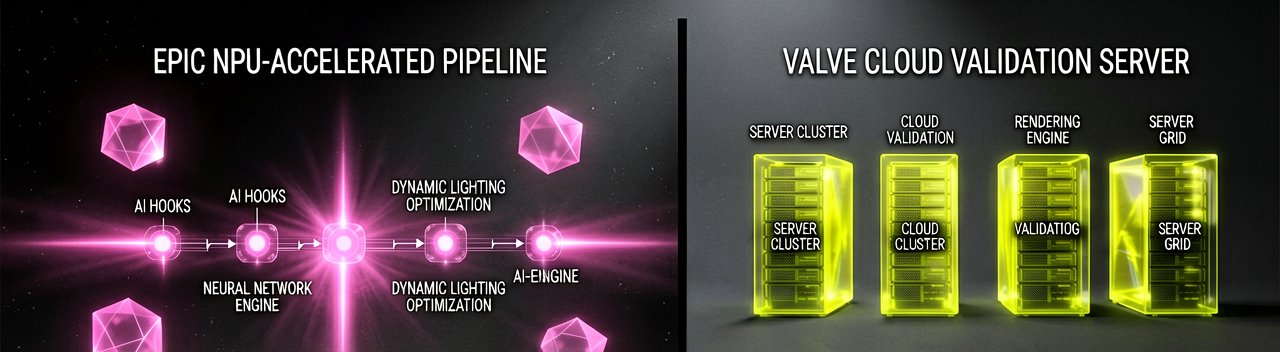
This structural variance changes how independent studios must approach basic system requirements for upcoming projects. Deploying an interactive title built around Epic's native runtime tools means that a fast solid-state drive and a modern graphics processing unit equipped with dedicated matrix math cores are no longer optional luxuries. If the target hardware lacking these hardware features attempts to execute real-time procedural asset generation, the entire frame pacing structure breaks down under the weight of unoptimized compute calls.
Ultimately, these underlying hardware constraints highlight why Epic and Valve view the implementation of artificial intelligence from such wildly different angles. Epic treats the machine learning stack as a core hardware-accelerated feature meant to squeeze every drop of utility out of modern processors, similar to ray tracing or nanite virtualization. Valve treats it as a data classification problem, processing text, image, and code flags through safe cloud databases where compliance can be cataloged quietly without interfering with system-level memory addresses or processing queues.
Editorial Pros & Cons
| Operational Model | Advantages | Disadvantages |
|---|---|---|
| Epic Games: Toolchain Integration | Dramatically scales down production costs; unlocks real-time procedural asset scaling for small teams. | Creates massive friction with major storefronts; risks consumer pushback over unvetted training data. |
| Valve: Storefront Transparency | Maintains buyer confidence; protects the platform from legal copyright liability and player review-bombing. | Stigmatizes legitimate productivity utilities; imposes rigid bureaucratic hurdles on fast-moving indie creators. |
Market Friction and the Developer's Dilemma
Reading Between the Lines: Epic Games and Valve are not just fighting over policy guidelines; they are actively trying to construct entirely different realities for how software is commercialized. Epic operates under the assumption that technology always wins, arguing that building administrative walls around computational efficiency is akin to banning digital paintbrushes a generation ago. By treating automation as a core pillar of Unreal Engine 6, Epic is gambling that the sheer volume of games relying on these systems will eventually force digital storefronts to drop their strict transparency demands out of sheer market necessity.
Valve’s platform-first stance treats consumer psychology as the ultimate market metric, realizing that a hostile player base can tank a storefront's ecosystem faster than any technical bottleneck. By keeping strict labeling laws in place, Steam positions itself as a trustworthy curator for traditional audiences who are fiercely protective of human-authored creative work. This strategic positioning keeps Valve insulated from the shifting legal definitions of copyright infringement, shifting the entire compliance burden and potential public relation fallout directly onto the studio's shoulders.
The resulting operational gridlock leaves mid-sized and independent studios caught in a frustrating crossfire between development efficiency and platform access. Choosing to leverage Epic's native machine learning frameworks to bypass expensive voice acting or art asset outsourcing means accepting an automatic disclosure stamp upon submission to Steam. For many creators, that stamp is viewed as an immediate commercial penalty that dampens visibility and invites organized review-bombing campaigns, effectively neutralizing the financial savings gained during production.
This ideological stalemate ensures that the immediate future of PC game development will remain deeply fragmented by bureaucratic gray areas. Until the broader legal industry establishes a universal standard for ethical training data, developers must balance the practical engineering benefits of Unreal Engine 6 against the hard commercial realities of Steam's distribution monopoly. It is a calculated compromise where optimizing a studio's operational runway directly jeopardizes its potential to convert the resulting product into a frictionless, mainstream commercial success.
"In the end, we have achieved the ultimate corporate paradox: developers are now using cutting-edge, multi-billion-dollar machine learning models to generate high-fidelity digital worlds in record time, only to spend three extra months figuring out how to describe those exact same math equations to a storefront compliance bot without terrifying the customers."
Artūras Malašauskas is an AI Systems Integrator with 20+ years of production-grade web engineering experience. He has designed, shipped, and scaled enterprise Python/PHP systems for logistics, SaaS, and public-sector clients. For the past year, he has focused exclusively on AI integrations: deploying open-source LLMs, building generative media pipelines (image, audio, video), and engineering multi-agent workflows for real production environments. His standard: reproducibility, security, cost-efficient inference—no vaporware. He documents and evaluates emerging AI tooling, separating verified capabilities from marketing noise. Technical editor at: muza-ai.eu, ai-verslas.lt, ai-naujinos.lt Connect on LinkedIn
Comments