Silicon’s Successor: Inside onsemi’s GaNEXUS Strategy for the AI and Robotics Era

The crushing energy demands of modern artificial intelligence and automated machinery are pushing legacy silicon infrastructure to its absolute physical limits. As hyperscale data centers prepare to swallow an unprecedented share of global electricity, power grid delivery and internal system thermal management have evolved from secondary engineering hurdles into make-or-break operational bottlenecks. Addressing this impending crunch, onsemi has launched its GaNEXUS gallium nitride (GaN) power portfolio, targeting the exact high-voltage and low-voltage conversion stages where conventional silicon hardware drops the ball.
By moving past traditional silicon limitations, this wide-bandgap platform fundamentally alters how hardware designers approach power architectures. The initial lineup rolls out with enhancement-mode discrete GaN High Electron Mobility Transistors (HEMTs) scaling across a broad voltage spectrum from 40V up to 650V. Crucially, the rollout features the specialized 650V GaNEXUS Smart FETs, which weave vital protective circuitry directly onto the silicon-substrate die. This integration eliminates much of the painstaking micro-level troubleshooting traditionally required to shield fast-switching wide-bandgap components from destructive voltage spikes and transient system anomalies.
The architectural shift pays dividends where it matters most: system footprint and conversion performance. Operating at drastically higher switching frequencies allows engineers to shrink bulky magnetics by up to 60% in high-frequency AC-DC stages, fundamentally changing the physical layout of future AI power shelves and industrial machinery. Depending on the chosen system topology, GaNEXUS yields an immediate 1.5x to 2x jump in raw power density alongside efficiency gains ranging between 0.5% and 2%. When paired with the company's Treo control platform, these incremental percentage gains stack up into massive operational savings and reduced cooling expenses for operators racing to deploy next-generation computational muscle.
Engineering the AI Power Shelf: Gate-Loop Ringing and Parasitic Suppression
Behind the Scenes: System architects and electrical engineers face a brutal balancing act when optimizing transient response behaviors under the dynamic step-load changes typical of modern GPU clusters. While traditional discrete GaN configurations yield blazing switching frequencies, they simultaneously weaponize parasitic inductances inherent to standard printed circuit board traces. At high frequencies, even minor trace variations introduce extreme gate-loop ringing and severe voltage overshoots that threaten to breach gate oxides and trigger catastrophic latch-up events.
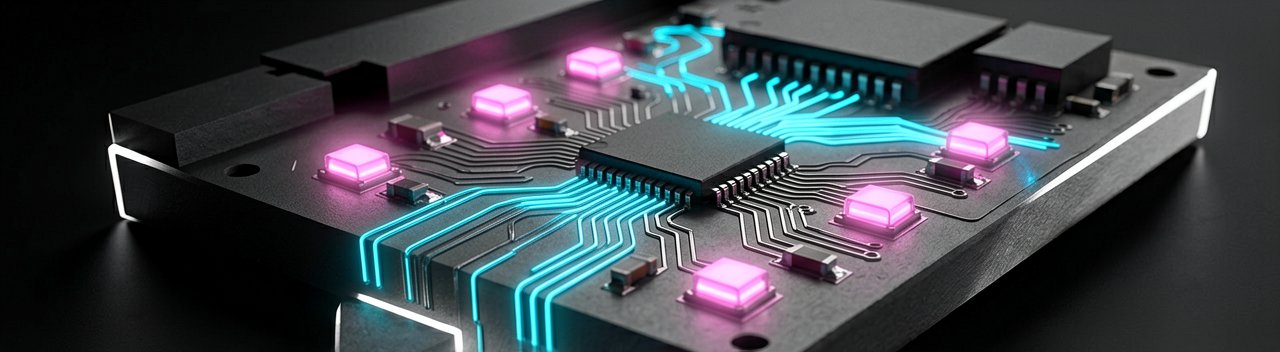
The core structural solution engineered for the onsemi 650V GaNEXUS Smart FET family relies on die-level integration to completely eliminate these external bottlenecks. By embedding advanced sensing and protection logic directly onto the silicon-substrate die alongside the high-voltage GaN HEMT channel, the platform shrinks critical interconnect paths down to microscopic dimensions. This layout drops parasitic gate inductance to nearly absolute zero, stabilizing the gate drive loop and permitting clean, controlled switching trajectories even under harsh high-current demands.
From an operational standpoint, this hardware-level shielding directly changes how digital control systems handle severe duty cycles. When coupled with the 65nm BCD-processed Treo mixed-signal controller platform, system firmware can aggressively optimize power factor correction (PFC) stages and high-voltage LLC resonant converters without adding heavy margins for passive snubber overhead. Because the integrated driver mitigates reverse-conduction losses natively, firmware engineers can safely minimize dead-time windows within their microcontroller PWM registers down to single-digit nanoseconds.
This tight hardware-software synchronization yields unprecedented dividends for high-density power delivery architectures. In automated manufacturing and robotics, where rapid actuator braking creates massive inductive feedback, the integrated high-speed thermal and overcurrent protection loops respond in sub-microsecond timelines. By handling transient faults directly in the physical silicon layer rather than waiting for an external controller interrupt over an SPI or I2C bus, GaNEXUS ensures localized system stability while maintaining peak efficiency metrics up to 96 percent under continuous full-load operating conditions.
The Reality Check: Supply Chains, Yield Realities, and Market Adoption
Reading Between the Lines: While the marketing literature paints a flawless picture of massive power density leaps and slashed magnetics footprints, the physical implementation of gallium nitride at this scale remains a deeply nuanced endeavor. Silicon has maintained its ironclad grip on the industry for over half a century because it is exceptionally cheap to manufacture and predictable to scale. Transitioning high-density server architectures to a wide-bandgap platform like GaNEXUS forces infrastructure operators to confront a stark reality: theoretical efficiency boosts do not automatically translate to seamless real-world deployment.

The primary point of friction lies in the complex manufacturing supply chain and die yield curves associated with lateral GaN-on-Silicon tech. While onsemi mitigates integration headaches by consolidating protective logic onto a single substrate, this internal structural complexity naturally compounds the risk of material defects during fabrication. For data center operators operating on razor-thin margins, a nominal 1% to 2% efficiency improvement in an LLC resonant stage can quickly lose its financial luster if initial component procurement premiums or unexpected wafer yield constraints distort the projected return on investment.
Furthermore, positioning a single platform to satisfy both the low-voltage 40V requirements of robotic motor drives and the punishing 650V demands of AI data center power shelves introduces a clear engineering paradox. High-voltage infrastructure requires ultra-rugged thermal dissipation pathways to survive massive continuous step-loads, whereas compact industrial robotics prioritize minimal physical weight and strict spatial restrictions above all else. Attempting to blanket this entire operational spectrum under a single architectural umbrella implies that hardware engineers will inevitably have to accept compromise design trade-offs in layout optimization, despite the dual-sourcing promise of thermally enhanced TOLL and TOLT packaging structures.
Ultimately, the industry-wide shift toward wide-bandgap platforms will not be decided by benchtop demonstration metrics, but by the cold, hard mathematics of component reliability over multi-year lifecycles. By weaving the GaNEXUS portfolio directly into its existing mixed-signal Treo platform ecosystem, the company is making an aggressive play to lock developers into an integrated hardware-software loop before competing silicon carbide and gallium nitride providers can mature their standalone offerings. Whether hyperscalers fully embrace this unified architecture or choose to cherry-pick discrete alternatives depends entirely on how quickly these integrated smart FETs can prove their long-term structural resilience under non-stop, maximum-load operational conditions.
"It appears that while gallium nitride is undeniably the undisputed future of high-efficiency energy management, engineering teams will still spend the next few years discovering that eliminating board space means finding increasingly creative ways to cool the microscopic hot spots they just compressed."
Artūras Malašauskas is an AI Systems Integrator with 20+ years of production-grade web engineering experience. He has designed, shipped, and scaled enterprise Python/PHP systems for logistics, SaaS, and public-sector clients. For the past year, he has focused exclusively on AI integrations: deploying open-source LLMs, building generative media pipelines (image, audio, video), and engineering multi-agent workflows for real production environments. His standard: reproducibility, security, cost-efficient inference—no vaporware. He documents and evaluates emerging AI tooling, separating verified capabilities from marketing noise. Technical editor at: muza-ai.eu, ai-verslas.lt, ai-naujinos.lt Connect on LinkedIn
Comments