Silicon Beyond the Cloud: How Edge AI is Carving a New Growth Narrative Past Nvidia

The relentless expansion of artificial intelligence is experiencing a crucial migration pattern away from power-constrained hyperscale data centers and directly into the hardware at the network's edge. While centralized server infrastructure has driven unprecedented valuations for enterprise graphics processing units (GPUs), the physical bottlenecks of grid capacity and latency are forcing localized deployments. As specialized models become increasingly efficient, the financial opportunity is pivoting toward companies supplying silicon for local inferencing in consumer devices, corporate fleets, and automotive networks, according to a recent hardware outlook published by Yahoo Finance.
This macro architecture shift changes the investment thesis for the broader semiconductor sector. Rather than relying entirely on raw, centralized compute pipelines, hardware architects are emphasizing operations-per-watt efficiencies to run multi-billion parameter neural networks natively on localized devices. This distributed approach requires sophisticated neural processing units (NPUs) engineered for minimal thermal footprints, introducing a distinct competitive arena where legacy server dominance does not automatically translate into market capture, as documented in an investment thesis by Investing.com.
Among the primary beneficiaries of this structural change is Qualcomm. Positioned historically as a cellular communications specialist, the firm has systematically retooled its intellectual property to specialize in low-power on-device machine learning architectures. By establishing a robust hardware foothold across mobile, personal computing, and smart transportation ecosystems, the enterprise is capitalizing on real-world demand shocks that operate entirely outside the hyper-competitive data center buildout.
Diversification Outside Handsets and the Mobile Core
Qualcomm's financial metrics confirm that its edge intelligence narrative is moving from a speculative pilot phase directly into material balance-sheet contributions. The company reported overall revenue of $10.60 billion for its fiscal second quarter of 2026, as detailed in an earnings analysis by The Futurum Group . Although the core handset segment continues to navigate typical industry supply patterns, the expansion into adjacent edge sectors reflects a permanent structural diversification strategy.

The premium smartphone market is increasingly leaning on local silicon processing to execute agentic AI applications without generating constant cloud-compute network overhead. Operating these foundational workflows locally reduces cloud subscription tolls and secures data privacy for enterprise clients. Consequently, top-tier mobile equipment manufacturers are adopting highly integrated platform solutions like the Snapdragon platform series to maintain computational parity at the consumer layer.
Automotive Infrastructure Emerges as a Key Revenue Pillar
The most compelling velocity within the localized silicon transition is unfolding inside the intelligent vehicle market. Driven by digital cockpit systems and advanced driver-assistance systems (ADAS), automakers are demanding high-performance computing platforms capable of localized data analysis. Qualcomm's QCT Automotive segment capitalized on this transition by generating a record-breaking $1.3 billion in revenue for the quarter, marking a substantial 38% year-over-year growth rate as detailed by AlphaSense.
Modern vehicles require rapid, deterministic processing capabilities to analyze multiple camera sensors and telemetry data pipelines simultaneously. Relying on cloud-based servers to execute safety-critical decisions creates unviable latency vulnerabilities. By installing high-performance NPUs directly inside vehicle frames, automakers achieve localized autonomy, solidifying a stable contractual pipeline for specialized edge chip manufacturers.
The PC Transition and Capital Efficiency Guardrails
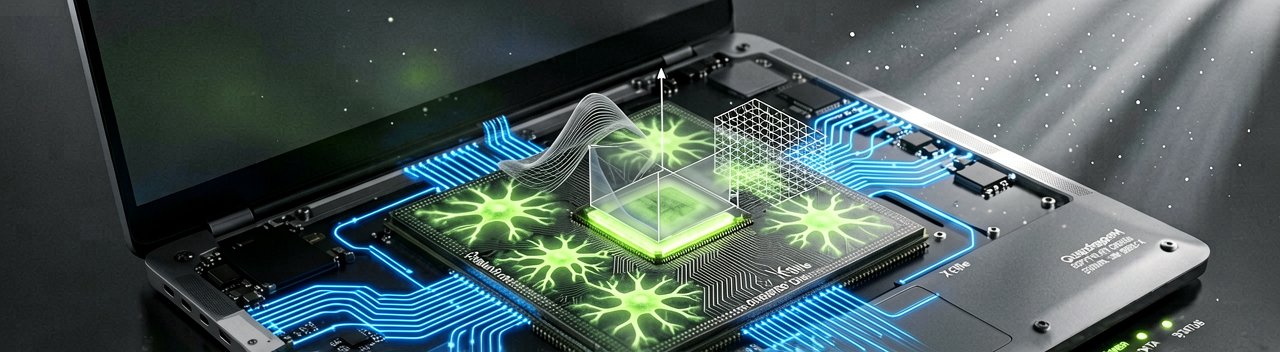
The personal computing ecosystem represents the third pillar of this distributed intelligence shift. Windows-based laptops are undergoing a systemic architectural overhaul to support native AI processing tasks. Strategic scaling remains on track, with the platform maintaining a baseline of dozens of Snapdragon X Elite laptop designs launched or active in current product lines, as highlighted by HotHardware. This transition targets an expansive portfolio exceeding 100 designs to cement a long-term alternative architecture in personal computing.
For market market participants looking beyond standard growth metrics, the company's financial model pairs this fundamental AI exposure with robust capital return structures. During its second quarter of 2026, the company returned a combined $3.7 billion to shareholders, deploying $2.8 billion toward equity repurchases alongside $945 million in direct dividend distributions, per AlphaSense. This operational profile offers an alternative risk mitigation channel compared to pure-play growth foundries, enabling investors to participate in the upcoming edge deployment phase backed by deep corporate liquidity and resilient pricing power.
What Most Reports Miss: The Architectural Battle lines of Ambient Computing
The Edge AI Economics Shift: Beyond superficial hardware spec sheets, the real battle over decentralized silicon is fought on the balance sheets of massive application developers. Relying exclusively on centralized clouds for every real-world user query forces software companies to shoulder compounding network, cooling, and hardware subscription costs. By shifting foundational inference workflows down to localized mobile devices, personal laptops, and edge appliances, the technology industry is executing an architecture optimization plan to protect operating margins. This systematic realignment redefines the strategic role of neural processing units (NPUs) from mere smartphone components into vital nodes of an independent, ambient computing grid, as highlighted during the .
Engineering the Software Ecosystem Layer: Hardware dominance in this emerging landscape requires building an integrated ecosystem that bridges developer concepts with real-world, industrial-scale deployment. Silicon design cannot scale effectively if developers must manually patch disparate frameworks across distinct device fleets. To resolve this fragmentation, specialized deployment architectures like the Qualcomm Dragonwing ecosystem are unifying hardware, software pipelines, and machine learning lifecycle management. This comprehensive platform design simplifies the path from initial prototype to operational edge deployment, enabling software teams to run complex generative models locally across varied consumer networks, as outlined by Qualcomm Developer Blog .
The New Physical Reality of Enterprise Edge Assets: This transformation extends past mobile handsets into structural frameworks like municipal utilities, automated logistics, and smart security infrastructure. Enterprise physical networks are transitioning rapidly from basic telemetry cameras into intelligent sensor arrays capable of independent, real-time decision-making. Operating this localized intelligence protects sensitive customer privacy, eliminates dangerous round-trip network latency, and maintains operational continuity during severe network outages. Industry leaders are deploying scalable edge AI engines across tens of thousands of localized hardware terminals, converting distributed physical equipment into monetization networks, according to an infrastructure overview from the
Qualcomm OnQ Platform
The Illusion of Seamless Execution: Wall Street’s current enthusiasm for on-device AI assumes a frictionless consumer upgrade cycle that historical hardware trends simply do not support. While silicon providers successfully showcase impressive operations-per-second benchmarks in controlled laboratory settings, the real-world utility of these localized neural processors remains Bottlenecked by software implementation. Application developers are hesitant to split their development pipelines between legacy cloud architectures and a fragmented array of edge chipsets. Without a definitive, universally adopted killer application that mandates local processing, consumers are extending the lifecycle of their existing devices, threatening the aggressive growth projections baked into current chip valuations. The Power Efficiency Paradox: A structural contradiction undermines the marketing narrative surrounding low-power edge intelligence. Silicon marketing campaigns frequently champion independent localized processing as a solution to the cloud's compounding energy crisis. However, executing multi-billion parameter models natively on consumer hardware rapidly drains mobile battery reserves and creates severe thermal challenges in compact enclosures. When thermal throttling inevitably engages to prevent device damage, the processing workload is silently offloaded right back to centralized servers. This cyclical reliance exposes the reality that edge hardware often acts as a temporary buffer rather than a total replacement for hyperscale data centers. Geopolitical Realities and Supply Constraints: The optimism surrounding distributed hardware assumes a highly stable global supply chain capable of producing advanced nodes at unprecedented scale. This thesis ignores the acute geopolitical vulnerabilities of advanced lithography, where the manufacturing of next-generation edge silicon remains concentrated in a small handful of vulnerable foundries. Furthermore, as automotive and personal computing sectors demand increasingly sophisticated processing units, they enter direct competition for limited wafer allocations with the very cloud titans they seek to bypass. This impending capacity constraint suggests that the edge AI revolution may be gated not by market demand or architectural ingenuity, but by the physical limits of semiconductor fabrication facilities.Reading Between the Lines: The Friction Points of Distributed Silicon
"We are told the future of artificial intelligence belongs to a hyper-efficient pocket device that respects your data privacy, works entirely offline, and preserves global power grids—assuming, of course, that you do not mind your smartphone running hot enough to fry an egg every time you ask it to summarize an email."
Artūras Malašauskas is an AI Systems Integrator with 20+ years of production-grade web engineering experience. He has designed, shipped, and scaled enterprise Python/PHP systems for logistics, SaaS, and public-sector clients. For the past year, he has focused exclusively on AI integrations: deploying open-source LLMs, building generative media pipelines (image, audio, video), and engineering multi-agent workflows for real production environments. His standard: reproducibility, security, cost-efficient inference—no vaporware. He documents and evaluates emerging AI tooling, separating verified capabilities from marketing noise. Technical editor at: muza-ai.eu, ai-verslas.lt, ai-naujinos.lt Connect on LinkedIn
Comments