Securing the AIoT Frontier: Hikvision’s 2026 Cybersecurity White Paper Signals Strategic Shift Toward Digital Trust

The convergence of artificial intelligence and the Internet of Things (AIoT) has transformed the global technology landscape, transforming isolated physical hardware into vast, interconnected data ecosystems. In response to the complex threat landscape introduced by these network architectures, Hikvision has officially unveiled its 2026 Cybersecurity White Paper, which establishes a revised blueprint for hardening next-generation smart technologies. Documented on the official Hikvision platform, the comprehensive publication highlights systemic practices designed to minimize operational vulnerabilities while fostering transparency among international partners and commercial enterprises.
As corporate infrastructures rely heavily on decentralized computing, security can no longer exist as a secondary or auxiliary patch; it must be deeply engineered into the foundational product lifecycle. Hikvision’s strategic documentation reflects an industry-wide push toward zero-trust principles and robust device compliance. According to regional coverage published via PR Newswire, this updated framework explicitly targets emerging systemic risks associated with data security, user privacy protection, and the ongoing deployments of large-scale artificial intelligence models at the network edge.
Evolution of the HSDMM Framework
At the center of the newly outlined compliance trajectory is the Hikvision Security Development Maturity Model (HSDMM). This structural methodology standardizes security benchmarks across three foundational pillars: organizational governance, management processes, and specific technical countermeasures. By institutionalizing these metrics from original product design to end-of-life deprecation, the framework is architected to optimize data confidentiality, system integrity, and resource availability for large-scale enterprise Internet of Things deployments.
Artificial Intelligence and Edge Model Protection
A primary structural update in the 2026 edition is the addition of a dedicated chapter examining Artificial Intelligence Security. As edge devices increasingly run localized vision models and data processing algorithms, the safeguarding of weights, parameters, and localized training datasets has become critical. The framework establishes specialized defensive boundaries around AI models to protect against malicious adversarial attacks, data poisoning, and unauthorized reverse-engineering during complex digital transformations.
Advanced Data Classification and Open-Source Software Governance
The white paper addresses the expansion of edge-to-cloud architectures by introducing precise guidelines for data classification and grading. These guidelines enforce stricter compliance mandates for storage environments, ensuring sensitive metadata is securely compartmentalized across localized endpoints and remote cloud environments. Furthermore, because open-source components frequently serve as an entry point for supply chain vulnerabilities, Hikvision has formalized closed-loop governance protocols that oversee the introduction, strict auditing, and final commercial release of open-source software packages.
Vulnerability Management and International Compliance Standards
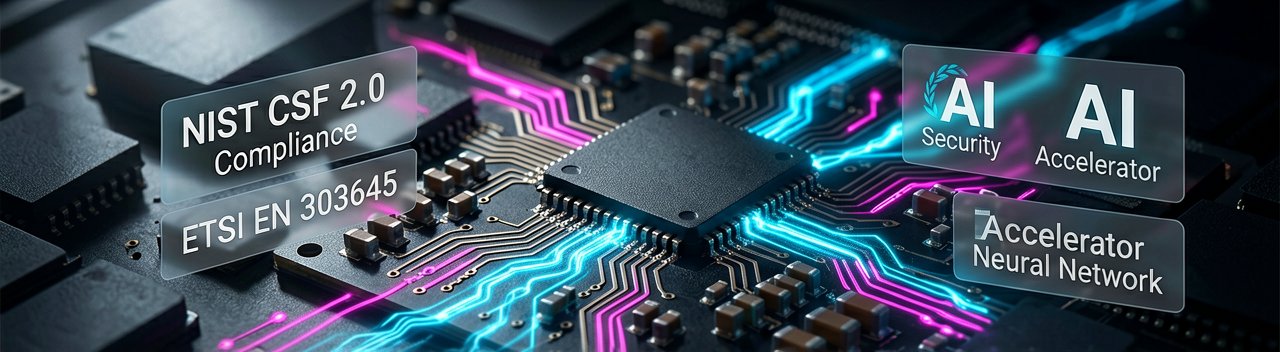
To assure global markets of its engineering integrity, the documentation highlights an integrated vulnerability management ecosystem that unifies internal detection mechanisms with external incident response pipelines. As syndicated by financial networks like Yahoo Finance, the security posture aligns directly with modern international benchmarks, including the European Telecommunications Standards Institute (ETSI) EN 303645 standard and the National Institute of Standards and Technology (NIST) Cybersecurity Framework (CSF) 2.0. This active alignment with international certification groups signals a concentrated market effort to address geopolitical regulatory scrutiny through transparent technical documentation.
Beneath the Spec Sheets: Navigating Geopolitical Headwinds and Hardware-Level Rigor
While industry documentation frequently relies on high-level security buzzwords, the true battleground for Hikvision lies in reconciling global geopolitical skepticism with verifiable, code-level transparency. For years, Western regulators have scrutinized firmware origins and supply chain vulnerabilities within massive camera networks. The updated 2026 framework acts as a technical defense mechanism against these persistent market restrictions, aiming to prove that decentralized edge devices can maintain a verifiable perimeter despite intense regulatory headwinds. By codifying strict compliance vectors, the company attempts to shift the narrative from political debate to quantifiable, third-party audited security metrics.
A significant part of this transition involves the structural evolution of the Hikvision Security Development Maturity Model. Instead of treating security as a final checklist before shipping, engineers must now treat code integrity as an ongoing variable. This shift requires immense operational overhauls, forcing development teams to treat every firmware patch with the same scrutiny as a major product launch. The integration of advanced open-source software governance ensures that third-party code libraries, which are often the primary vector for supply chain exploits, are constantly audited, isolated, and replaced if they fail to meet strict cryptographic benchmarks.

Furthermore, the operational reality of managing edge artificial intelligence introduces entirely new threat vectors that traditional network firewalls cannot mitigate. Stakeholders are no longer just worried about simple video interception; they face the complex reality of automated adversarial attacks designed to trick vision algorithms or extract sensitive model weights. By dedicating an entirely new operational architecture to AI safeguarding, the strategy recognizes that a compromised machine-learning model is just as dangerous as a compromised root password. Protecting these local parameters ensures that commercial facilities, traffic grids, and industrial hubs can deploy autonomous analytics without fearing localized tampering.
Ultimately, the success of this digital trust initiative depends heavily on real-world implementation across fragmented global distribution networks. Integrating international standards like NIST CSF 2.0 and ETSI EN 303645 looks excellent on corporate presentations, but the true test occurs when local system integrators deploy these devices across diverse IT environments. Enterprise security teams must actively configure these advanced features rather than relying on default out-of-the-box settings. As data protection laws continue to tighten globally, the transition from theoretical security compliance to rigorous, active defense will determine whether these interconnected systems remain resilient assets or become unexpected operational liabilities.
Reading Between the Lines: The Friction Between Policy and Real-World Implementation
The core paradox of any comprehensive cybersecurity white paper lies in the vast chasm between theoretical engineering frameworks and the unpredictable realities of field deployment. While the documented enhancements to the Hikvision Security Development Maturity Model paint a picture of flawless, automated compliance, the actual security posture of any AIoT network remains at the mercy of the human element. System integrators and local installers, frequently operating under tight margins and compressed timelines, routinely bypass advanced configuration steps. A highly hardened edge device running sophisticated model-protection algorithms is only as secure as the network password chosen by an overworked field technician, highlighting a persistent disconnect between corporate policy and on-the-ground execution.
Furthermore, the strategic emphasis on aligning with Western compliance frameworks like NIST CSF 2.0 and ETSI EN 303645 introduces an undeniable layer of institutional irony. Hikvision continues to invest heavily in formal technical compliance to appeal to global enterprise markets, yet these architectural safeguards do little to alter the company's broader geopolitical positioning. The reality is that technical transparency rarely trumps political risk assessment in international trade. Consequently, this heavy focus on universal standards serves a dual purpose: it builds a robust technical defense for neutral markets while acting as a public relations buffer against regulatory entities that remain structurally incentivized to reject the hardware regardless of its cryptographic credentials.
Looking ahead, the commitment to edge AI model protection and rigorous open-source software governance will inevitably trigger an escalating resource tax on hardware performance. Isolating firmware environments, constantly running closed-loop vulnerability audits, and encrypting localized machine learning weights demand significant processing overhead. This creates a challenging engineering compromise where the cost of security threatens to erode the price-to-performance advantage that fueled the brand's global expansion in the first place. As computing demands intensify at the network perimeter, enterprise buyers will eventually have to choose between paying a premium for hyper-secure hardware or accepting calculated risks in exchange for more affordable, less restricted processing power.
"Ultimately, the grand promise of securing tens of billions of smart devices reminds us that the 'S' in IoT will always stand for simplicity; we can build a digital fortress at the corporate headquarters, but out in the real world, someone will inevitably leave the server room key under the doormat."
Artūras Malašauskas is an AI Systems Integrator with 20+ years of production-grade web engineering experience. He has designed, shipped, and scaled enterprise Python/PHP systems for logistics, SaaS, and public-sector clients. For the past year, he has focused exclusively on AI integrations: deploying open-source LLMs, building generative media pipelines (image, audio, video), and engineering multi-agent workflows for real production environments. His standard: reproducibility, security, cost-efficient inference—no vaporware. He documents and evaluates emerging AI tooling, separating verified capabilities from marketing noise. Technical editor at: muza-ai.eu, ai-verslas.lt, ai-naujinos.lt Connect on LinkedIn
Comments