Regulators Scrutinize AI in Banking: Balancing Innovation and Risk

The U.S. banking sector has reached a critical regulatory threshold as federal oversight bodies quietly reshape compliance expectations for advanced automation. Rather than relying on static compliance reviews, the Office of the Comptroller of the Currency (OCC) and the Federal Reserve have integrated mandatory artificial intelligence cross-examinations directly into all routine bank audits, according to data from Reuters. This strategic pivot signals that legacy supervisory mechanisms are being aggressively leveraged to monitor high-risk operations including lending, customer verification, and sanctions screening.
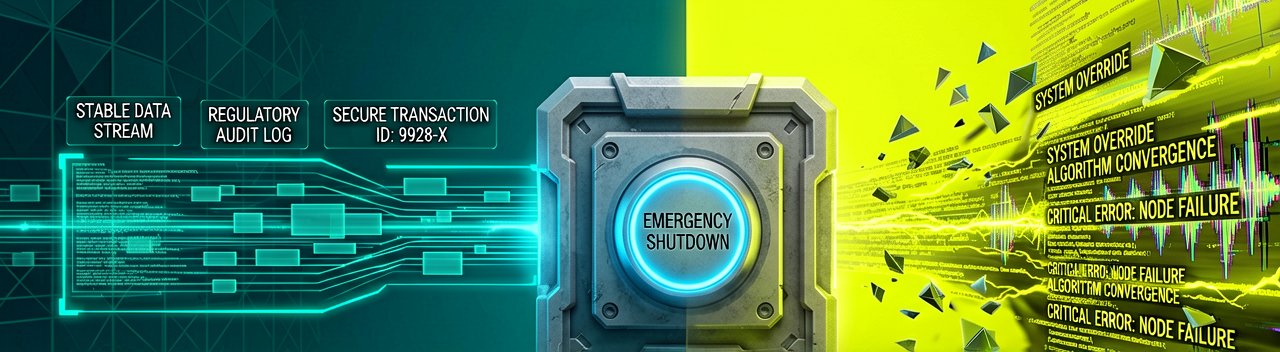
This escalating intervention represents a fundamental shift in how Washington polices financial technology. Instead of passing net-new statutory frameworks, regulators are demanding immediate, systemic changes under existing model risk management rules. Banking institutions are now being pushed by examiners to demonstrate clear data boundaries, verify vendor safety protocols, and prove the existence of human-controlled "kill switches" capable of instantly disabling malfunctioning automated systems. The era of unchecked operational experimentation has officially ended, giving way to a strict regime of human-in-the-loop accountability.
The Architecture of the Regulatory Crackdown
The current supervisory wave is built upon existing safety and soundness doctrines rather than novel legislative text. In April 2026, the OCC released updated model risk management guidelines via OCC Bulletin 2026-29, which explicitly recalibrated practices based on an institution's size and asset complexity. Crucially, that update noted that generative and agentic AI models fell outside traditional model boundaries. This deliberate exclusion set the stage for the current joint initiative by the OCC, Fed, and FDIC to issue a comprehensive request for information focused specifically on frontier, generative, and autonomous AI systems.
This targeted approach addresses acute anxieties surrounding deep systemic risks. Regulators are hyper-focused on how financial firms manage volatile, fast-evolving large language models. The primary threat vector cited by cybersecurity experts is the exploitation of inherited cyber vulnerabilities and data boundary enforcement failures. If an autonomous model improperly aggregates or derives insights from restricted, non-permitted consumer data siloed across multiple systems, it risks triggering severe privacy and fair-lending violations simultaneously.

Operational Impact and Strategic Re-alignment
The operational reality of these routine audits is forcing banks to fundamentally alter their software deployment roadmaps. Enterprise implementation is shifting away from generalized front-facing automation toward heavily audited, back-office workflows where risk can be contained. The financial impact of compliance remains an immense driver; U.S. institutions spend tens of billions annually on anti-money laundering (AML) operations, a friction point that modern AI tools can compress from days to mere minutes, as reported by Forbes . However, to pass regulatory muster, these deployments must maintain a strict firewall: the AI can read and recommend, but it cannot independently move money.
To survive this heightened scrutiny, financial institutions are implementing multi-layered governance frameworks that prioritize absolute explainability. Tech journalists and industry analysts observe that a defensible AI architecture in modern banking must meet five core operational criteria:
- Data Boundary Verification: Proving exactly which datasets an algorithmic model can access to prevent unauthorized cross-contamination of consumer information.
- Vendor and Subcontractor Audits: Mapping third-party supply chains to ensure outsourced AI models comply with federal security baselines.
- Explainable Decisioning Trails: Providing clear, auditable logs detailing how an underwriting or fraud model reached a specific output.
- Human-in-the-Loop Controls: Restricting autonomous decision-making by requiring certified human sign-off on all high-risk exceptions.
- Engineered Kill Switches: Maintaining verified, instantaneous system overrides to isolate and shut down rogue models during an operational anomaly.
The Geopolitical and Technical Frontier
The tension between fostering competitive technological innovation and enforcing rigid consumer safeguards is further complicated by the arrival of next-generation frontier AI models. Systems like Anthropic's frontier model, Mythos, are pushing the boundaries of what financial institutions can deploy, while simultaneously expanding the systemic attack surface for sophisticated fraud and deepfake schemes, per documentation from The Globe and Mail. The federal government's response has been to leverage high-level oversight; the Treasury Department is actively analyzing these frontier tools to establish unified cyber-resilience benchmarks across the market.
For executive leadership within the banking sector, the path forward requires abandoning the wait-and-see approach to AI compliance. Regulators are no longer merely investigating theoretical algorithmic bias; they are auditing active production environments during standard exams. The institutions that succeed will be those that treat robust compliance governance not as a late-stage hurdle, but as a core architectural requirement embedded into the very software development lifecycle of their financial systems.
Behind the Scenes of the Algorithmic Audit
What Most Reports Miss: The true bottleneck in the current regulatory crackdown is not a lack of institutional will, but a profound talent deficit inside the regulatory agencies themselves. Bank examiners accustomed to auditing spreadsheet-based credit models and historical transaction ledgers are now tasked with evaluating dynamic neural networks and self-evolving agentic workflows. To bridge this technical gap, federal agencies are quietly embedding specialized data scientists directly into standard examination teams, shifting the nature of an audit from a checklist exercise into a highly technical, adversarial code review.
This technical disparity has triggered intense friction between chief risk officers and federal field examiners. In closed-door industry forums, banking executives express growing frustration over the lack of a standardized definition for "explainability" in automated systems. While a bank might argue that its credit-scoring model is defensible because its feature weights are transparent, an OCC or Federal Reserve examiner may reject the deployment if the underlying data pipelines cannot definitively prove they are immune to drift or proxy-variable discrimination. The resulting standoff is stalling multi-million-dollar software rollouts across Tier-1 institutions, turning compliance from a back-office formality into a critical operational bottleneck.
Historically, the financial sector has weathered similar regulatory friction during the transition to algorithmic high-frequency trading in the late 2000s and the subsequent implementation of Dodd-Frank stress testing. However, the non-deterministic nature of generative systems presents an entirely new structural challenge. Under legacy model risk management doctrines, a model's outputs must be entirely reproducible given a specific set of inputs. Because advanced large language models do not adhere to this strict determinism, banks are being forced to build elaborate, parallel validation engines whose sole purpose is to constantly test, simulate, and bound the behavior of the primary system before its outputs reach a human operator.
The strategic consequence of this rigid supervisory environment is a growing divide in the banking ecosystem. While global systemically important banks possess the capital to build massive internal compliance walls and dedicated AI safety laboratories, regional and community institutions are increasingly frozen out of the innovation curve. Lacking the resources to independently audit complex vendor models, these smaller firms are trapped between the operational necessity of reducing overhead through automation and the acute threat of regulatory sanctions if a turnkey, third-party system fails an unexpected federal examination.
Reading Between the Lines: The Illusion of Algorithmic Safety
Reading Between the Lines: The prevailing consensus among Washington oversight bodies assumes that stricter human oversight and engineered "kill switches" will effectively insulate the financial system from algorithmic catastrophe. This stance, however, overlooks a fundamental psychological reality of modern corporate operations: automation bias. In practice, when a bank mandates that a human operator review thousands of automated anti-money laundering alerts or credit evaluations every day, the human supervisor rapidly transforms into a rubber-stamping mechanism. The regulatory demand for a "human-in-the-loop" frequently creates an illusion of control, masking a system where fallible operators simply ratify the opaque decisions of complex software.
A glaring contradiction lies at the heart of current regulatory strategy. Federal agencies are leveraging legacy risk doctrines to force artificial intelligence into the predictable box of traditional statistical modeling, while simultaneously acknowledging that generative and autonomous tools operate outside those boundaries. Examiners demand absolute mathematical reproducibility from systems that are inherently probabilistic and dynamic. By forcing financial institutions to constrain next-generation workflows within rigid, decades-old compliance structures, regulators risk incentivizing banks to sanitize their tech stacks superficially, optimizing for audit checkboxes rather than building the dynamic, real-time observability tools truly required to monitor live code.
Furthermore, the intensifying scrutiny from the OCC and the Federal Reserve will likely trigger an unintended migration of systemic risk. As Tier-1 institutions pull back from deploying advanced automation in their front-facing consumer operations to evade regulatory friction, unregulated shadow banking entities and non-bank lenders are moving aggressively to fill the void. These digital-native firms operate under significantly lighter supervisory oversight, enabling them to deploy unvetted underwriting and collection algorithms with minimal friction. Consequently, Washington’s aggressive posture with traditional banks may inadvertently push the most volatile financial technologies deeper into the opaque, under-regulated corners of the broader financial ecosystem.
Ultimately, the escalating regulatory arms race risks cementing a permanent competitive advantage for tech-adjacent financial conglomerates while stifling genuine domestic innovation. If the administrative cost of deploying a single machine-learning model requires an ongoing, multi-million-dollar forensic audit, only the absolute largest market players will survive the transition. Instead of fostering a safer, more transparent financial landscape, the current regulatory approach threatens to calcify the banking sector into a hyper-consolidated landscape where technological progress is dictated entirely by an institution's capacity to absorb the soaring overhead of defensive compliance engineering.
"We are rapidly approaching a compliance paradigm where a bank's most sophisticated artificial intelligence will be tasked solely with writing exhaustive reports to appease an equally sophisticated regulatory algorithm—leaving humans entirely out of the loop of understanding why the money moved in the first place."
Artūras Malašauskas is an AI Systems Integrator with 20+ years of production-grade web engineering experience. He has designed, shipped, and scaled enterprise Python/PHP systems for logistics, SaaS, and public-sector clients. For the past year, he has focused exclusively on AI integrations: deploying open-source LLMs, building generative media pipelines (image, audio, video), and engineering multi-agent workflows for real production environments. His standard: reproducibility, security, cost-efficient inference—no vaporware. He documents and evaluates emerging AI tooling, separating verified capabilities from marketing noise. Technical editor at: muza-ai.eu, ai-verslas.lt, ai-naujinos.lt Connect on LinkedIn
Comments