Stadium Security AI: Shift to Crowd Behavior Analysis Redefines Public Safety Standards
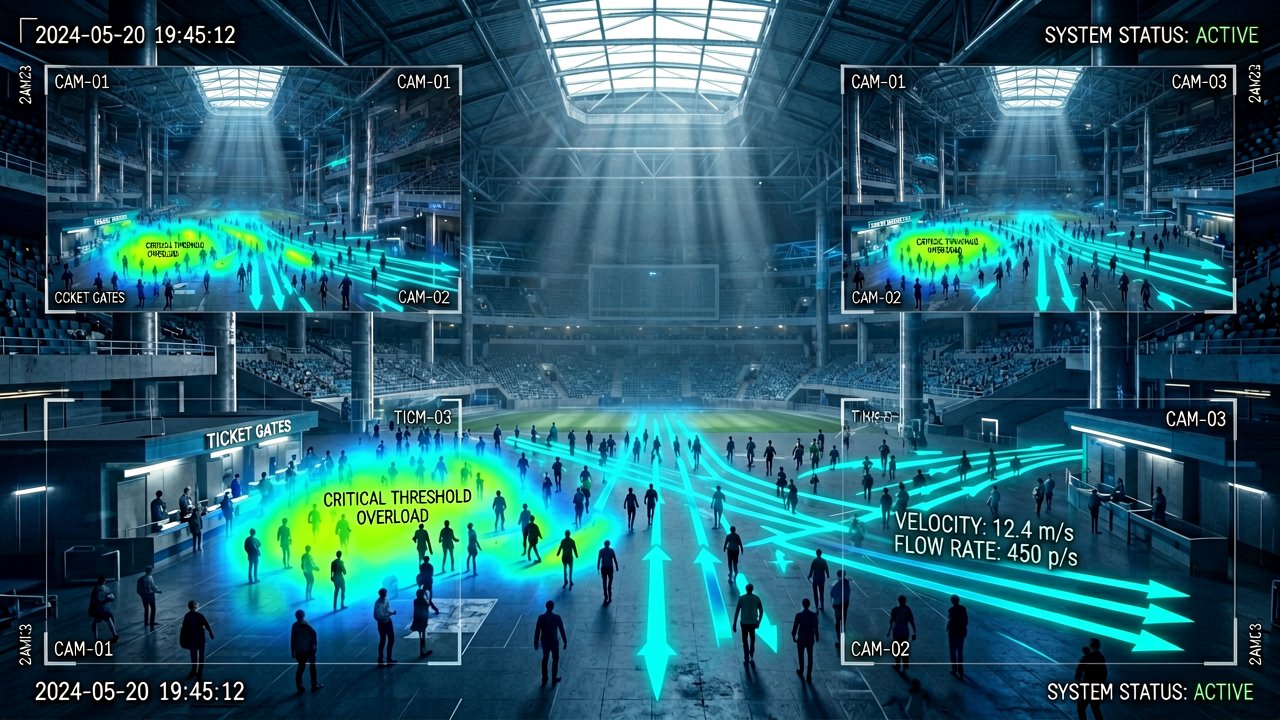
The global security paradigm for high-density public venues is undergoing a fundamental transformation. Legacy surveillance models, which traditionally relied on human operators to identify active threats or review post-incident footage, are being replaced by autonomous systems. Modern deployment strategies now require software infrastructures to dynamically evaluate environmental variables, transforming standard cameras into proactive security assets. This technological evolution marks a definitive transition from reactive threat isolation to comprehensive, real-time crowd dynamics management.
Industry consensus highlights a critical market demand for software that interprets spatial data alongside historical operational metrics. According to market analysis shared by Stock Titan, the institutional focus within public safety has rapidly pivoted toward predictive analytics to mitigate operational bottlenecks before they manifest. Rather than simply scanning for prohibited items, next-generation AI architectures are engineered to decipher the collective fluid mechanics of thousands of moving individuals simultaneously.
This operational maturity is driven by sophisticated video content analytics capable of granular tracking across complex layouts. As detailed by deployment specialists at Ipsotek, these platforms map foot traffic velocity, regional density thresholds, and automated anomaly detection across concourses, ticketing gates, and exit corridors. By monitoring precise variables—such as flagging when localized densities approach critical safety margins—stadium operators can execute preemptive protocols, including automated fan re-routing and staggered access control, to ensure structural safety and optimal crowd flow.
Predictive Analytics Over Reactive Threat Detection
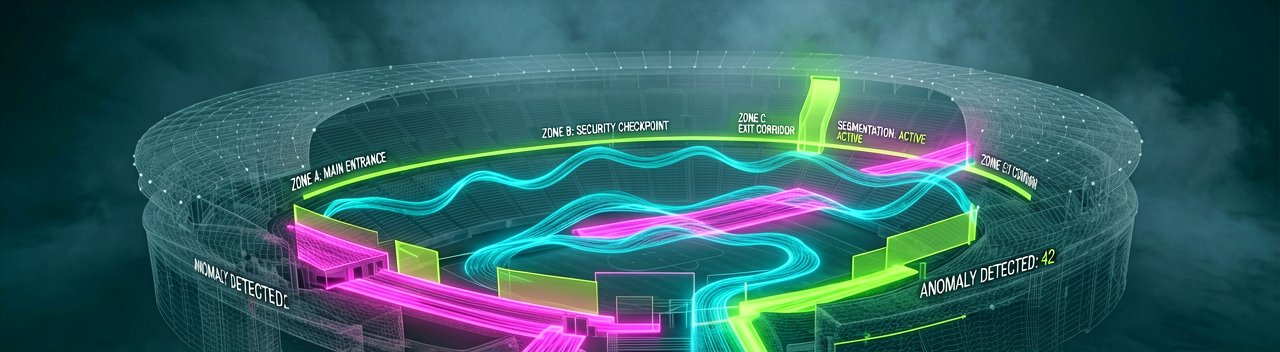
The primary value proposition of behavioral AI lies in its ability to calculate risk probabilities in real time. Advanced machine learning scripts process live multi-camera feeds to differentiate between standard high-volume movement, such as a localized post-game surge, and dangerous architectural bottlenecks. By layering historical attendance records, real-time ticketing velocities, and spatial segmentation, these deep learning frameworks project crowd behaviors minutes before physical congestion peaks. This foresight allows security commanders to reallocate field personnel dynamically, preventing localized crowd crushes and optimizing overall venue safety pipelines.
Advanced Behavioral Profiling and Flow Management
Beyond simple density monitoring, modern computer vision platforms leverage motion-tracking and pose-estimation algorithms to detect behavioral disruptions. System integrations allow security networks to cross-examine rapid structural shifts, such as sudden counter-flow movements or localized velocity changes that indicate panic or altercation. Furthermore, integrating these behavioral models with automated access control systems ensures that transit infrastructure, turnstiles, and emergency exit routes adapt fluidly to live conditions. This holistic data-driven methodology eliminates human latency, setting a new baseline for global public safety standards in massive entertainment spaces.
Architectural Realities and the Engineering of Fluid Spaces
Beneath the Operational Surface: The integration of behavioral AI into modern venue infrastructure is fundamentally changing how stadiums are designed, constructed, and monetized. For decades, structural engineering relied on static math and peak-load estimates to build concourses, stairwells, and emergency exits. Today, architectural firms collaborate with data scientists to run millions of simulated crowd-flow variations before a single cubic yard of concrete is poured. By injecting algorithmic intelligence into the physical footprint, venues are transitioning from rigid physical enclosures into fluid, adaptive environments capable of responding dynamically to localized structural pressures.
This integration of software and steel redefines the standard lifecycle of public safety operations. Legacy infrastructure often suffered from a visibility paradox, where security teams only recognized a choke point after it became a physical bottleneck. Advanced spatial computing systems solve this by establishing a digital twin of the entire footprint, continuously cross-referencing real-time camera feeds against mathematical models of fluid dynamics. When an artificial intelligence model flags an anomalous density spike at a specific gate, the response is no longer just a dispatch of physical personnel, but a systemic adjustments of digital signage, automated turnstile velocities, and perimeter access paths to naturally diffuse the pressure.
The financial and logistical stakeholders driving these deployments extend far beyond internal security departments. Insurance conglomerates and global underwriting syndicates are beginning to scrutinize a venue’s predictive analytics capabilities when calculating liability premiums for massive public events. A stadium equipped with audited, closed-loop behavioral AI systems presents a significantly lower risk profile for catastrophic crowd events, allowing operators to secure more favorable operational terms. Simultaneously, concessions vendors and retail partners leverage the underlying flow data to maximize commercial throughput, positioning security infrastructure as a direct contributor to venue profitability.
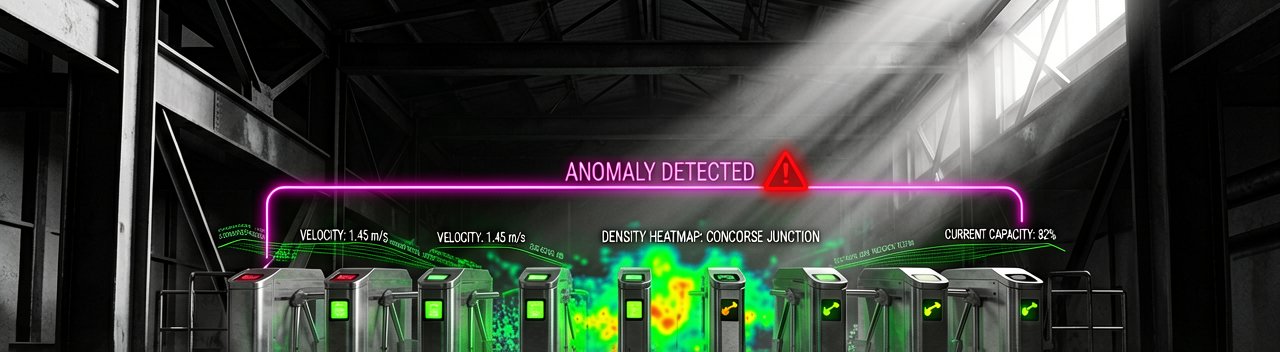
However, the rapid transition to predictive behavioral tracking introduces complex socio-technical challenges that seasoned field engineers must navigate. Distinguishing between a high-energy celebratory surge and the early stages of a panic-driven crowd crush requires hyper-calibrated machine learning models that account for cultural variations, event types, and regional fan behaviors. Furthermore, compliance with evolving international data privacy frameworks requires that these computer vision systems operate strictly on vectorized spatial patterns and anonymous telemetry rather than individualized facial recognition. The future of public safety relies on maintaining this delicate equilibrium between maximizing situational awareness and upholding strict ethical data standards.
The Friction Between Automated Oversight and Human Volatility
Reading Between the Lines: The industry's rush toward algorithmic crowd management operates on a comforting but fundamentally flawed premise: that human crowds behave like predictable physical fluids. While fluid mechanics formulas can accurately model water rushing through a pipe, they frequently break down when applied to thousands of autonomous individuals influenced by alcohol, tribal sports rivalries, and sudden atmospheric changes. By treating human behavior as a series of predictable telemetry points, venue operators risk over-relying on automated risk-scoring models that look flawless on a control room dashboard but fail to account for the chaotic, irrational nature of real-world panics.
This reliance introduces a dangerous paradox where the presence of advanced predictive systems may actually slow down critical human intervention. When security commanders begin deferring to algorithmic confidence intervals, the traditional, intuition-based decisions of seasoned field personnel are frequently sidelined. If an AI platform fails to register a localized dispute because the participants' physical postures do not match pre-programmed anomaly profiles, a dangerous situation can escalate long before a digital alert is triggered. The industry faces an underlying vulnerability where technical complacency replaces active, human situational awareness.
Furthermore, the commercialization of public safety data creates a profound conflict of interest within venue operations. The exact same computer vision pipelines used to identify safety risks are simultaneously being pitched to corporate stakeholders as tools to optimize retail engagement, analyze fan dwell times, and maximize concession sales. When the boundary between automated safety enforcement and aggressive monetization blurs, public trust erodes. Stadium operators risk transforming their security infrastructure into a mechanism for corporate surveillance, ultimately alienating the very public they are tasked with protecting.
The long-term regulatory outlook suggests a looming reckoning for automated behavioral modeling in public spaces. As international legal frameworks increasingly restrict the use of automated profiling in public spheres, the defense that these systems are strictly "anonymous telemetry" will face intense judicial scrutiny. If a predictive routing decision inadvertently funnels a crowd into a secondary bottleneck, establishing legal liability between the software developers, the venue operators, and the automated triggers will become an operational nightmare. The future of stadium safety will not be a seamless, friction-free utopia of automated order, but a continuous compromise between technological capability, legal boundaries, and unpredictable human behavior.
The supreme irony of the modern smart stadium is that after spending tens of millions of dollars on predictive algorithms, deep learning models, and automated response systems, the ultimate success of the entire public safety apparatus still hinges on a nineteen-year-old usher convincing five hundred heavily refreshed fans that walking toward Exit B is a thoroughly splendid idea.
Artūras Malašauskas is an AI Systems Integrator with 20+ years of production-grade web engineering experience. He has designed, shipped, and scaled enterprise Python/PHP systems for logistics, SaaS, and public-sector clients. For the past year, he has focused exclusively on AI integrations: deploying open-source LLMs, building generative media pipelines (image, audio, video), and engineering multi-agent workflows for real production environments. His standard: reproducibility, security, cost-efficient inference—no vaporware. He documents and evaluates emerging AI tooling, separating verified capabilities from marketing noise. Technical editor at: muza-ai.eu, ai-verslas.lt, ai-naujinos.lt Connect on LinkedIn
Comments