From Brief to Blueprint: Decoding Function2Scene’s Human-Centric Approach to 3D Indoor Layouts

Most AI-driven text-to-3D generators operate like hyperactive decorators hoarding furniture. They read a prompt for a "modern living room" and dutifully dump a couch, a coffee table, and an assortment of plant meshes into a digital sandbox, completely ignoring how an actual human being moves or breathes within a physical space. arXiv documentation reveals a paradigm shift in how neural networks tackle architectural spatial planning. Dubbed Function2Scene, this framework abandons typical object-centric generation in favor of functional design briefs, translating a natural-language description of who will use a room and what they intend to do there into an ergonomically optimized 3D environment.
Instead of relying on a large language model to spit out a flawless 3D coordinate map on its first attempt—a strategy that usually yields clipping geometries and inaccessible doorways—the system implements an intricate, multi-layered architecture. It begins by extracting occupant personas and distinct activities directly from a user's natural-language brief. These parameters are then mapped across a comprehensive taxonomy of 17 distinct design criteria encompassing spatial layout, ergonomics, activity flows, and environmental variables. It is a highly systemic approach that turns abstract programmatic human needs into rigid geometric targets.
The Tool-Augmented Check-and-Repair Pipeline
The operational engine powering this breakthrough relies on a tool-augmented check-and-repair loop rather than single-shot inference. First, an underlying generative model sets up an initial baseline layout. The pipeline then executes a meticulous cycle of evaluation using three specialized modalities: precise geometric measurements to catch physical intersections, LLM-based contextual reasoning to ensure logical object placement, and Vision-Language Model visual assessments to judge the holistic flow of the scene. If an armchair blocks a pathway or a desk faces away from ambient light, the loop triggers targeted corrections, refining the spatial coordinates until the layout satisfies the constraints of the design taxonomy.
When stacked against contemporary generative baselines, the performance metrics reveal just how effectively this structural feedback loop bridges the gap between chaotic clutter and actual interior design. In user studies involving 30 professionally written interior-design test cases highlighted by GameDev.net , scenes generated by this new methodology were preferred in an overwhelming 94.3% of pairwise comparisons against existing LLM-driven pipelines. By forcing the AI to evaluate spatial logic through an explicit behavioral framework, the system drastically cuts down on the nonsensical object clustering that has historically plagued procedural world generation.

Broadening the Horizon for Virtual Environments
For game developers and architectural visualizers, the implications of this structural pipeline stretch far beyond automated furniture placement. It offers a scalable solution to the perpetual bottleneck of virtual world building by letting creators build expansive, functional interior spaces via high-level systemic parameters rather than placing assets piece by piece. As these multi-model validation pipelines continue to mature, the focus of generative scene design will fundamentally pivot from merely populating a room with visually plausible geometry to algorithmically engineering spaces engineered explicitly for human interaction.
Behind the Scenes: Architectural Underpinnings of Spatial Optimization
Behind the Scenes: Translating an abstract functional spec into a structurally sound 3D coordinate map requires moving past typical token-prediction mechanics. At the systems level, the framework converts raw text into a strict parametric schema. The underlying architecture treats room generation not as a pixel-clustering exercise, but as a constrained optimization problem. By parsing natural language into explicit geometric boundary conditions, the system maps out strict clearance zones, operational vectors, and spatial hierarchies before a single mesh is ever instantiated in memory.
To prevent the massive computational overhead associated with traditional physics engines, the check-and-repair pipeline utilizes a highly optimized bounding-box evaluation matrix. Instead of running heavy per-poly collision checks during the initial layout phase, objects are abstracted into oriented bounding boxes (OBBs) defined by concise center-point, extent, and rotation matrices. A specialized geometric evaluation thread runs parallel cross-intersection algorithms, catching clipping errors and calculating spatial proximity metrics in milliseconds, which allows the system to execute dozens of repair iterations without bottlenecking the main generation pipeline.
The true engineering feat lies in how the framework anchors contextual logic to these geometric bounds through a dual-stage reasoning matrix. While the geometric evaluator handles physical boundaries, a lightweight Vision-Language Model handles semantic relationships by assessing layout topology against a pre-compiled architectural graph. This graph dictates logical object pairings—such as ensuring a task chair is oriented precisely relative to a desk's primary surface. If a mismatch occurs, the system calculates a correction vector, translating abstract design critiques into precise spatial transformations that adjust the asset's transform properties.
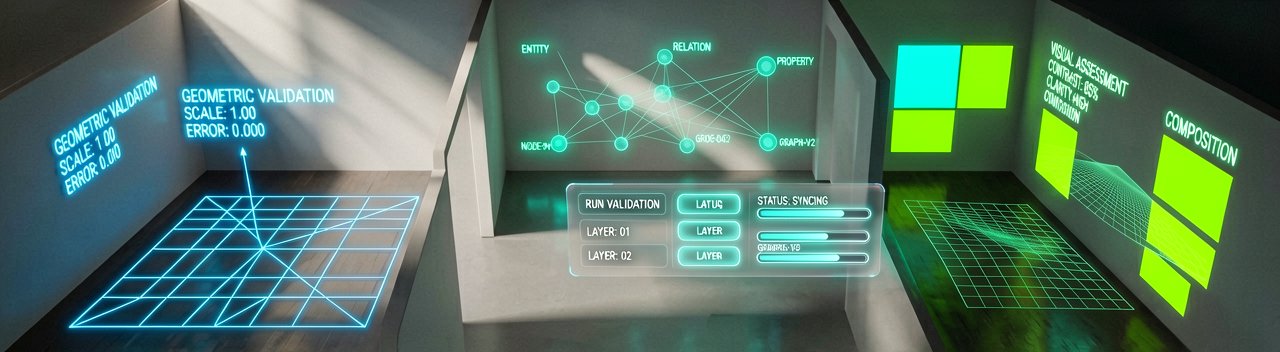
This automated validation loop eliminates the manual edge-case scripting that traditionally bogs down procedural asset placement. By delegating structural evaluation to specialized local tools rather than relying entirely on a massive, slow-parameter model, the framework optimizes runtime efficiency and system throughput. The result is a highly reliable spatial pipeline capable of generating complex, human-centric layouts that adhere to real-world architectural standards, providing systems engineers with a predictable and deterministic blueprint for automated environment design.
Reading Between the Lines: The Reality of Algorithmic Ergonomics
Reading Between the Lines: While a 94.3% preference rate makes for an impressive headline, it glosses over the inherent friction between systemic architectural logic and the chaotic reality of human behavior. The framework operates on the idealistic assumption that human utility can be fully mapped across 17 distinct design criteria. In practice, architectural spaces are rarely defined by such tidy, mathematical optimization. By leaning so heavily on a standardized design taxonomy, the system risks producing sterile, overly rationalized environments that lack the idiosyncratic charm, historical layering, and accidental design choices that make real-world spaces feel genuinely lived-in.
Furthermore, evaluating spatial flow through the dual lenses of geometric bounding boxes and vision-language validation introduces a glaring systemic contradiction. The pipeline relies on a vision model to judge human-centric layout flow, yet the model itself possesses no actual physical presence or spatial awareness. It merely mimics architectural consensus based on its training data. This creates an echo chamber of design, where the AI optimizes rooms to look like the polished, highly staged interior photography found across the web, rather than configuring them for the messy, unpredictable ways people actually move through a physical home.
From an infrastructure standpoint, the tool-augmented check-and-repair loop shifts the computational bottleneck rather than completely eliminating it. Swapping out a massive, single-shot language model for a frantic cycle of localized geometric checks, semantic graph evaluations, and vision assessments introduces a complex web of multi-modal dependencies. In a production pipeline, this iterative repair loop could easily stall when confronted with highly irregular room geometry or conflicting design briefs. If the layout logic gets trapped in an infinite loop trying to reconcile a tiny studio apartment footprint with a high-end luxury specification, the automated system becomes just as tedious to debug as traditional procedural generation systems.
Ultimately, treating interior design as a closed-loop optimization problem exposes the current limits of generative spatial AI. The technology undoubtedly excels at handling the mundane, mechanical baseline of world building—such as keeping chairs from clipping through desks or ensuring doorways remain clear. However, by substituting rigid, algorithmic compliance for true creative intuition, it threatens to turn game environments and architectural layouts into a monoculture of hyper-optimized predictability, proving that while AI can easily calculate the math of a room, it still struggles to capture its soul.
"Automating interior design is a triumph of engineering right up until the system perfectly optimizes a living room for human efficiency, forgetting that the primary human activity in a living room is collapsing onto a couch in a shape that defies all known laws of ergonomics."
Artūras Malašauskas is an AI Systems Integrator with 20+ years of production-grade web engineering experience. He has designed, shipped, and scaled enterprise Python/PHP systems for logistics, SaaS, and public-sector clients. For the past year, he has focused exclusively on AI integrations: deploying open-source LLMs, building generative media pipelines (image, audio, video), and engineering multi-agent workflows for real production environments. His standard: reproducibility, security, cost-efficient inference—no vaporware. He documents and evaluates emerging AI tooling, separating verified capabilities from marketing noise. Technical editor at: muza-ai.eu, ai-verslas.lt, ai-naujinos.lt Connect on LinkedIn
Comments