Intel Puts Agentic AI to Work with Xeon 6+ Infrastructure
Intel kicked off its Computex keynote by making its highly anticipated Xeon 6+ processor family official. The new silicon targets the demands of cloud-native systems and agentic AI infrastructure, shifting the focus away from traditional large model training toward efficient, real-world data orchestration. It represents a bold data center play by the company, framing the CPU as the essential controller that directs modern AI reasoning and data movement.
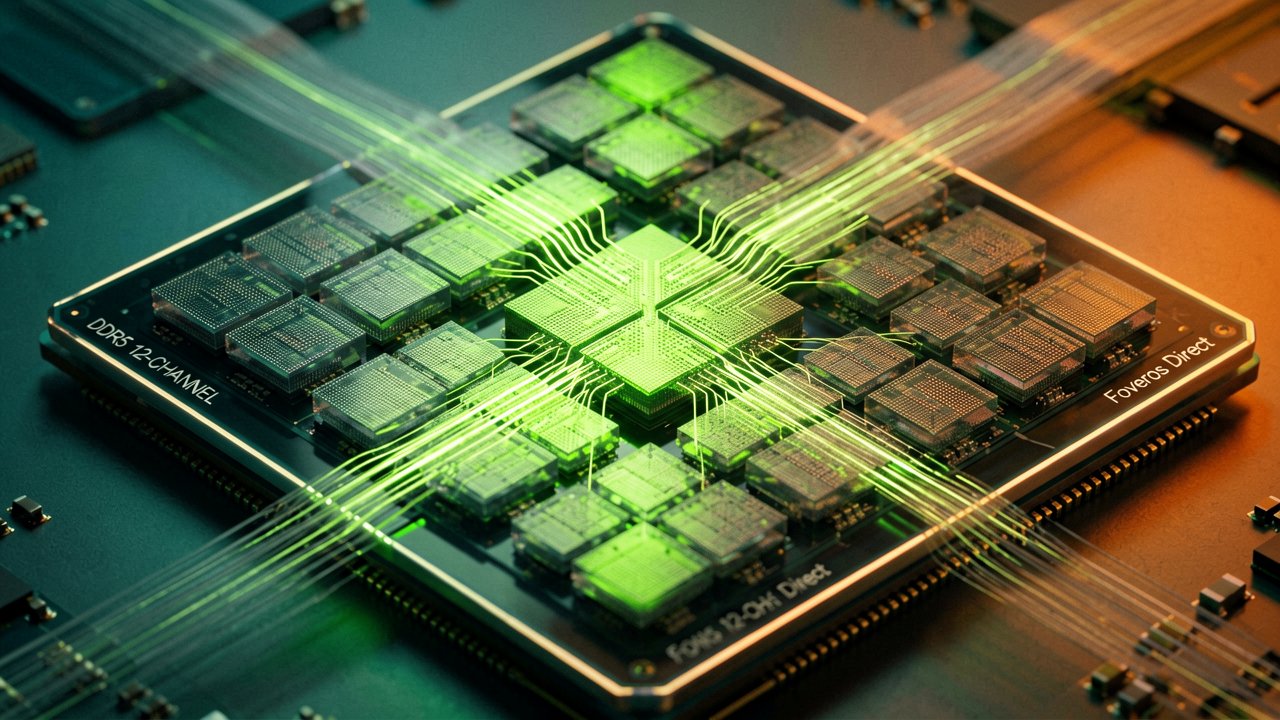
The standout feature of this release is Intel's manufacturing shift, as the chipmaker confirmed the Xeon 6+ is the first data center CPU built on its cutting-edge Intel 18A process node. To push density limits even further, the platform leverages Foveros Direct 3D advanced packaging technology. This technical foundation allows the flagship 6990E+ SKU to pack a massive 288 efficient cores based on the new Darkmont architecture, alongside 576 MB of last-level cache to eliminate data delivery bottlenecks.
Performance Density and Architectural Scaling
Intel designed the platform specifically for power-constrained server environments, emphasizing scale-out performance density over brute force clock speeds. According to documentation shared by Intel Newsroom , a single liquid-cooled rack packed with these new processors can scale up to 36,864 cores within 32U of compute space. This massive density configuration operates at roughly 100 kilowatts of rack-level power, allowing enterprises to maximize their footprint without requiring a total redesign of their existing electrical infrastructure.
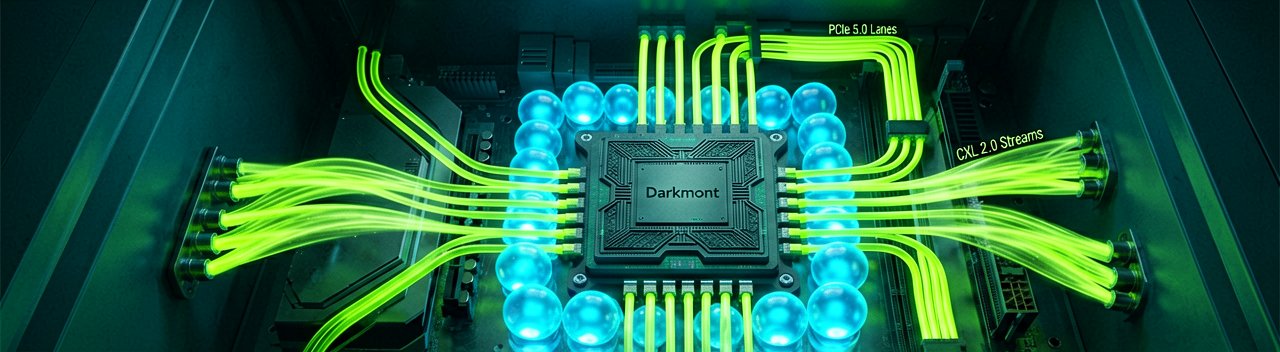
On the memory and connectivity front, the processors bring 12-channel DDR5 support running at speeds up to 8000 MT/s, paired with 96 PCIe 5.0 lanes and 64 CXL 2.0 lanes. This massive boost in bandwidth translates directly to a claimed 48% greater performance per watt compared to Intel's previous generation of efficient server chips. Furthermore, early evaluation metrics suggest that the platform delivers up to 30% higher performance per thread than competing hardware, giving cloud providers a path to squeeze more value out of every watt.
Eliminating Data Center Bottlenecks
To ensure the new processors do not choke on network traffic, Intel also debuted the 800 Series Ethernet portfolio alongside the main chip launch. The new Intel Ethernet E835 controllers and adapters scale up to 200GbE bandwidth, designed explicitly to remove networking bottlenecks in dense AI clusters. Internal testing highlights significant efficiency gains, with the E835 pulling roughly 47% lower power than NVIDIA ConnectX-6 DX alternatives and 80% lower power than competing Broadcom hardware at line rate under bidirectional load.
Ecosystem partners like HPE, Dell Technologies, Lenovo, and Supermicro are already configuring systems based on the new platform. By distributing heavy AI workloads across a mature x86 environment, Intel is banking on seamless software compatibility to win back enterprise customers weary of proprietary hardware lock-ins. The architecture presents a highly dense foundation for organizations rushing to deploy real-time AI agents without blowing through their data center energy budgets.
The Reality Behind the Silicon Shift
Reading Between the Lines: Intel’s aggressive pivot toward massive core counts reveals a critical admission about the state of modern data centers. For years, the chipmaker chased raw single-threaded velocity, but the thermal realities of generative AI and agentic orchestration have shattered that playbook. By packing 288 Darkmont efficient cores onto its 18A node, Intel isn't just offering a performance upgrade; it is actively retreating from the power-hungry, high-clock-speed race to prevent data center racks from literally melting down under load.
Yet, this architectural transition introduces a glaring contradiction in Intel's broader enterprise strategy. While the marketing materials loudly champion the Xeon 6+ as an AI powerhouse, E-cores are inherently stripped of the heavy matrix-multiplication blocks found in high-performance silicon. This design choice means that while the processor excels at juggling thousands of micro-services and micro-agents simultaneously, it remains fundamentally unsuited for heavy LLM training or high-throughput deep learning inference. The industry is being asked to buy into an AI processor that requires external accelerators the moment the math gets truly heavy.

Furthermore, relying on the unproven 18A process node combined with complex Foveros Direct 3D packaging is a massive gamble for a company struggling to stabilize its manufacturing timeline. Deploying a disaggregated, multi-die architecture across dozens of compute tiles introduces substantial latency penalties when data must traverse the interconnect fabric. If the on-die scheduling firmware fails to properly localize cache hits, the promised 48% efficiency gains will quickly evaporate into interconnect overhead. Enterprise buyers, burned by past execution delays, are entirely justified in waiting for independent, real-world stress tests before ripping out their existing, stable infrastructure.
The long-term industry implications also highlight a growing fragmentation in the server market. By focusing so heavily on scale-out density to counter AMD’s EPYC momentum, Intel risks alienating legacy enterprise workloads that still rely on high single-threaded performance. Cloud service providers will certainly appreciate the ability to carve up 288 cores into thousands of cheap virtual machines, but traditional IT departments may find themselves forced into a complex architectural migration they never actually wanted, all just to keep up with the industry's frantic, AI-fueled marketing cycle.
A Shift in Enterprise Strategy
This pivot ultimately signals that the x86 duopoly is no longer just fighting each other; they are collectively fighting for survival against an onslaught of custom ARM-based silicon deployed by hyperscalers. If Intel cannot convince the market that its high-density x86 architecture can match the power profiles of bespoke in-house chips, the data center crown will permanently slip away. The Xeon 6+ is an expensive, highly complex line in the sand meant to prove that legacy compatibility can still outmaneuver custom-tailored efficiency.
"We are officially entering the era where server rooms require the electrical budget of a small municipality, meaning the ultimate metric of silicon success is no longer how fast a chip can think, but whether it can do so without triggering a regional blackout."
Artūras Malašauskas is an AI Systems Integrator with 20+ years of production-grade web engineering experience. He has designed, shipped, and scaled enterprise Python/PHP systems for logistics, SaaS, and public-sector clients. For the past year, he has focused exclusively on AI integrations: deploying open-source LLMs, building generative media pipelines (image, audio, video), and engineering multi-agent workflows for real production environments. His standard: reproducibility, security, cost-efficient inference—no vaporware. He documents and evaluates emerging AI tooling, separating verified capabilities from marketing noise. Technical editor at: muza-ai.eu, ai-verslas.lt, ai-naujinos.lt Connect on LinkedIn
Comments