Silicon Unchained: Inside NVIDIA and Microsoft’s AI-First Windows PC Architecture
The consumer personal computer is undergoing its most radical architectural shakeup since the transition to multi-core processing. Rather than acting as mere passive clients renting cloud-based intelligence, local machines are evolving into autonomous, agentic entities. At the epicenter of this shift sits a deep engineering alliance between NVIDIA and Microsoft, a collaboration aimed squarely at shattering the data center bottleneck. By shifting the computational gravity of complex foundational models directly to the edge, they're rewiring the fundamental operating relationship between Windows and PC silicon.
For years, the industry leaned heavily on the cloud to execute complex generative tasks, accepting the penalties of network latency and data privacy risks. That compromise is no longer sustainable as software moves from passive chat interfaces to persistent, multi-step AI agents. Microsoft and NVIDIA recognized that a standard Neural Processing Unit (NPU) simply lacks the raw horsepower required for heavy agentic workloads. Their response is a combined hardware and software offensive designed to expose massive parallel computing pipelines directly to the Windows operating system core.
The Architecture of the Unified Superchip
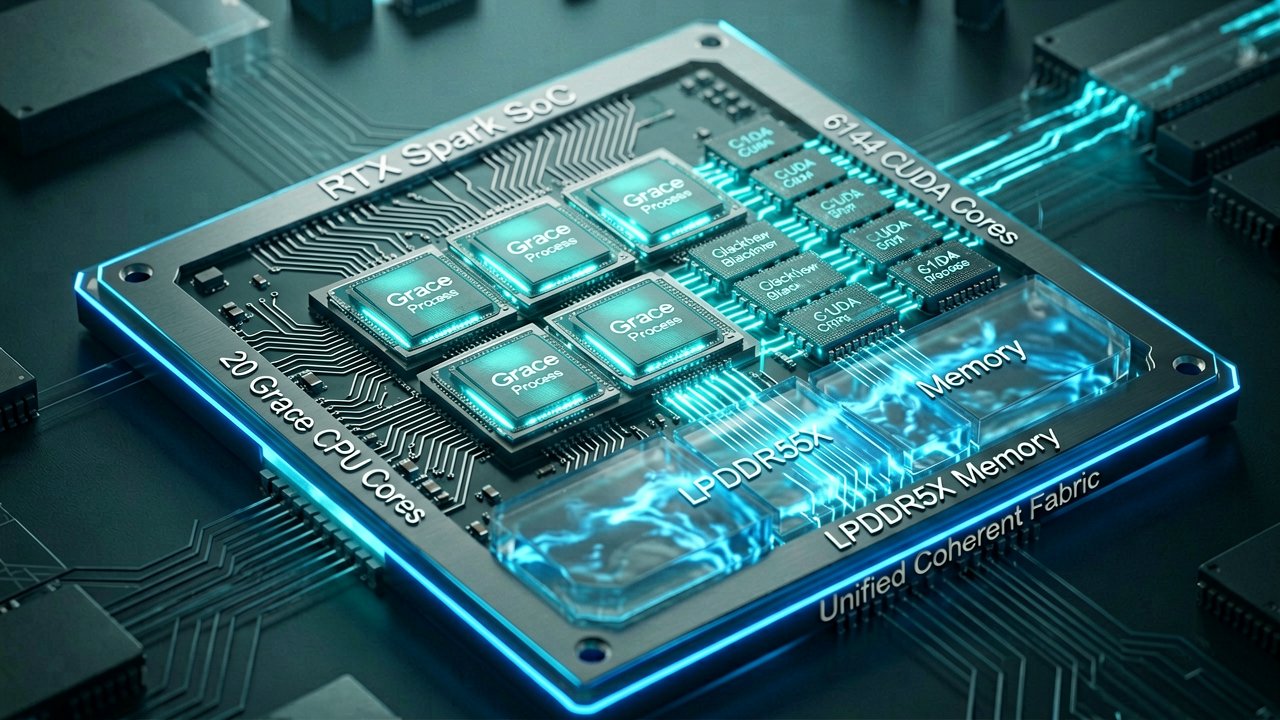
The physical manifestation of this strategy arrived with the unveiling of the NVIDIA RTX Spark, an ARM-based system-on-chip co-developed with MediaTek. This silicon collapses the traditional barriers of PC motherboard geometry. Instead of routing data across isolated pools of system RAM and dedicated graphics memory, the architecture integrates an ultra-efficient 20-core Grace CPU with a Blackwell-generation GPU packing 6,144 CUDA cores onto a single 3nm die. This design completely eliminates the PCIe bus bottleneck that has choked data transfers between processors for decades.
This physical unification enables a massive, shared pool of up to 128GB of LPDDR5X unified coherent memory. According to architectural deep dives by VentureBeat , Microsoft had to aggressively re-engineer the Windows memory management logic to exploit this architecture. The operating system now utilizes smarter page-size allocation and higher GPU system memory addressing ceilings. This allows large language models (LLMs) to reside completely within memory accessible by both the CPU and GPU simultaneously without resource starvation.
Bypassing the Cloud with Petaflop Performance
The performance dividends of this architectural shift are staggering, pushing consumer hardware into territory once reserved for server rooms. The hardware architecture unleashes a massive 1 petaflop of local AI performance. This allows premium laptops and developer hardware, like the Surface RTX Spark Dev Box, to execute workloads that would completely paralyze a mainstream thin-and-light PC. Local inference of 120-billion-parameter models can run with context windows scaling up to 1 million tokens, bypassing remote servers entirely.
Because processing stays local, applications can route inference requests directly to the Blackwell cores through the newly optimized Windows ML runtime. This approach bypasses external cloud APIs and drops latency down by an order of magnitude. Local inference runs between 10 to 50 times faster than round-tripping data to a cloud data center, offering immediate responsiveness. The economic math changes just as drastically, liberating developers and power users from recurring per-token subscription charges.
Software Integration and the Agentic Ecosystem
Hardware is only half the equation; the true magic happens within the software stack where Windows Copilot Runtime leverages native TensorRT for RTX execution providers. Data published on NVIDIA Developer indicates that this optimized inference library delivers a 50% performance improvement over standard DirectML. By adopting advanced FP4 quantization, the system compiles highly optimized inference engines in seconds, drastically accelerating complex diffusion and transformer models on consumer hardware.
To prevent these local agents from compromising the integrity of the operating system, the partnership introduces specialized software layers. A native runtime layer called NVIDIA OpenShell operates alongside new Windows security primitives to ensure autonomous workflows execute inside a hardened sandbox. Major creative suites are already pivoting to exploit this low-level access. Adobe is rearchitecting Photoshop and Premiere Pro from the ground up to achieve a doubling of AI and graphics performance, proving that this architecture is a massive leap forward for everyday consumer applications.
Behind the Scenes: The realization of a unified local AI architecture requires a fundamental rewriting of the Windows memory manager and kernel scheduler. Historically, Windows treated CPU and GPU memory spaces as discrete, isolated islands connected by a PCIe bus that introduced crushing latency overhead. For a systems engineer, loading an LLM meant copying model weights from system RAM over PCIe to VRAM, a process that stalled the pipeline during heavy context switching. The co-developed unified architecture bypasses this entirely by implementing a hardware-enforced coherent memory fabric where both processors address the same physical LPDDR5X space simultaneously.
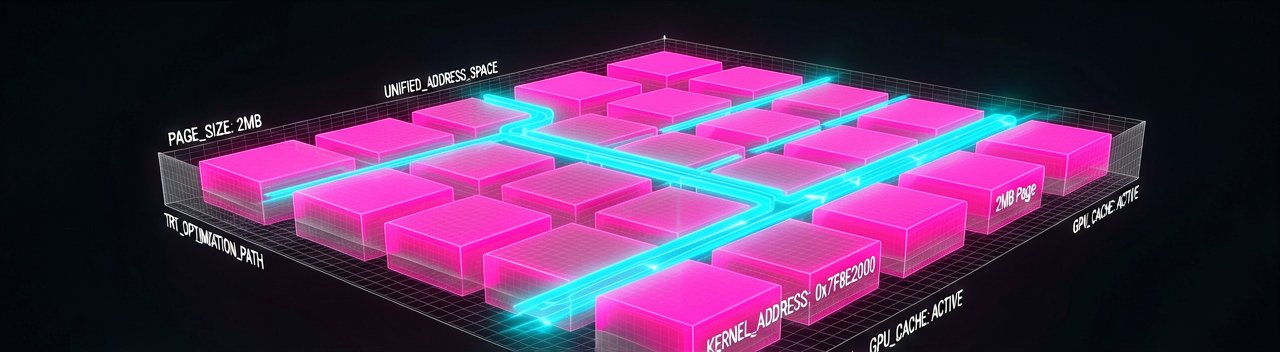
To prevent the operating system from thrashing under the weight of a massive transformer model, Microsoft introduces modified virtual memory allocation strategies at the NT kernel level. Traditional 4KB memory pages are highly inefficient for handling the gigabytes of dense matrix tensors required by generative models. The kernel now dynamically shifts to large-page allocations up to 2MB, reducing Translation Lookaside Buffer (TLB) misses on the CPU during inference prep. Furthermore, the operating system bypasses standard Windows I/O stacks by routing model files directly from NVMe storage to the unified memory pool using specialized DirectStorage extensions optimized for tensor data structures.
At the silicon execution layer, optimizing for the FP4 data format is critical to squeezing 1 petaflop out of consumer-grade thermal envelopes. Quantizing weights down to 4-bit floating-point precision allows the Blackwell tensor cores to double their effective math throughput compared to FP8, but it risks severe accuracy degradation if handled blindly. The TensorRT for RTX compiler solves this by implementing fine-grained, per-channel scaling factors during model compilation. Systems engineers can leverage hardware-accelerated decompression pipelines that unpack these highly compressed FP4 tensors directly inside the GPU registers, minimizing the memory bandwidth required to feed the execution units.
Low-Level Kernel Scheduling and Thread Prioritization
Scheduling autonomous AI agents introduces an entirely new problem: how to prevent a background text-generation model from stealing execution cycles from a user-facing 3D application or UI thread. The updated Windows Copilot Runtime addresses this by introducing a dual-priority compute queue within the graphics driver model. The hardware scheduler can preempt low-priority background inference jobs mid-compute cycle with sub-millisecond latency. This ensures that when a user interacts with the desktop, the GPU can instantly pivot to rendering frames, pausing the background LLM agent without losing its current state or throwing a memory exception.
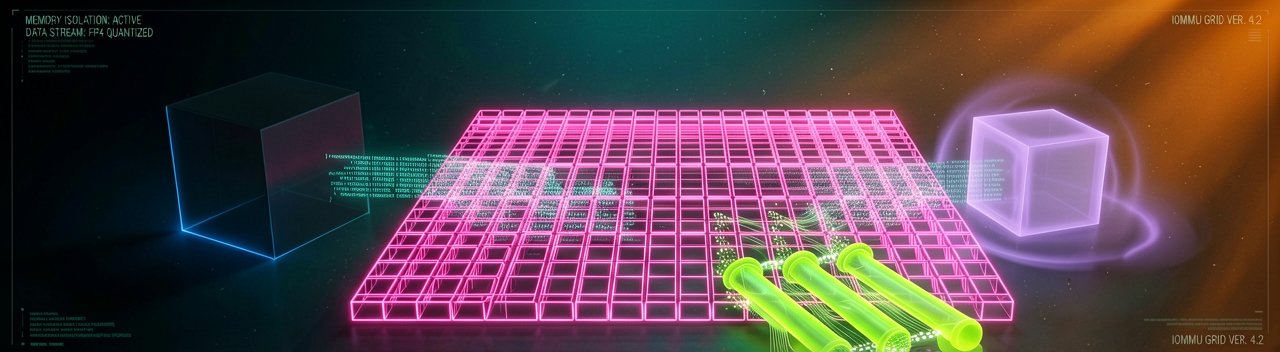
Finally, the security implications of giving autonomous local agents deep access to the file system required a complete overhaul of the Windows application sandbox. The NVIDIA OpenShell environment utilizes hardware-enforced virtualization to isolate the agent's inference engine from the core operating system kernel. Every memory address accessed by the agent during multi-step execution passes through a secondary Input-Output Memory Management Unit (IOMMU) layer. This strict hardware-level partitioning prevents prompt injection attacks or malicious model payloads from escaping their designated memory space and reading sensitive user data or modifying critical system binaries.
Reading Between the Lines: The industry’s rush toward localized 1-petaflop consumer architectures conveniently papers over a glaring contradiction in the tech ecosystem. While NVIDIA and Microsoft champion the democratization of hardware capable of running massive models on a laptop, developers are simultaneously shrinking those exact models to fit on mid-range smartphones. If a tightly quantized, 3-billion-parameter model running on a standard mobile chip can handle 90% of a user's daily automated tasks, the commercial viability of a power-hungry 128GB unified memory PC setup becomes harder to justify. The engineering achievement is undeniable, but it risks creating an architectural solution looking for a consumer problem.
There is also a massive friction point between the hardware’s theoretical capability and the messy reality of open-source software fragmentation. The current architecture relies entirely on the premise that developers will rebuild their applications around Windows ML and TensorRT for RTX execution providers. Yet, the vibrant AI research community remains deeply entrenched in the raw PyTorch ecosystem, which traditionally treats Windows as a secondary citizen compared to Linux. Forcing data scientists and independent software developers to hop through proprietary quantization hoops just to unlock local hardware optimization creates a barrier to entry that no marketing campaign can easily erase.
Furthermore, the promise of total data privacy through edge computing ignores how modern software monetization actually works. Both Microsoft and creative software giants have built their business models around recurring cloud subscriptions and data aggregation. Delivering true local autonomy means cutting the umbilical cord to the cloud, depriving these corporations of the very telemetry and processing data that fuels their broader corporate strategies. It is highly likely that "local" processing will eventually morph into a hybrid model, where the local chip does the heavy lifting but a cloud gatekeeper still demands authentication, undermining the idealistic vision of an unchained, private workstation.
The Realities of Thermal Envelopes and Power Draw
From a hardware engineering standpoint, shoving Blackwell-class silicon and 6,144 CUDA cores into premium, ultra-thin laptop chassis introduces severe thermal compromises. A silicon die capable of outputting a petaflop of compute inherently demands a massive power draw under peak load. While the 3nm node and ARM architecture mitigate some efficiency concerns, sustained local inference tasks will inevitably trigger aggressive thermal throttling, shrinking that pristine theoretical performance down to fractions of its promised speed during extended workloads.
Ultimately, this architectural shift moves the bottleneck from the network card to the battery cell. Users buying into this revolution under the assumption that they can run continuous, background agentic workflows on the go will quickly find themselves tethered to a wall outlet. Until battery chemistry undergoes a parallel revolution, the vision of a truly untethered, local AI powerhouse will remain confined to high-end developer desktop blocks and beefy, desktop-replacement laptops that stretch the definition of portability.
The tech industry spent a decade convincing us that the cloud was the answer to every computational limitation, only to pivot and declare that your laptop now needs the power consumption of a small server room just to help you write an email. Progress, it seems, is measured in how quickly we can reinvent the mainframe.
Artūras Malašauskas is an AI Systems Integrator with 20+ years of production-grade web engineering experience. He has designed, shipped, and scaled enterprise Python/PHP systems for logistics, SaaS, and public-sector clients. For the past year, he has focused exclusively on AI integrations: deploying open-source LLMs, building generative media pipelines (image, audio, video), and engineering multi-agent workflows for real production environments. His standard: reproducibility, security, cost-efficient inference—no vaporware. He documents and evaluates emerging AI tooling, separating verified capabilities from marketing noise. Technical editor at: muza-ai.eu, ai-verslas.lt, ai-naujinos.lt Connect on LinkedIn
Comments