The AMD Gambit: Zyphra’s $500 Million Bet to Break the Nvidia Monopoly

In a move that signals a hardening rebellion against Nvidia’s iron grip on the AI sector, San Francisco-based AI lab Zyphra is reportedly raising $500 million in a Series B funding round. This massive cash injection, which sources suggest could value the startup at a staggering $5 billion, isn't just about building another LLM; it is a strategic strike against the "Nvidia tax" that has long governed the cost of intelligence. What makes the deal particularly spicy is the presence of AMD on the cap table, highlighting a concerted effort to prove that frontier-grade AI can thrive—and perhaps even scale more efficiently—on non-CUDA hardware.
Zyphra’s pitch to investors centers on its dual-threat business model: a research wing that churns out high-efficiency, open-weight models like the Zamba series, and "Zyphra Cloud," a specialized infrastructure platform built entirely on AMD silicon. By shunning the industry-standard H100s in favor of AMD’s MI300X accelerators, Zyphra is positioning itself as the primary alternative for "compute-constrained" labs like OpenAI and Meta that are desperate to diversify their supply chains. In a market where lead times for Nvidia chips can feel like a lifetime, Zyphra’s "all-AMD" stack offers a tantalizing promise of immediate availability and significantly lower overhead.
The Architecture of Independence
The Real Story Behind the Silicon: While most of the valley remains tethered to Nvidia’s CUDA software ecosystem—a moat so wide it has swallowed dozens of well-funded challengers—Zyphra is betting that the tide is finally turning toward architectural flexibility. According to insiders and recent technical reports from Forbes, the startup isn't just swapping chips; they are redesigning the math of AI to suit them. Their Zamba models utilize State Space Models (SSMs) and hybrid Mamba-attention architectures, which are fundamentally more efficient at handling long-context reasoning than the "vanilla" transformers that made Nvidia famous.
This isn't just a technical flex; it’s a survival strategy. By co-designing their models to run natively on AMD’s ROCm software, Zyphra is effectively bypassing the performance penalties that usually plague Nvidia-to-AMD migrations. Veteran hardware architects on the team, many of whom have history at Apple and Google, understand that the next phase of the AI war won't be won by raw FLOPs alone, but by who can deliver the most tokens per watt. Zyphra’s internal benchmarks suggest they can hit Llama-3 levels of performance with a fraction of the training tokens, a claim that has clearly loosened the purse strings of Tier-1 VCs.
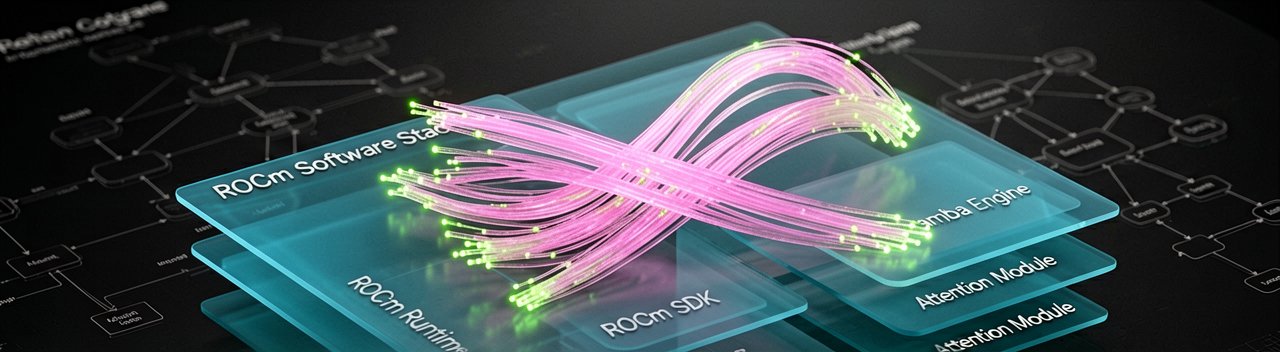
Historically, the "alternative hardware" graveyard is full of startups that underestimated the difficulty of software orchestration. However, Zyphra’s strategy of releasing high-quality open-weight models acts as a Trojan horse. By giving developers powerful models that are pre-optimized for AMD, they are essentially seeding the market for their own cloud services. It’s a "full-stack" approach that mirrors Nvidia’s own playbook, but with an open-source twist designed to appeal to a world increasingly wary of closed-door monopolies.
The broader implications for the chip industry are hard to ignore. If Zyphra can successfully court "frontier laboratories" to its AMD-powered cloud, it validates the MI300X as a viable competitor for training, not just inference. This would be a massive win for AMD, which has struggled to gain meaningful market share in the high-end training space. The $500 million check is a bet that the future of AI is heterogeneous, and that the first company to truly "solve" AMD at scale will own the keys to a multi-billion dollar kingdom.
As the round nears its close, the spotlight shifts to execution. Scaling a "neocloud" while simultaneously pushing the research frontier is a high-wire act that has humbled many. But with a $5 billion valuation and a roster of hardware-savvy leadership, Zyphra is no longer just a laboratory; it is a well-funded insurgent. The message to Santa Clara is clear: the days of the single-vendor AI economy are numbered.
The Reality of the Moat
Reading Between the Lines: The $500 million check headed for Zyphra’s coffers is as much a hedge against Nvidia’s scarcity as it is a vote of confidence in AMD’s silicon. While the narrative of "breaking the monopoly" sells well in Sand Hill Road boardrooms, the industrial reality is far grittier. Nvidia’s dominance isn't just about the H100’s performance; it’s about CUDA, a software ecosystem so deeply embedded in the muscle memory of AI engineers that switching to AMD feels like trying to write a novel in a language you only half-understand. Zyphra is betting that their custom-built Mamba architectures can bridge this gap, but history suggests that hardware-software co-design is a graveyard for startups that underestimate the sheer inertia of the status quo.
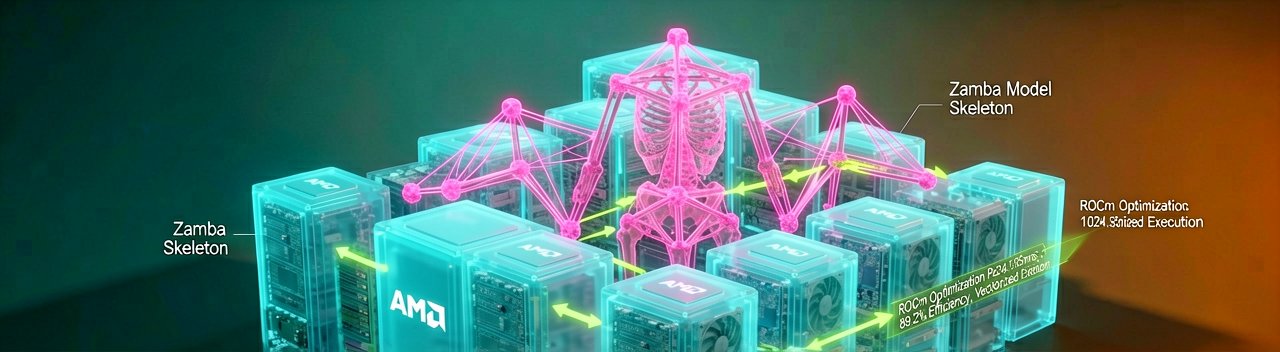
There is also a palpable contradiction in Zyphra’s dual-identity as both a research lab and a cloud provider. By positioning themselves as a "neutral" alternative to Nvidia, they are simultaneously entering a brutal price war with established giants like AWS and Azure, who are also pouring billions into their own custom silicon like Trainium and Maia. For Zyphra to succeed, they must prove that their "AMD-first" optimization provides a performance-per-dollar advantage that is so significant it outweighs the risk of moving off the industry-standard stack. If the efficiency gains are only marginal, the gravitational pull of the Nvidia ecosystem will likely keep most frontier labs right where they are.
Furthermore, the reliance on AMD’s MI300X creates a secondary dependency that is often overlooked. Zyphra is effectively tethering its valuation to AMD’s ability to execute on its roadmap and maintain a steady supply of high-bandwidth memory. If AMD hits a production snag or its software stack—ROCm—continues to lag in developer friendliness, Zyphra’s "competitive advantage" could quickly become a bottleneck. We are witnessing a high-stakes proxy war where Zyphra is the infantry and AMD is the armory; if the weapons jam, the infantry is left exposed on a very expensive battlefield.
Projecting forward, the success of this $500 million bet will depend on whether Zyphra can turn its niche Mamba-based models into the new industry standard. If the AI community continues to favor the "brute force" scaling of traditional transformers, Zyphra’s specialized hardware-software stack risks becoming a high-end boutique in a world that just wants a massive, standardized factory. The irony is that for Zyphra to truly challenge Nvidia, it doesn't just need to build a better chip or a better model; it needs to convince the entire industry to stop thinking in CUDA—a feat that may prove more expensive than any single funding round can cover.
In the end, trying to unseat Nvidia is like trying to replace the world’s plumbing while the water is still running at high pressure; you might have a shinier pipe, but most people are just happy the floor isn't wet yet.
Artūras Malašauskas is an AI Systems Integrator with 20+ years of production-grade web engineering experience. He has designed, shipped, and scaled enterprise Python/PHP systems for logistics, SaaS, and public-sector clients. For the past year, he has focused exclusively on AI integrations: deploying open-source LLMs, building generative media pipelines (image, audio, video), and engineering multi-agent workflows for real production environments. His standard: reproducibility, security, cost-efficient inference—no vaporware. He documents and evaluates emerging AI tooling, separating verified capabilities from marketing noise. Technical editor at: muza-ai.eu, ai-verslas.lt, ai-naujinos.lt Connect on LinkedIn
Comments