Verkor’s VerTQ: The Silicon Solution to the LLM Memory Tax
The AI hardware arms race just took a sharp turn toward efficiency. Verkor has officially pulled the curtain back on VerTQ, the industry’s first silicon IP implementation of Google’s TurboQuant algorithm. For those who haven’t been tracking the white papers, TurboQuant is essentially a "shrink-ray" for the Key-Value (KV) cache—the notoriously greedy memory buffer that expands as Large Language Models (LLMs) process longer conversations. By baking this logic directly into hardware, Verkor is tackling the single biggest bottleneck in modern inference: the crushing demand for high-bandwidth memory that currently makes running massive models a luxury for the few. This isn't just another incremental chip release; it’s a fundamental shift in how we architect AI at the edge.
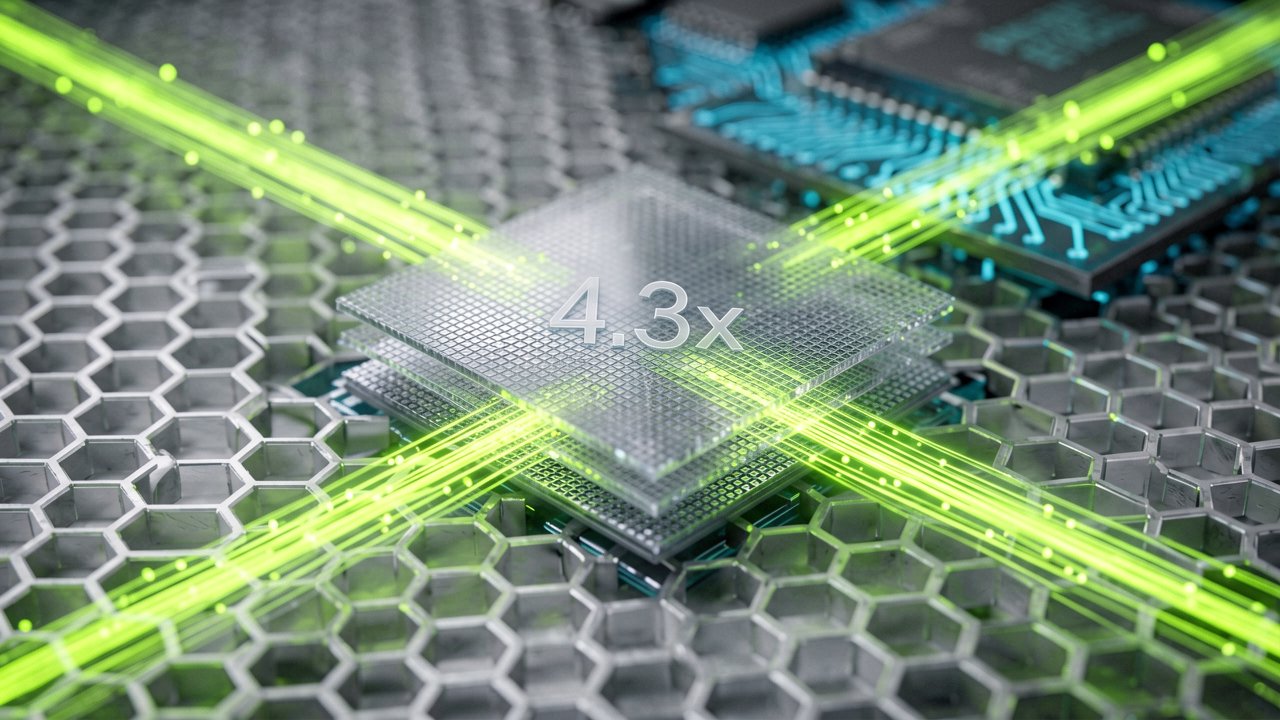
What makes VerTQ particularly spicy is its origin story. The design wasn’t painstakingly hand-crafted over years by legions of engineers; instead, it was built in roughly 80 hours by Verkor using their Conductor 2.0 autonomous agentic AI platform. This "AI-building-AI" approach allowed them to move from Google's mathematical theory to a fully verified FPGA implementation at a speed that should make traditional semiconductor firms sweat. The resulting IP reduces KV cache memory usage by a factor of 4.3x without the usual "quantization tax" of lost accuracy, effectively allowing more users and longer contexts to fit onto existing silicon footprints.
Under the Hood: Precision Without the Bulk
Technically speaking, VerTQ handles the heavy lifting of KV data compression and accelerates the computationally expensive Flash Attention operations on-chip, including online SoftMax. By performing these tasks without decompressing the data, the chip saves precious memory bandwidth—the "gold" of the generative AI era. The architecture is modular and scalable, supporting anywhere from 1 to 32 attention decoders. When mapped to a Xilinx XCVU29P-3 FPGA, a single decoder consumes roughly 500,000 LUTs, making it a viable addition to custom "XPU" silicon for automobiles, drones, and robotics where power budgets are tight and performance is non-negotiable.
This release signals a broader industry pivot from training-at-all-costs to inference-with-finesse. As the market moves away from the "bigger is always better" mantra, the competitive edge is shifting to whoever can serve intelligence most economically. By delivering a silicon-ready version of Google Research's latest compression breakthrough, Verkor is positioning itself as the bridge between theoretical math and the reality of local AI deployment. It is a clear message to the industry: the era of the memory-constrained LLM is coming to an end.

Behind the Scenes: The Autonomous Architect and the End of Memory Bloat
The Reality Check: What most surface-level reports miss is that Verkor isn't just selling a piece of hardware; they are stress-testing a radical new methodology for semiconductor design. The 80-hour development cycle for VerTQ wasn't a fluke of luck but a proof-of-concept for their Conductor 2.0 platform. In the traditional silicon world, moving from a mathematical paper like Google’s TurboQuant to a verified, synthesizable IP block usually involves a "human-in-the-loop" bottleneck that lasts months. Verkor’s agentic AI bypassed the standard manual RTL coding phase, suggesting that the future of AI hardware will be designed by the very intelligence it is meant to accelerate.
Historically, the industry has struggled with the "KV cache wall." As users demand longer context windows—think of a legal bot reading a 500-page contract—the memory required to store the keys and values of every previous word grows linearly. This has forced providers to either buy more expensive HBM3 memory or aggressively prune data, which often results in the model "hallucinating" or forgetting the beginning of the prompt. Verkor’s implementation of TurboQuant effectively sidesteps this compromise by achieving a 4.3x compression ratio. This allows a device with modest RAM to "punch above its weight class," handling conversations that would typically crash a standard edge processor.
From a stakeholder perspective, this is a massive win for the "Local AI" movement. Companies like NVIDIA and AMD have a vested interest in selling high-margin, power-hungry GPUs, but the broader ecosystem is desperate for cheaper, decentralized alternatives. By making this IP available for integration into custom SoCs, Verkor is giving automotive manufacturers and robotics firms a way to run sophisticated LLMs locally without needing a server-grade power supply in the trunk of a car or the chassis of a drone. It turns the LLM from a cloud-locked service into a portable utility.
The technical nuance here lies in the "Online SoftMax" and Flash Attention acceleration. Most compression schemes require the data to be "unpacked" before the chip can actually use it for calculations, which wastes clock cycles and energy. VerTQ performs the math directly on the compressed TurboQuant format. This architectural choice minimizes the "data movement" penalty, which is often the silent killer of performance in modern computing. It represents a pivot from raw flops to smart data management, prioritizing how information flows rather than just how fast it can be crunched.

Industry analysts see this as a shot across the bow for traditional IP vendors. If a startup can leverage autonomous agents to beat established players to market with the latest research from Verkor and Google, the barrier to entry for custom silicon has effectively collapsed. We are likely looking at a future where "niche" AI chips are spun up in days to support specific, emerging algorithms, rather than waiting years for a general-purpose processor to catch up.
Ultimately, Verkor is betting that efficiency will win the long game over brute force. As the hype around massive data centers begins to meet the reality of soaring electricity costs and hardware shortages, silicon that does more with less becomes the most valuable asset in the stack. VerTQ isn't just an accelerator; it’s a blueprint for how the next generation of AI hardware will be conceived, designed, and deployed at scale.
Reading Between the Lines: The Friction of Fast-Track Silicon
Reading Between the Lines: While Verkor’s 80-hour design cycle is a public relations masterstroke, it raises uncomfortable questions about the longevity of specialized silicon in a field that moves at the speed of software. The "agentic AI" design process assumes that today’s gold-standard algorithm, TurboQuant, will remain relevant long enough to survive the grueling journey from FPGA prototype to mass-produced ASIC. There is a palpable tension here: Verkor has solved the speed-of-design problem, but they are still tethered to the physical reality of semiconductor lead times. If a superior compression method emerges from a research lab next month, this specialized hardware risks becoming a very expensive paperweight before the first production batch even leaves the fab.
Furthermore, the claim of "no accuracy loss" during 4.3x compression often comes with an asterisk that industry veterans know all too well. While synthetic benchmarks like perplexity might remain stable, real-world edge cases in nuanced linguistic tasks can be far more sensitive to quantization than a marketing deck suggests. There is a inherent contradiction in promising "server-grade" performance on "drone-grade" power budgets; eventually, the laws of thermodynamics and information theory demand a sacrifice. The industry must weigh whether the efficiency gains of VerTQ are worth the risk of "black box" hardware generation where the underlying RTL logic was never touched by a human hand.
The strategic move to open this IP for licensing is also a double-edged sword. By democratizing the ability to run long-context LLMs on the edge, Verkor is effectively commoditizing the inference layer. If every mid-range SoC can suddenly handle a Llama-3-grade model with ease, the competitive advantage shifts back to the software layer and the proprietary data used for fine-tuning. Verkor is providing the shovel in a gold rush where the gold itself is rapidly losing its value due to oversupply. This creates a market where hardware efficiency is a prerequisite for survival rather than a differentiator for premium pricing.
Projecting forward, the broader implication of Verkor's "AI-building-AI" model is a potential talent crisis in traditional electrical engineering. If autonomous agents like Conductor 2.0 become the primary architects of our chips, we risk losing the "tribal knowledge" required to debug the complex physical phenomena—like signal integrity and thermal throttling—that software-driven designs often gloss over. We are racing toward a future where we understand the output of our machines perfectly, but the physical gates that generate that output are increasingly a mystery even to their creators.
There is also the matter of the "Google dependency." By pinning their flagship hardware release so closely to a single Google Research breakthrough, Verkor has tied its mast to a specific architectural philosophy. Should the industry pivot toward a different attention mechanism—or away from Transformers entirely—the specialized logic gates within VerTQ cannot simply be "reprogrammed" with a software update. It is a high-stakes gamble on the permanence of current AI mathematics in an era defined by constant disruption.
The semiconductor industry spent fifty years perfecting the art of the multi-year roadmap, only for AI to show up and demand a new architecture every Tuesday afternoon; Verkor’s 80-hour design cycle is impressive, but one suspects the engineers might still need more than a long weekend to figure out how to cool a chip that thinks faster than the thermal paste can melt.
Artūras Malašauskas is an AI Systems Integrator with 20+ years of production-grade web engineering experience. He has designed, shipped, and scaled enterprise Python/PHP systems for logistics, SaaS, and public-sector clients. For the past year, he has focused exclusively on AI integrations: deploying open-source LLMs, building generative media pipelines (image, audio, video), and engineering multi-agent workflows for real production environments. His standard: reproducibility, security, cost-efficient inference—no vaporware. He documents and evaluates emerging AI tooling, separating verified capabilities from marketing noise. Technical editor at: muza-ai.eu, ai-verslas.lt, ai-naujinos.lt Connect on LinkedIn
Comments