Septentrio’s mosaic-G5 P8: Serious GNSS Resilience in a Tiny Package
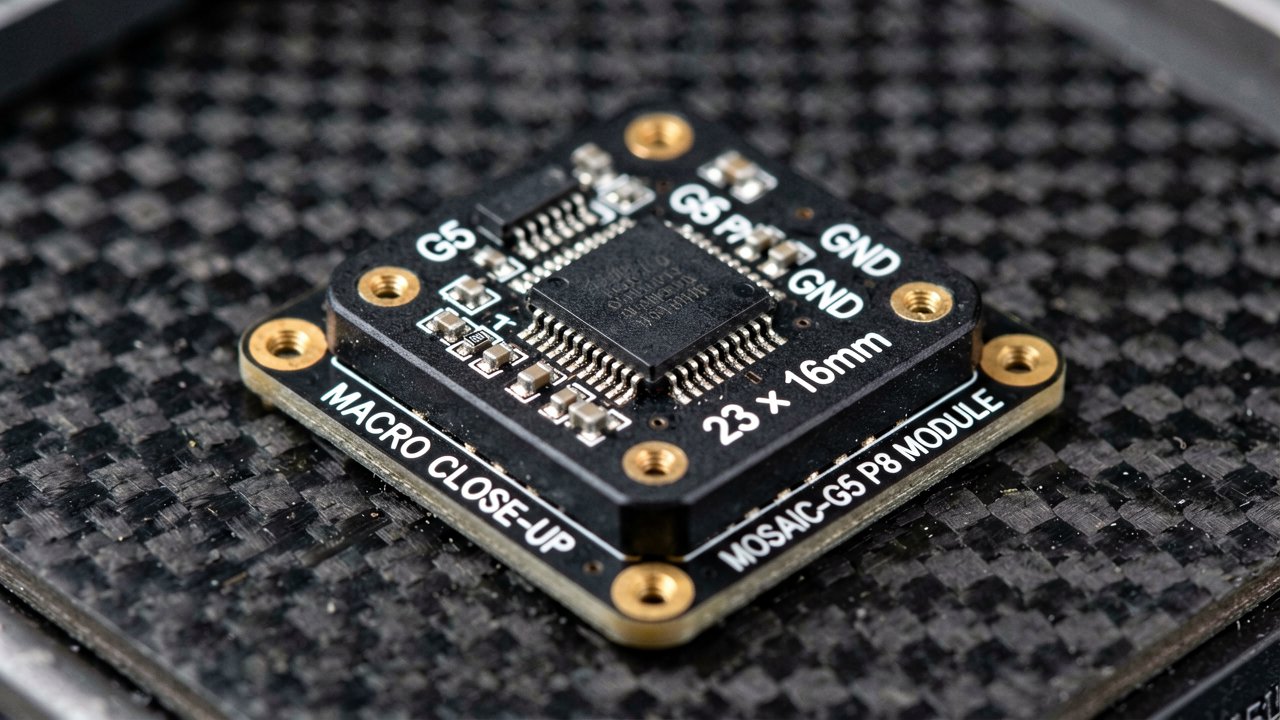
Septentrio just pulled the curtain back on the mosaic-G5 P8, and if you’ve been following the evolution of high-precision GNSS, this one’s worth a look. It’s a multi-frequency receiver that packs a massive punch into a footprint about the size of a postage stamp. Measuring just 23 mm by 16 mm and tipping the scales at a mere 2.2 grams, it’s clearly built for those mission-critical rigs where every millimeter and milligram counts. We’re talking drones, autonomous marine vessels, and rail systems—applications where "pretty good" positioning isn't an option. According to the official reveal on EEJournal, the module is designed to thrive even when the RF environment gets messy.
What sets the P8 apart from its predecessors is the "Ultimate" flavor of Septentrio's AIM+ technology. It isn't just about filtering out simple noise; this thing is built to spot and mitigate sophisticated jamming and spoofing attacks that would normally leave a receiver spinning its wheels. It provides a level of situational awareness that’s rare in this size class, offering detailed power and frequency data that can actually help operators pinpoint where the interference is coming from. It’s a smart play by Septentrio, acknowledging that as autonomous systems become more common, they also become bigger targets for electronic interference.
Built for Real-World Integration
The tech specs are impressive, but the practical side is where the mosaic-G5 P8 will likely win over engineers. It’s fully compatible with open-source autopilots like ArduPilot and PX4, which makes the "plug and play" dream a bit more of a reality for drone developers. It also boasts a high update rate and remarkably low latency, which is the secret sauce for keeping dynamic vehicles on track when they're moving at speed. For those ready to start prototyping, the company is rolling out an evaluation kit that features direct autopilot connections and their RxTools interface for easier setup.
A Shift Toward Secure Autonomy
This launch feels like a direct response to the growing demand for "hardened" GNSS. As Inside GNSS notes with earlier family variants, Septentrio has been aggressively expanding this lineup to balance high-end accuracy with resilience. The P8 sits at the top of that hierarchy, ensuring that even in contested environments, the machine knows exactly where it is. It’s a sophisticated piece of hardware that proves you don’t need a bulky enclosure to get industrial-grade reliability.

Behind the Scenes: The Engineering Logic of the P8
The "Ultimate" Shield: While the headline-grabbing feature is the size, what most reports miss is the specific strategic pivot Septentrio is making with the "Ultimate" AIM+ suite. In the GNSS world, there has historically been a trade-off between sensitivity and robustness; if you make a receiver too sensitive, it’s easily blinded by high-power interference. Septentrio’s engineers managed to cram a more sophisticated digital signal processing (DSP) architecture into the P8 that allows it to maintain a high signal-to-noise ratio even in the presence of wideband interference. This isn't just about survival; it’s about maintaining "integrity," which is the industry’s way of saying the receiver knows when it’s being lied to and can alert the system before a drone drifts off course.
From a stakeholder perspective, this module is a direct answer to the anxiety currently rippling through the commercial drone and robotics sectors. As regulatory bodies like the FAA and EASA tighten the screws on Beyond Visual Line of Sight (BVLOS) operations, the "certified" reliability of a GNSS receiver becomes a major bottleneck for market entry. By offering a module that provides real-time interference monitoring and logging, Septentrio is giving developers the data they need to prove their systems are safe. It shifts the GNSS module from being a simple sensor to a diagnostic tool that provides a fingerprint of the local RF environment, a feature that was previously reserved for rack-mounted equipment costing ten times as much.
Historically, Septentrio has occupied a niche as the "high-end" choice, often perceived as too expensive or complex for mid-market applications. However, the mosaic-G5 P8 represents a clear attempt to democratize that high-end resilience. By ensuring native compatibility with the ArduPilot and PX4 ecosystems, they are courting the massive community of developers who have grown frustrated with consumer-grade GPS modules that fail at the first sign of a nearby cellular tower or radio mast. This move forces competitors to reconsider their own anti-jamming roadmaps, as "basic" positioning is rapidly becoming a commodity, while "resilient" positioning—like what is found in the EEJournal report—is becoming the new baseline for professional hardware.
The integration of L5 frequency support is another nuanced win for the P8. L5 signals are inherently more robust and less prone to multipath errors—the "bouncing" effect signals have in urban canyons or near large metal structures. For autonomous rail and port automation, this is a game-changer. It means a container crane or a train can maintain centimeter-level accuracy even when surrounded by steel and concrete. By combining this frequency diversity with their proprietary LOCK+ technology, which keeps the signal tracking even during high-vibration events, Septentrio has effectively built a receiver that refuses to let go of the satellites.

Ultimately, the P8 launch signals a shift in the industry toward "security by design" at the component level. In years past, security was an afterthought or an external layer. Now, the receiver itself is expected to act as a frontline defender against electronic warfare tactics that have trickled down from military theaters into the commercial world. The mosaic-G5 P8 isn't just a smaller receiver; it’s a more cynical one, designed with the assumption that the sky is no longer a friendly or predictable environment for radio signals.
Reading Between the Lines: The Cost of Total Awareness
The Resilience Paradox: While Septentrio bills the mosaic-G5 P8 as a "set it and forget it" solution for secure autonomy, there is an inherent contradiction in the push for total RF awareness. By providing operators with granular data on jamming and spoofing attempts, Septentrio is essentially handing over a firehose of information that many commercial flight controllers aren't yet equipped to process in real time. There is a fine line between a resilient receiver and a paranoid one; if the threshold for "threat detection" is too low, developers risk grounding fleets due to phantom interference that might not have actually compromised a flight path. The challenge now shifts from the hardware’s ability to see the threat to the software’s ability to intelligently ignore the noise.
Furthermore, the move toward "Ultimate" anti-spoofing in a 2-gram package raises questions about power budgets that the marketing gloss often glosses over. Advanced digital signal processing is computationally expensive. While the P8 is undeniably efficient for its class, engineers working on ultra-lightweight, battery-constrained drones have to weigh the milliwatts spent on "military-grade" security against the actual flight time lost. In many commercial scenarios, the threat of a sophisticated spoofing attack remains a theoretical outlier compared to the very real threat of a dead battery. Septentrio is betting that the industry is ready to pay the "security tax," but for many low-margin delivery startups, the transition from basic GNSS to high-resilience modules may be a harder sell than the tech specs suggest.
There is also the matter of the "black box" nature of proprietary mitigation algorithms. Septentrio’s AIM+ technology is a formidable USP, but as the industry moves toward more transparent, open-standard safety protocols, the reliance on a single vendor's secret sauce for mission-critical security creates its own kind of vulnerability. If every autonomous system relies on the same proprietary logic to detect spoofing, a single clever workaround by bad actors could theoretically blind an entire generation of P8-equipped hardware. We are seeing a classic arms race where the hardware is the weapon, but the battlefield is shifting toward the algorithms—and in that arena, "smaller and lighter" isn't always the winning metric.
The projection for the next five years suggests that "resilient GNSS" will cease to be a premium feature and will instead become a regulatory mandate. However, this creates a secondary market tension: if every drone is required to have a module like the P8, the supply chain for high-precision silicon becomes a single point of failure for the entire autonomous economy. Measured skepticism suggests that while the P8 is a masterclass in miniaturization, its success depends as much on international RF regulations and the stability of global semiconductor manufacturing as it does on its ability to track a satellite in a thunderstorm.
It’s a remarkable feat of engineering to make a device that can detect a sophisticated electronic warfare attack while weighing less than a single penny, though it remains to be seen if the drones carrying it will spend more time flying or just nervously reporting that the neighbors have a particularly noisy microwave.
Artūras Malašauskas is an AI Systems Integrator with 20+ years of production-grade web engineering experience. He has designed, shipped, and scaled enterprise Python/PHP systems for logistics, SaaS, and public-sector clients. For the past year, he has focused exclusively on AI integrations: deploying open-source LLMs, building generative media pipelines (image, audio, video), and engineering multi-agent workflows for real production environments. His standard: reproducibility, security, cost-efficient inference—no vaporware. He documents and evaluates emerging AI tooling, separating verified capabilities from marketing noise. Technical editor at: muza-ai.eu, ai-verslas.lt, ai-naujinos.lt Connect on LinkedIn
Comments