Legion Intelligence Launches Mission Packs and Expands Centurion to Put Agentic AI to Work in the Field
The transition from experimental AI to frontline operational tools just took a significant leap forward. Legion Intelligence has officially rolled out its "Mission Packs" and a major expansion of its Centurion hardware-software ecosystem, a move aimed squarely at bridging the gap between high-level data centers and the messy, disconnected reality of tactical operations. By shifting focus from generic chatbots to role-specific "agentic" workflows, the company is betting that the future of defense tech isn't just about answering questions, but about executing complex, multi-step tasks where the internet simply doesn't exist.
At the heart of this launch is the "Mission Pack" concept—pre-configured bundles of AI agents and data integrations tailored for specific roles like intelligence officers, commanders, and maintenance technicians. Rather than staring at a blank prompt, a technician can use a dedicated pack to parse maintenance manuals and check parts availability in one go. According to recent reports from , these packs are designed to run seamlessly across environments ranging from secure clouds to the air-gapped "tactical edge" provided by the Centurion platform.
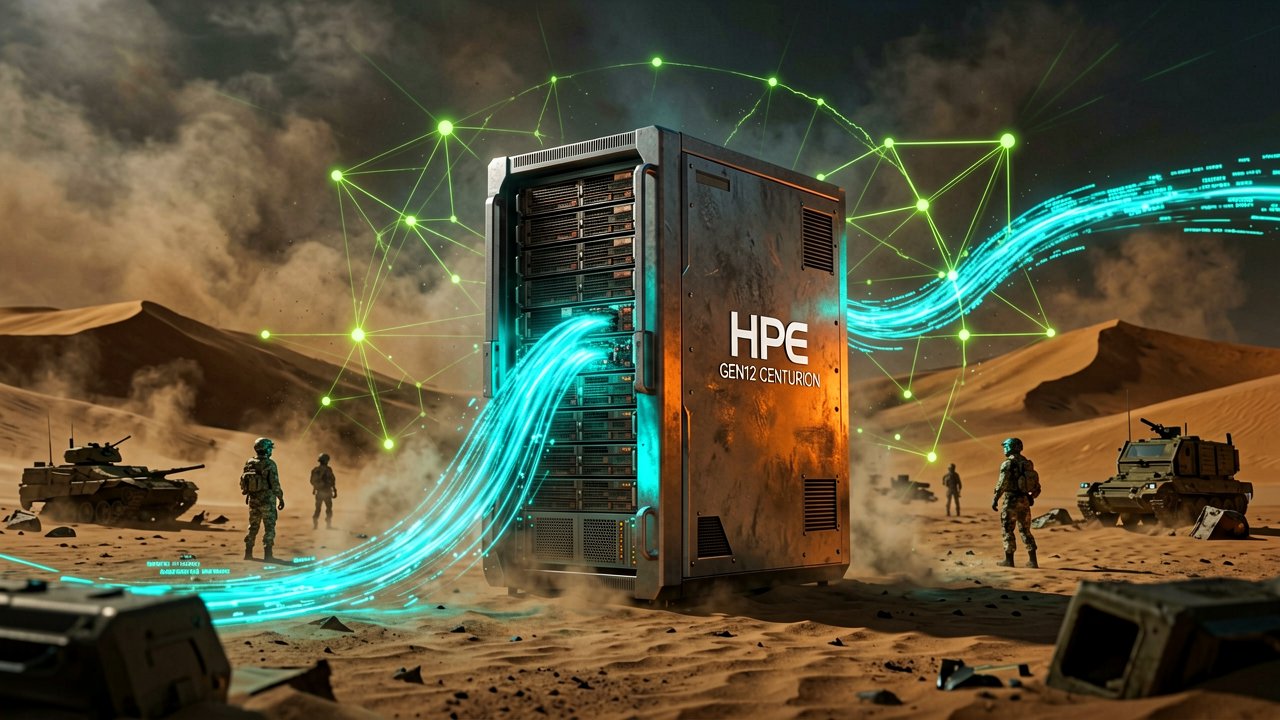
Centurion itself has grown from a single edge-node concept into a full-scale deployable system. This expansion introduces hardware options like the "Centurion Large," a rack-scale HPE Gen12 server capable of supporting hundreds of concurrent users without a single byte of data leaving the local network. By deploying these systems in "Denied, Degraded, Intermittent, and Limited" (DDIL) environments, Legion is proving that AI can sustain its value even when the satellites go dark, a critical requirement for modern "NGC2" command and control concepts.
The Reality of AI in Austere Environments
What Most Reports Miss: While the tech world obsesses over massive parameter counts and cloud-scale LLMs, the military-industrial complex is facing a much more grounded problem: physics. In a theater of operations, high-bandwidth connectivity is often the first casualty, rendering standard cloud-based AI useless. Legion’s pivot toward Centurion isn't just a hardware play; it’s an admission that for AI to be a "force multiplier," it has to live on the same ruggedized local area networks as the troops using it. This "edge-native" approach allows for what the company calls "agent swarms"—groups of AI agents that coordinate locally to automate reporting and analysis without needing a lifeline back to the Pentagon.

The stakes for this kind of "plumbing" are evident in the metrics coming out of early field tests. During exercises like Scarlet Dragon 26-01, the XVIII Airborne Corps utilized Legion’s platform to generate Intelligence Summaries (INTSUMs) 48 times faster than manual processes. This isn't just about saving time; it's about compressing the "OODA loop"—Observe, Orient, Decide, Act—to a point where human analysts can spend their energy on critical thinking rather than the soul-crushing task of formatting spreadsheets. Veteran observers from Tectonic Defense note that this represents a shift from "conversational AI" to "actionable AI," where the outcome is a finished product rather than a clever chat response.
Stakeholder perspectives highlight a growing demand for "sovereign" AI—systems that respect data locality and classification boundaries by design. By integrating NVIDIA NIM microservices and partnering with infrastructure giants like HPE and Intel, Legion is positioning itself as the orchestration layer that sits on top of existing "systems of record" like Palantir. This modularity is key; it allows the Department of War to swap out underlying models as technology evolves without having to retrain the entire workforce on a new interface. This "fight with what you train on" philosophy is becoming the gold standard for reducing vendor lock-in and operational friction.
Historical context suggests we are moving out of the "AI hype" phase and into a period of hardening and integration. Much like the early days of mobile computing, the challenge isn't making the tech work in a lab, but making it survive the rigors of the field. Legion's expansion of Centurion into multiple form factors—from portable nodes to rack-scale systems—mirrors the way ruggedized laptops eventually became ubiquitous in military vehicles. The focus has shifted from the "magic" of the AI to the reliability of the deployment, ensuring that the software remains as resilient as the hardware it inhabits.
Ultimately, the success of these Mission Packs will depend on their ability to handle the "boring" tasks that currently bog down mission-critical operations. Automating 99% of a SITREP or 88% of a maintenance work order might not grab headlines like a sentient robot, but in the context of national security, it is exactly the kind of efficiency that wins long-term engagements. As these systems move from USSOCOM into broader departmental use, the real test will be how well they scale across the heterogeneous, legacy-filled infrastructure that defines modern global logistics and defense.

The transition from experimental AI to frontline operational tools just took a significant leap forward. Legion Intelligence has officially rolled out its "Mission Packs" and a major expansion of its Centurion hardware-software ecosystem, a move aimed squarely at bridging the gap between high-level data centers and the messy, disconnected reality of tactical operations. By shifting focus from generic chatbots to role-specific "agentic" workflows, the company is betting that the future of defense tech isn't just about answering questions, but about executing complex, multi-step tasks where the internet simply doesn't exist.
At the heart of this launch is the "Mission Pack" concept—pre-configured bundles of AI agents and data integrations tailored for specific roles like intelligence officers, commanders, and maintenance technicians. Rather than staring at a blank prompt, a technician can use a dedicated pack to parse maintenance manuals and check parts availability in one go. According to recent reports from GlobeNewswire, these packs are designed to run seamlessly across environments ranging from secure clouds to the air-gapped "tactical edge" provided by the Centurion platform.
Centurion itself has grown from a single edge-node concept into a full-scale deployable system. This expansion introduces hardware options like the "Centurion Large," a rack-scale HPE Gen12 server capable of supporting hundreds of concurrent users without a single byte of data leaving the local network. By deploying these systems in "Denied, Degraded, Intermittent, and Limited" (DDIL) environments, Legion is proving that AI can sustain its value even when the satellites go dark, a critical requirement for modern "NGC2" command and control concepts.
The Reality of AI in Austere Environments
What Most Reports Miss: While the tech world obsesses over massive parameter counts and cloud-scale LLMs, the military-industrial complex is facing a much more grounded problem: physics. In a theater of operations, high-bandwidth connectivity is often the first casualty, rendering standard cloud-based AI useless. Legion’s pivot toward Centurion isn't just a hardware play; it’s an admission that for AI to be a "force multiplier," it has to live on the same ruggedized local area networks as the troops using it. This "edge-native" approach allows for what the company calls "agent swarms"—groups of AI agents that coordinate locally to automate reporting and analysis without needing a lifeline back to the Pentagon.
The stakes for this kind of "plumbing" are evident in the metrics coming out of early field tests. During exercises like Scarlet Dragon 26-01, the XVIII Airborne Corps utilized Legion’s platform to generate Intelligence Summaries (INTSUMs) 48 times faster than manual processes. This isn't just about saving time; it's about compressing the "OODA loop"—Observe, Orient, Decide, Act—to a point where human analysts can spend their energy on critical thinking rather than the soul-crushing task of formatting spreadsheets. Veteran observers from Tectonic Defense note that this represents a shift from "conversational AI" to "actionable AI," where the outcome is a finished product rather than a clever chat response.
Stakeholder perspectives highlight a growing demand for "sovereign" AI—systems that respect data locality and classification boundaries by design. By integrating NVIDIA NIM microservices and partnering with infrastructure giants like HPE and Intel, Legion is positioning itself as the orchestration layer that sits on top of existing "systems of record" like Palantir. This modularity is key; it allows the Department of War to swap out underlying models as technology evolves without having to retrain the entire workforce on a new interface. This "fight with what you train on" philosophy is becoming the gold standard for reducing vendor lock-in and operational friction.
The Friction of Deployment and the "Black Box" Problem
Reading Between the Lines: The promise of "agentic" AI in the field carries a heavy burden of proof that marketing gloss often ignores. While Legion Intelligence highlights the 48x speed increase in report generation, they are less vocal about the "human-in-the-loop" bottleneck that inevitably occurs when lives depend on an algorithm's output. In a tactical setting, a hallucinated coordinate isn't just a digital glitch; it’s a potential disaster. Moving from a chatbot that suggests text to an agent that autonomously pulls from maintenance logs and intelligence databases increases the complexity of the "trust but verify" model to a degree that might actually increase cognitive load for the supervisor tasked with signing off on the AI’s work.
There is also a palpable contradiction between the push for "sovereign AI" and the reliance on commercial hardware-software stacks. By building Centurion on HPE servers and NVIDIA microservices, Legion is essentially importing the vulnerabilities of the global commercial supply chain directly into the air-gapped bunkers of the military. This creates a fascinating tension: the hardware is physically local, but the intellectual property and the foundational logic remain tied to corporate giants in Silicon Valley. The defense sector is trading one form of dependency—the cloud—for another—the specialized silicon and proprietary microservices required to make these "Mission Packs" function at speed.
Furthermore, the scalability of "Mission Packs" assumes a level of data cleanliness that rarely exists in the wild. Real-world military data is often fragmented, messy, and siloed across decades-old legacy systems that weren't built to talk to each other, let alone an AI agent. The success of Legion’s expansion depends less on the brilliance of their LLMs and more on their ability to act as a glorified, high-tech janitor for defense data. Without flawless integration into these "systems of record," these agents will likely find themselves stuck in the same "pilot purgatory" that has claimed dozens of other promising AI startups over the last decade.
Looking forward, the implication of Centurion’s expansion is the eventual birth of a "shadow net" of AI infrastructure that operates entirely outside the public internet. This bifurcated tech world—where the military uses a completely different, air-gapped version of the AI tools we use at home—will lead to a widening gap in capability and safety standards. As agentic AI becomes the default operating system for the field, we may find that the biggest hurdle isn't the technology's ability to act, but our ability to understand why it made a specific choice when the stakes are at their highest and the network is at its weakest.
It’s comforting to know that while the rest of us are using AI to write passive-aggressive emails, the military is using it to automate the paperwork of the apocalypse—provided, of course, that nobody trips over the power cord of the rack-scale server in the middle of a desert.
Artūras Malašauskas is an AI Systems Integrator with 20+ years of production-grade web engineering experience. He has designed, shipped, and scaled enterprise Python/PHP systems for logistics, SaaS, and public-sector clients. For the past year, he has focused exclusively on AI integrations: deploying open-source LLMs, building generative media pipelines (image, audio, video), and engineering multi-agent workflows for real production environments. His standard: reproducibility, security, cost-efficient inference—no vaporware. He documents and evaluates emerging AI tooling, separating verified capabilities from marketing noise. Technical editor at: muza-ai.eu, ai-verslas.lt, ai-naujinos.lt Connect on LinkedIn
Comments