Giotto.ai and the Rise of the Sovereign Workstation: Why the Future of Reasoning is Local
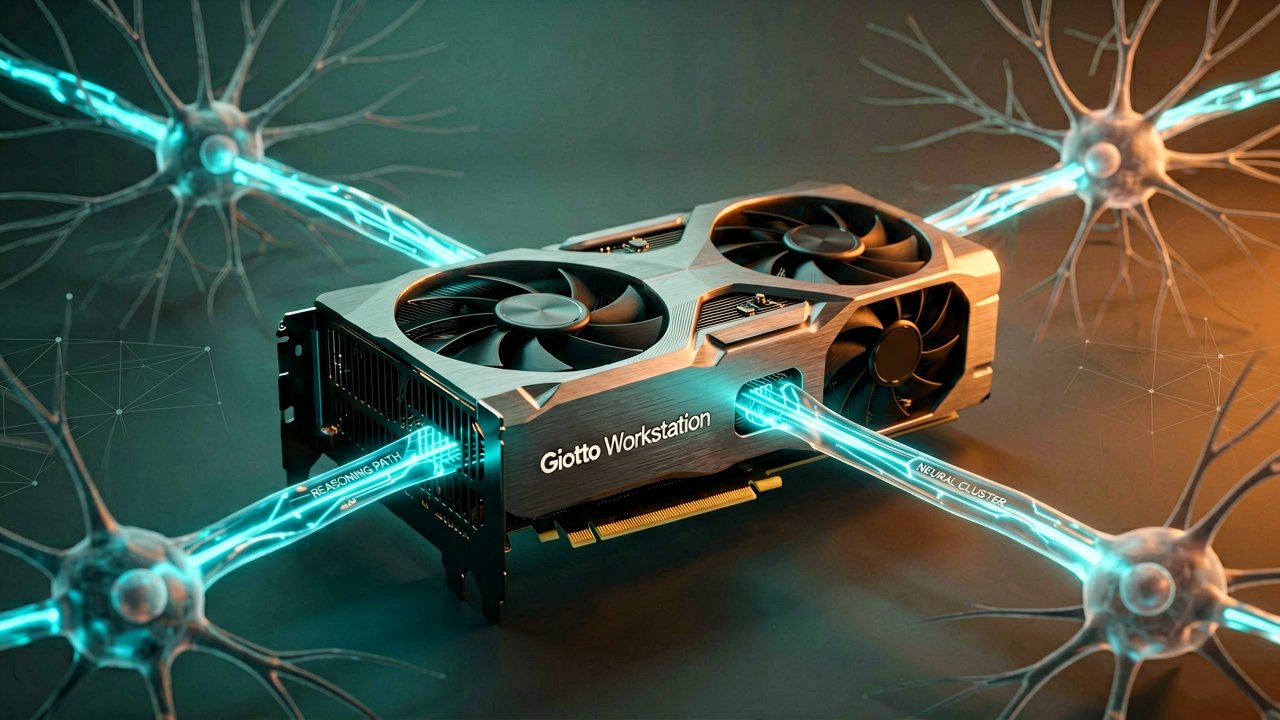
For years, the narrative around advanced artificial intelligence has been one of massive scale: bigger clusters, more parameters, and a total reliance on the sprawling cloud infrastructure of a few tech giants. But Lausanne-based Giotto.ai just flipped that script. On May 18, 2026, the Swiss AI lab announced the launch of its first portable general-purpose AI model and operating system, a move designed to bring high-level reasoning out of the data center and directly onto the desks of enterprise professionals.
This isn't just another incremental update to a chatbot. According to EQS News, Giotto.ai’s new system is built on a "portable intelligence" architecture that delivers top-tier performance on reasoning benchmarks like MATH and AIME while running on a single GPU. By prioritizing "test-time computation"—essentially allowing the model to "think" longer on complex problems rather than just getting bigger—the lab has managed to cram frontier-level smarts into a footprint small enough for a standard workstation.
The End of the API Leash?
For many enterprises, the "cloud-only" nature of today’s most powerful AI has been a non-starter due to data privacy concerns or the sheer cost of keeping an external API on life support. Giotto’s CEO, Aldo Podestà, isn’t mincing words about why this launch matters. He frames it as a matter of "strategic independence," arguing that organizations shouldn't have to outsource their core intelligence to external black boxes. It’s a compelling pitch for governments and sensitive industries that need to govern their own technology stack without a massive engineering team in tow.
What makes this technically interesting is the departure from the monolithic model paradigm. Instead of one giant, lumbering network, Giotto uses a coordinated web of smaller, specialized agents. As detailed on TradingView, this modularity allows the system to scale its reasoning depth in real-time based on the task at hand. If you’re asking for a simple summary, it’s fast and light; if you’re asking it to solve a complex engineering simulation, it allocates the necessary "brainpower" without blowing up your hardware budget.

The rollout includes a physical appliance called the Giotto Workstation, which essentially turns a high-end PC into a localized AI powerhouse. For those with larger needs, the Giotto Server extends that same controllable layer to on-premise data centers. It’s a "sovereign AI" play through and through, and coming from a lab that’s already been making waves in the ARC-AGI reasoning competitions, it’s a signal that the next industrial revolution might just be localized.
In a world where we’ve become accustomed to the "bigger is better" gospel of Silicon Valley, Giotto.ai is making a strong case for "smarter and closer." By proving that advanced reasoning can be portable, they aren't just launching a product; they're challenging the fundamental idea of who gets to control the future of machine intelligence. If this catches on, the "reindustrialization" Podestà speaks of won't happen in the cloud—it'll happen right under our desks.
The Real Game-Changer Beneath the Hood: While the headlines are buzzing about "portability," the true narrative isn't just about shrinking a model; it's about a fundamental shift in how we value machine "thinking" time. For years, the industry has been obsessed with pre-training—spending millions to bake knowledge into a static file. Giotto.ai is pivoting toward "inference-time compute," a fancy way of saying they’ve taught the AI how to pause, double-check its work, and explore multiple logical paths before giving an answer. It’s the difference between a student who blurs out the first thing that comes to mind and one who meticulously works through a proof on a scratchpad.
A Rejection of the "Cloud Tax"
Talk to any CTO in a mid-sized enterprise today, and you’ll hear the same grievance: the "Cloud Tax." The current AI economy forces companies to ship their most sensitive proprietary data over the fence to providers who may or may not be using that data to train the next generation of their own products. Giotto’s workstation-first approach is a direct middle finger to this dependency. By localizing frontier-level reasoning, they are effectively decapitating the subscription model that has kept corporate R&D departments on a leash. It’s a move that echoes the early days of the PC revolution, moving power from the mainframe back to the individual creator.

Historically, the bottleneck for local AI has always been the "reasoning gap." You could run a small model locally, but it would hallucinate or fail at basic logic. Giotto is leveraging their pedigree in Topological Data Analysis (TDA) and their high rankings in the ARC-AGI leaderboard to bridge this gap. They aren't just using brute force; they are using sophisticated mathematical structures to ensure that a smaller model doesn't mean a dumber model. For industries like aerospace or pharmaceuticals, where a single logical error can cost millions, this localized reliability is the "killer app" the market has been waiting for.
The "Sovereign AI" Geopolitical Play
Beyond the tech specs, there is a distinct European flavor to this launch that shouldn't be ignored. As the US and China race for AI supremacy through massive compute clusters, Switzerland is positioning itself as the hub for "Sovereign AI." Giotto’s emphasis on "strategic independence" isn't just marketing fluff; it’s a response to the growing desire for technological neutrality. If an organization can own its hardware and its weights, it is immune to the shifting sands of international trade wars or API throttling. In this context, Giotto isn't just selling software—they’re selling digital borders.
The rollout of the Giotto OS also hints at a broader ecosystem play. By creating an operating system specifically tuned for agentic workflows, they are setting the stage for a "modular intelligence" marketplace. Imagine a world where a company buys the base Giotto workstation and then snaps in specialized "reasoning modules" for legal compliance, tax code analysis, or fluid dynamics. It’s a bespoke approach to AI that feels far more human and professional than the "one-size-fits-all" chatbots we’ve been forced to settle for until now.
The Skeptic’s Lens: For all the talk of "portable intelligence," we have to ask if Giotto.ai is solving a genuine technical bottleneck or simply leaning into the current zeitgeist of corporate paranoia. The promise of "frontier-level" reasoning on a single GPU is a massive claim that flies in the face of the scaling laws championed by OpenAI and Anthropic. While the Giotto OS certainly offers a slick alternative to the API status quo, the trade-off is often a hidden one: the "maintenance tax." Shifting from the cloud to a localized workstation means enterprises are now responsible for their own hardware lifecycle and thermal management—tasks most IT departments spent the last decade trying to outsource.
The Latency Paradox
There is also a curious contradiction in the "test-time computation" strategy. While allowing a model to "think longer" improves accuracy on complex math and logic, it essentially reintroduces latency through the back door. We’ve spent years demanding faster, more responsive AI, yet Giotto’s path to quality involves making the user wait while the silicon chews on a problem. In a high-stakes engineering environment, a ten-minute wait for a correct answer is a bargain; in a fast-paced corporate office, that same delay might feel like a regression to the days of dial-up. The success of this platform hinges entirely on whether the market values correctness over the instant gratification of a mediocre cloud response.
Furthermore, the "Sovereign AI" narrative assumes that hardware will remain accessible and agnostic. As the global chip supply remains caught in a geopolitical tug-of-war, a "portable" strategy is only as good as your ability to source the high-end NVIDIA or Blackwell chips required to run these "compact" models. If the hardware supply chain tightens, the dream of localized independence could quickly turn into a nightmare of backordered workstations and obsolete local nodes. Giotto is betting on the democratization of compute, but they are doing so at a time when compute has never been more of a luxury resource.
Ultimately, Giotto.ai is forcing a long-overdue conversation about the "Minimum Viable Intelligence" required for business. Not every task requires a trillion-parameter behemoth burning enough electricity to power a small town. By targeting the workstation, Giotto is betting that "good enough and private" will beat "perfect and public" every time. It’s a gamble that presumes enterprises are tired of the shiny, bloated toys of Silicon Valley and are finally ready for a tool that just stays in its lane—and on its own desk.
"We’ve spent a decade convincing everyone that the cloud is a magical, weightless ether, only for the smartest people in the room to realize that, actually, it’s just someone else’s computer—and they’re charging you for the privilege of sitting in the passenger seat."
Artūras Malašauskas is an AI Systems Integrator with 20+ years of production-grade web engineering experience. He has designed, shipped, and scaled enterprise Python/PHP systems for logistics, SaaS, and public-sector clients. For the past year, he has focused exclusively on AI integrations: deploying open-source LLMs, building generative media pipelines (image, audio, video), and engineering multi-agent workflows for real production environments. His standard: reproducibility, security, cost-efficient inference—no vaporware. He documents and evaluates emerging AI tooling, separating verified capabilities from marketing noise. Technical editor at: muza-ai.eu, ai-verslas.lt, ai-naujinos.lt Connect on LinkedIn
Comments