Nvidia’s Ising Gamble: Can Open-Source AI Finally Tame Quantum Chaos?

The Quantum Jigsaw: Nvidia’s Ising Models and the Battle for Coherence
For years, the tech world has treated quantum computing like a brilliant but erratic child—full of potential, yet prone to temper tantrums the moment things get a little noisy. But Nvidia, ever the opportunist in the high-stakes world of compute, is trying to change the narrative. Their latest move involves the release of "Ising," a suite of open-source quantum AI models that aim to bridge the gap between today’s "noisy" hardware and the fault-tolerant dreams of tomorrow. It’s not just about raw power anymore; it’s about finesse, specifically in the grueling arenas of calibration and error correction.
The problem with quantum bits, or qubits, is that they are notoriously fragile. A stray photon or a slight temperature fluctuation can cause "decoherence," essentially scrambling the data before the calculation finishes. As reported by NVIDIA , the Ising models are designed to accelerate the path to useful quantum computing by using AI to navigate these complex optimization problems. By open-sourcing these tools, Nvidia is effectively crowdsourcing the solution to quantum instability, inviting the global developer community to help steady the ship.
Closing the Gap: AI-Driven Calibration
Calibration is the unsung hero of the quantum stack. Think of it as tuning an instrument before a concert; if your qubits aren't perfectly aligned, the music—or in this case, the algorithm—is just noise. Traditional calibration is a manual, agonizingly slow process. Nvidia’s approach leverages the massive parallel processing power of their GPUs to automate this. According to historical context on Wikipedia , Nvidia's shift from gaming to high-performance computing and AI has positioned them perfectly to handle these massively parallel workloads. Using AI to predict and compensate for hardware drift in real-time isn't just a convenience; it’s a necessity for scaling beyond a handful of qubits.
The beauty of the "Ising" name—borrowed from the Ising model in statistical mechanics—lies in its focus on how individual elements in a system interact. In a quantum processor, qubits don't exist in a vacuum; they influence one another. Nvidia’s models use AI to map these interactions, allowing for more precise error correction. It's a bit like having a sophisticated noise-canceling headphone for your quantum computer, filtering out the environmental "static" so the underlying logic can actually be heard.
Open Source as an Industry Catalyst
Nvidia’s decision to go open-source here is a calculated power play. By lowering the barrier to entry, they’re ensuring that their CUDA-Quantum platform becomes the de facto standard for the industry. While competitors are often protective of their proprietary stacks, Nvidia is betting that an open ecosystem will innovate faster. It’s a strategy we’ve seen work before in the AI space, and applying it to the calibration and error correction of quantum systems could be the spark that finally moves these machines out of the lab and into the data center.
We’re still a ways off from a "quantum desktop," but the release of Ising suggests that the focus is shifting from "how many qubits can we fit on a chip?" to "how can we make the qubits we have actually work?" For an industry that has often over-promised and under-delivered, this focus on the gritty, technical reality of error correction is a refreshing change of pace. It's not the flashiest part of the quantum revolution, but it might just be the most important.
The Hidden Layer: Why "Good Enough" Qubits Change the Math
Beyond the Press Release: While the headline-grabbing numbers in quantum often revolve around qubit counts, the real war is being fought in the milliseconds of "coherence time." For the seasoned observer, Nvidia’s Ising release isn’t just another open-source drop; it’s a strategic admission that hardware alone cannot solve the quantum puzzle. By focusing on the Ising model—a mathematical framework that describes how spins interact—Nvidia is providing the software "glue" needed to make sense of the chaotic magnetism inherent in quantum processors. It’s a shift from building better hardware to building smarter translators.
The industry is currently stuck in the NISQ era (Noisy Intermediate-Scale Quantum), where every calculation is a race against time. Stakeholders from research labs to venture capital firms are increasingly wary of "quantum vaporware." What most reports miss is that Nvidia’s move into error correction is actually a protective measure for their own GPU dominance. By offloading the heavy lifting of quantum simulation and error modeling onto H100s and Blackwell chips, they ensure that even as the world moves toward quantum, it remains tethered to Nvidia’s silicon. It is a symbiotic relationship where the "classical" GPU acts as the life-support system for the "quantum" CPU.
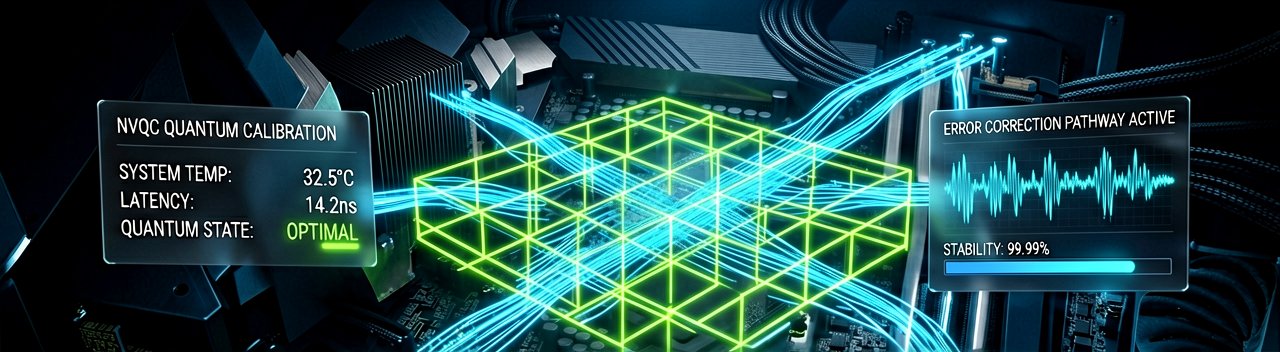
Historically, error correction was seen as a hurdle for the physicists to clear. However, as NVIDIA has demonstrated with their CUDA-Quantum initiatives, this is now a data science problem. The Ising models allow researchers to simulate "noise profiles" with unprecedented accuracy. Instead of guessing why a qubit flipped, developers can use these AI models to identify patterns in the interference. This "human-in-the-loop" calibration means that a system can learn its own flaws and adjust its gates accordingly, turning a temperamental laboratory experiment into a reliable computational tool.
The stakeholder perspective here is also telling. Academic partners have long complained about the "black box" nature of proprietary quantum stacks. By open-sourcing Ising, Nvidia is essentially giving the keys to the kingdom to the very people who can break—and then fix—the code. This transparency builds a level of trust that purely commercial ventures often lack. It invites a level of rigorous peer review that is essential for validating claims of quantum advantage, which have been under intense scrutiny lately.
Ultimately, this isn't just about making quantum computers work; it's about making them useful for the average enterprise. Most businesses don't care about the physics of entanglement; they care about optimization—be it logistics, drug discovery, or financial modeling. The Ising model is particularly adept at these types of "combinatorial" problems. By refining the error correction through open-source collaboration, Nvidia is effectively shortening the distance between a theoretical quantum speedup and a practical business result. It’s a pragmatic, boots-on-the-ground approach to a technology that has spent too much time in the clouds.
The Practicality Trap: Is Open Source a Cure or a Crutch?
Reading Between the Lines: There is a seductive narrative in the valley that open-sourcing a complex model is an act of pure altruism, a "rising tide lifts all boats" moment for the quantum community. But one must ask: if the Ising models were the silver bullet for quantum error correction, would a trillion-dollar company really give them away? The reality is likely more nuanced. By releasing these models, Nvidia is effectively crowdsourcing the R&D for a problem that they, for all their specialized hardware, cannot solve alone. It is a strategic move to ensure that when the "quantum winter" eventually thaws, the infrastructure everyone is using has a green logo stamped on it.
Furthermore, there is a fundamental contradiction in using classical GPUs to "fix" quantum errors. We are using the very architecture that quantum is supposed to replace to keep quantum alive. This creates a recursive loop of dependency. If we require massive clusters of H100s just to calibrate a handful of qubits, the energy efficiency and "quantum advantage" we’ve been promised start to look like a moving goalpost. There’s a risk that we aren't building a quantum computer so much as we are building a very expensive, very cold peripheral for an existing AI supercomputer.
Projecting forward, the implications are a double-edged sword. On one hand, the "democratization" of these models could accelerate the timeline for fault-tolerant computing by years, allowing a graduate student in a small lab to access the same error-mitigation tools as a tech giant. On the other hand, it risks standardizing an approach that might be a dead end. In the rush to adopt Nvidia’s framework, we might overlook more radical, non-Ising-based architectures that don't play as nicely with classical GPUs. Measured skepticism suggests that while these tools are a massive leap for current hardware, they may accidentally dictate the path of future hardware in ways we don't yet understand.
We also have to consider the "noise" in the data itself. AI-driven calibration is only as good as the simulation data it’s trained on. If our classical simulations of quantum noise are subtly flawed, we are effectively teaching our quantum computers to compensate for shadows that don't exist. It’s a high-stakes game of digital mirrors. While NVIDIA provides the best mirrors in the business, we shouldn't mistake the reflection for the reality of a stable, error-free quantum state.
"Building a quantum computer today is a bit like trying to build a cathedral out of Jell-O; Nvidia is kindly providing the toothpicks to hold it together, though they'll likely charge us for the premium mahogany scaffolding once the walls finally stop shaking."
Artūras Malašauskas is an AI Systems Integrator with 20+ years of production-grade web engineering experience. He has designed, shipped, and scaled enterprise Python/PHP systems for logistics, SaaS, and public-sector clients. For the past year, he has focused exclusively on AI integrations: deploying open-source LLMs, building generative media pipelines (image, audio, video), and engineering multi-agent workflows for real production environments. His standard: reproducibility, security, cost-efficient inference—no vaporware. He documents and evaluates emerging AI tooling, separating verified capabilities from marketing noise. Technical editor at: muza-ai.eu, ai-verslas.lt, ai-naujinos.lt Connect on LinkedIn
Comments