The Silicon Heavyweight: Why the New Razer Blade 18 is a Bet on Localized AI
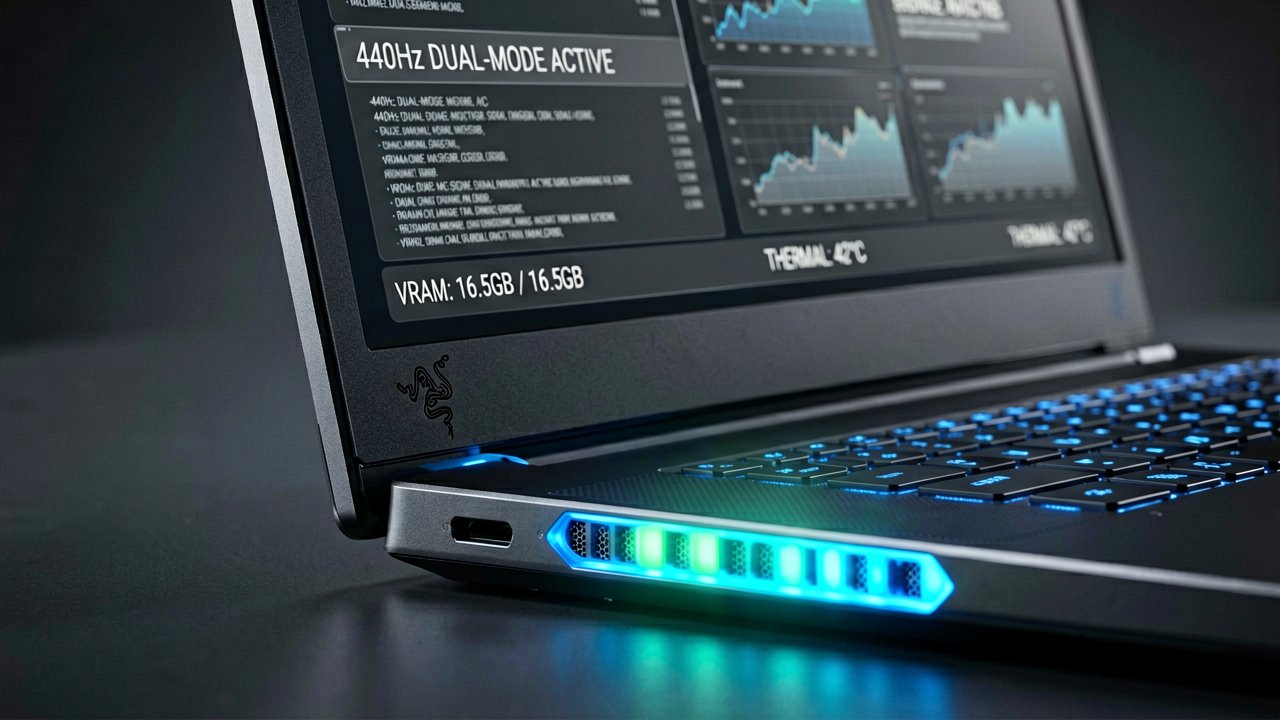
If you’ve been tracking the trajectory of high-end portables lately, you know the "desktop replacement" label usually comes with a massive asterisk. Usually, it means "desktop-level power, provided you don’t mind a chassis that weighs as much as a small boulder." But with the 2026 iteration of the Blade 18, Razer is making a convincing argument that we can finally ditch the fine print. This isn't just a gaming rig with a bigger screen; it’s a focused play for the emerging class of AI developers and local-model hobbyists who need serious iron in a form factor that can actually fit in a backpack.
The headline act here is undoubtedly the internals. Razer has packed in the new Intel Core Ultra 9 290HX Plus processor, a 24-core beast that pushes a max boost clock of 5.5GHz. While the raw speed is impressive for gaming, the real story for developers is the integrated NPU and the sheer throughput of the Arrow Lake Refresh architecture. According to Games Press , this setup delivers up to 37% faster LLM inference, which is the kind of leap that turns "waiting for the machine" into "actually getting work done."
Visuals and Versatility
We’ve seen high-refresh displays before, but the Blade 18’s dual-mode panel is a clever solution to a perennial problem. Developers and creative pros typically want the pixel density of 4K for detailed work, while gamers crave the buttery smoothness of high frame rates. This 18-inch screen manages both, allowing users to toggle between a crisp UHD+ 240Hz mode for deep-dive coding and a blistering FHD+ 440Hz mode for when the workday ends. It’s a specialized bit of kit that highlights Razer’s shift toward a hybrid "prosumer" demographic.
Of course, no AI-focused machine is complete without a massive GPU, and Razer hasn't held back. The top-tier configurations feature the NVIDIA GeForce RTX 5090 Laptop GPU with a full 175W TGP and 24GB of VRAM. That dedicated video memory is crucial; as noted by Hypebeast , having that much local VRAM allows developers to run complex generative AI models and large language models entirely on-device, bypassing the latency and privacy concerns of cloud-based APIs.

A True Desktop Replacement?
Connectivity is often where laptops fail to live up to the "desktop" moniker, but the inclusion of Thunderbolt 5 on the Blade 18 changes that math. With up to 3x more bandwidth than its predecessor, it’s finally possible to run multi-monitor 4K setups and high-speed external storage arrays without the usual bottlenecks. It’s a future-proofing move that feels essential given how fast AI development tools are evolving. Combined with Wi-Fi 7 and 2.5Gb Ethernet, the Blade 18 is basically a portable server room.
Sustaining this kind of performance in a 21.9mm chassis is no small feat, and Razer is leaning heavily on a refined vapor chamber cooling system. While previous 18-inch models were already solid performers, the 2026 version utilizes a multi-fan design specifically tuned to keep the CPU and GPU from throttling during long inference sessions or marathon gaming nights. It’s the kind of invisible engineering that justifies the "Blade" premium.
Starting at $3,499, the Blade 18 remains a luxury item, but for those bridging the gap between enthusiast gaming and professional AI development, the value proposition has never been clearer. It’s a specialized tool for a world where local compute is becoming just as important as high frame rates. If you need a machine that can compile a massive codebase in the morning and crush a ray-traced epic in the evening, Razer's latest is currently the one to beat.
Beyond the Spec Sheet: While the raw numbers on the Blade 18 are impressive, the real story lies in how Razer is pivoting its identity from a "gaming brand" to a foundational hardware provider for the silicon-hungry AI era. For years, the Blade was the "MacBook of gaming," but this latest iteration feels like a direct challenge to high-end workstations. By integrating Thunderbolt 5, Razer isn't just offering a faster port; they are solving the data-bottleneck issue that has long plagued mobile developers who need to move massive datasets between local NVMe drives and external training clusters.

Historically, the "Blade" ethos was about compromise—shaving off millimeters of thickness even if it meant the fans sounded like a jet engine. However, industry insiders suggest a shift in the engineering philosophy. The 2026 model prioritizes sustained thermal stability over record-breaking thinness. This is a nod to the AI researcher who might leave a model training overnight. Unlike a quick gaming session, AI workloads demand a steady power draw for hours on end, and Razer’s move to a more robust vapor chamber design suggests they’ve finally acknowledged that "peak performance" is meaningless if it can’t be maintained without thermal throttling.
The Local Compute Renaissance
There is also a broader industry narrative at play here regarding data sovereignty. As cloud costs for AI inference continue to climb, we are seeing a "re-localization" of compute power. Developers are increasingly looking for "Edge AI" capabilities—machines that can run Llama or Stable Diffusion variants without a subscription or an internet connection. The decision to spec the Blade 18 with 24GB of VRAM isn't just about rendering more realistic shadows in Cyberpunk; it’s about providing enough "headroom" to fit entire LLMs into memory, a move that places Razer in direct competition with specialized workstation manufacturers.
The reception from the creative community has been a mix of awe and sticker shock. While the $3,499 entry point is steep, long-time Razer enthusiasts point out that the build quality of the unibody aluminum chassis remains the gold standard for Windows machines. However, some critics argue that the move toward "desktop-class" parts pushes the limits of what a 330W power brick can realistically handle. It’s a delicate balancing act: how much power can you pull from a wall outlet before the "laptop" becomes a desktop tied to a permanent tether? Razer seems betting that for their target audience, the answer is "as much as possible."
Ultimately, the New Blade 18 represents the peak of the "one-machine" dream. It’s for the professional who refuses to maintain two separate rigs—one for the office and one for the home studio. By bridging the gap between a high-refresh gaming monitor and a workstation-grade GPU, Razer is betting that the future of tech isn't just mobile; it's modular. Whether this massive 18-inch footprint remains "portable" is a matter of debate, but for the developer who needs a portable command center, there is currently no other machine that packs this much punch into a single piece of aluminum.
Reading Between the Lines: For all the marketing luster surrounding "desktop-class" mobile performance, we have to address the elephant in the room: the law of physics remains undefeated. Razer is pitching a dream of uncompromised power, yet there is an inherent contradiction in stuffing a 175W GPU and a top-tier HX-series processor into a chassis barely an inch thick. While the benchmarks look stellar in a controlled lab environment, the real-world delta between a desktop RTX 5090 and its mobile namesake remains a significant chasm. We are looking at a "desktop replacement" that, while faster than almost anything else with a hinge, still operates under the strict thermal constraints of a battery-backed system.
The industry’s sudden pivot toward "AI Development" as a primary marketing pillar also warrants a healthy dose of skepticism. By branding the Blade 18 as a specialized tool for LLM training and inference, Razer is effectively rebranding high-end gaming specs to justify a professional-grade price hike. It’s a clever move to tap into corporate budgets rather than just teenage allowances, but it raises questions about longevity. If the "AI PC" era evolves toward specialized silicon like NPUs rather than raw CUDA core counts, today’s VRAM-heavy monsters might find themselves surprisingly ill-equipped for the software architectures of 2028.
The Portability Paradox
Then there is the question of what "portable" actually means in 2026. At nearly eight pounds before you add the substantial power brick, the Blade 18 is less of a laptop and more of a "foldable workstation" that migrates from one outlet to the next. The inclusion of a 440Hz display on a machine geared toward AI developers highlights a split personality; it’s a device trying to be everything to everyone, which often leads to a "jack of all trades, master of none" scenario. Are you buying a development kit that happens to play games, or a gaming rig that’s pretending to go to work?
Projecting forward, the success of the Blade 18 will likely hinge on whether the "Prosumer" niche actually exists in the numbers Razer expects. Most deep-learning researchers still rely on headless Linux servers or cloud clusters for heavy lifting, using their laptops merely as thin clients. Razer is betting that a significant portion of these users want to bring that heavy lifting to the coffee shop. It is a bold, expensive gamble on the idea that the future of innovation doesn't happen in a data center, but on a desk—provided that desk is within three feet of a high-voltage wall socket.
"It’s the ultimate machine for the person who wants to train a neural network at noon and play Cyberpunk at midnight, assuming they’ve also invested in a very sturdy backpack and a chiropractor on speed dial."
Artūras Malašauskas is an AI Systems Integrator with 20+ years of production-grade web engineering experience. He has designed, shipped, and scaled enterprise Python/PHP systems for logistics, SaaS, and public-sector clients. For the past year, he has focused exclusively on AI integrations: deploying open-source LLMs, building generative media pipelines (image, audio, video), and engineering multi-agent workflows for real production environments. His standard: reproducibility, security, cost-efficient inference—no vaporware. He documents and evaluates emerging AI tooling, separating verified capabilities from marketing noise. Technical editor at: muza-ai.eu, ai-verslas.lt, ai-naujinos.lt Connect on LinkedIn
Comments