UVA Researcher Uses Generative AI to Clear Up Grainy Sonograms
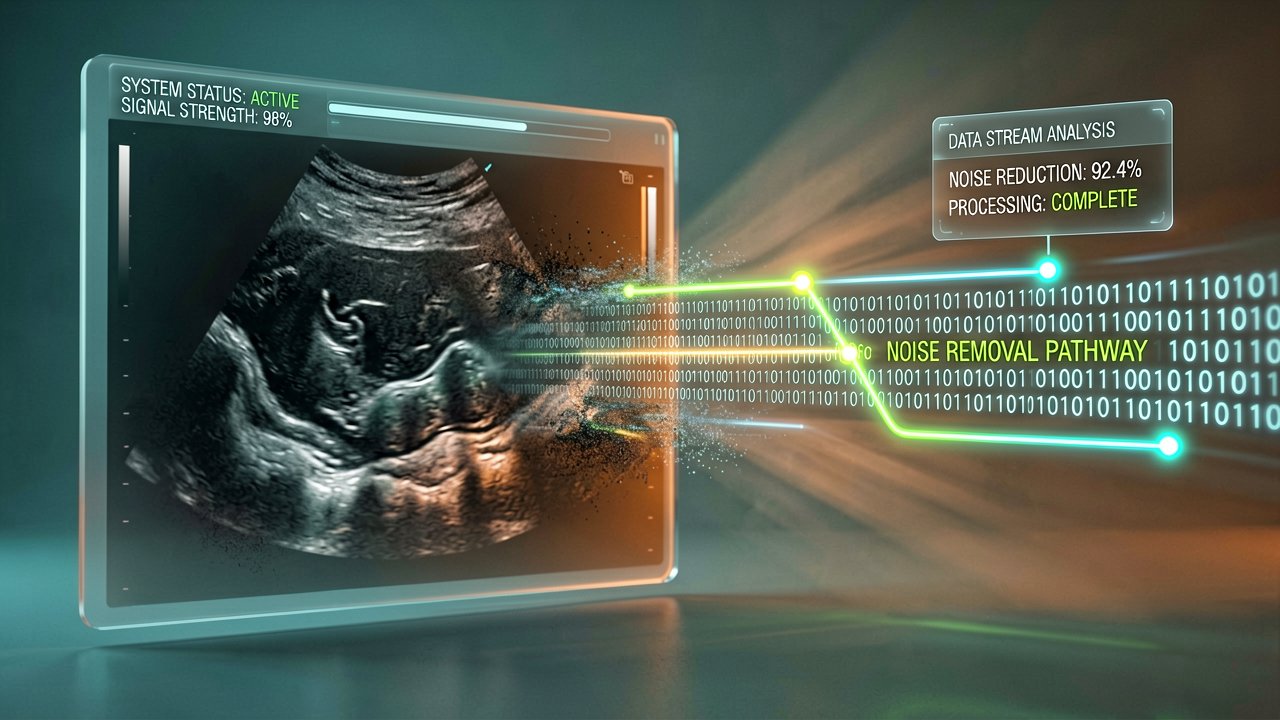
The first photographs many parents receive of their children are sonograms—grainy, gray images that reveal developing fetuses through noninvasive ultrasound technology. These images often lack diagnostic clarity, but University of Virginia engineering student Soumee Guha is working to change that.
Guha, a Ph.D. candidate in the Department of Electrical and Computer Engineering, builds generative artificial intelligence models designed to produce clearer medical images. Her research targets areas including the uterus, liver disease, and heart function. The work is unique because it doesn't require the large volumes of patient data typically needed to train diagnostic AI models—a constraint that has limited many similar projects.
To understand the problem, consider the physical reality of ultrasound imaging. A technician glides a specialized wand called a transducer across the abdomen. The device emits soundwaves through the skin and into the uterus. As those waves bounce off surfaces, they send back data from various depths and angles, resulting in the distorted images that give sonograms their distinctive look. Those granular patterns obscure details clinicians need to make diagnoses.
Guha's solution uses diffusion models, a type of generative AI architecture. The approach works by progressively diffusing visual noise within the image field, then dialing the noise back while looking for patterns. The AI creates the image it expects to see based on the data and models it trained on previously. The result is two different sets of images—one from the imaging equipment and one from AI—that doctors can compare or even combine.
According to the University of Virginia engineering news release, Guha's doctoral project is titled "Learning Under Multiplicative Noise: Principled Image Enhancement Frameworks for Coherent Imaging." She successfully defended it in spring 2026 and is preparing to graduate.
Her advisor, Scott Acton, American Telephone and Telegraph Company Professor of Engineering and chair of the department, said Guha is the first researcher to develop diffusion models for de-speckling and the first to address blurring caused by how imaging systems receive single points of light. "These aren't just one-off improvements," Acton noted. "Soumee is building solutions as part of a unified framework that will move the field forward."
The models Guha developed can improve the quality of sonar, radar, and laser images—all of which are degraded by speckling. Her approach considers domain-specific characteristics of imaging systems and the modes they use to capture images. Each mode is different, leading to variations in acquired images. Deep learning models for image enhancement often ignore the underlying physics captured in imaging systems, which leads to results that don't hold up in clinical or research settings.
Guha bridges that gap by integrating established physical models directly into the algorithmic framework. She eliminates the need for huge datasets by adding mathematical tools that help the algorithm tune into specific ranges for greater accuracy. This matters because that kind of data isn't always available in medical settings (a problem that has plagued researchers for years, frankly).
Many medical settings already apply AI to existing medical images to detect problems that may be unobservable. AI can analyze X-rays, magnetic resonance imaging, and computed tomography to see the tiniest fracture or find subtle changes to organs over time. Guha has entered the most cutting-edge segment of the diagnostic AI space by using AI-generated images as a way to better understand what's real.
The work has broad implications beyond immediate clinical use. Guha's AI images can be used to train future AI models and to judge the accuracy of other tasks such as tumor classification or volume measurements. The generative aspect creates new, clearer images from the original distorted ones, resulting in more accurate information for medical diagnostics.
Guha's journey into image processing began unexpectedly during her undergraduate studies with a simple data analysis project. She soon spent countless hours experimenting with image processing techniques, just for the sheer joy of discovery. That curiosity-driven work evolved into a dissertation that could fundamentally change how medical imaging systems handle noise.
Whether hospitals actually adopt this technology depends on regulatory approval, integration with existing imaging equipment, and whether clinicians trust AI-generated images enough to make diagnostic decisions based on them. The technology works in a lab setting, but the real test comes when a tired radiologist needs to make a call at 2 a.m. and has to trust an algorithm's output over their own eyes.
Artūras Malašauskas is an AI Systems Integrator with 20+ years of production-grade web engineering experience. He has designed, shipped, and scaled enterprise Python/PHP systems for logistics, SaaS, and public-sector clients. For the past year, he has focused exclusively on AI integrations: deploying open-source LLMs, building generative media pipelines (image, audio, video), and engineering multi-agent workflows for real production environments. His standard: reproducibility, security, cost-efficient inference—no vaporware. He documents and evaluates emerging AI tooling, separating verified capabilities from marketing noise. Technical editor at: muza-ai.eu, ai-verslas.lt, ai-naujinos.lt Connect on LinkedIn
Comments