The 'Southbound' Pivot: How China is Rewriting the AI Playbook in Emerging Markets

China is engineering a fundamental shift in its artificial intelligence ambitions by actively pivoting away from a head-to-head architectural race with the United States. Rather than measuring success solely through frontier model parameters or chasing Silicon Valley's hardware-heavy benchmarks, Beijing is focusing its state-backed and corporate AI ecosystems on unique, high-growth global markets. This approach treats AI less as an isolated proprietary product and more as a scalable public utility tailored for the Global South, establishing localized footholds where Western hyperscalers have historically underinvested.
This strategic diversion is deeply structural, accelerated by international export controls and a domestic drive to commercialize high-tech capacity. By bundling AI software with physical telecommunications networks, undersea cables, and regional data centers, Chinese technology firms are cementing long-term systemic dependencies across Southeast Asia, Central Asia, and the Middle East. The primary objective has evolved from beating Western tech giants in absolute computing power to defining the actual operational frameworks, data pipelines, and regulatory norms of the world's fastest-growing digital economies.
Infrastructure Bundling and the Digital Silk Road
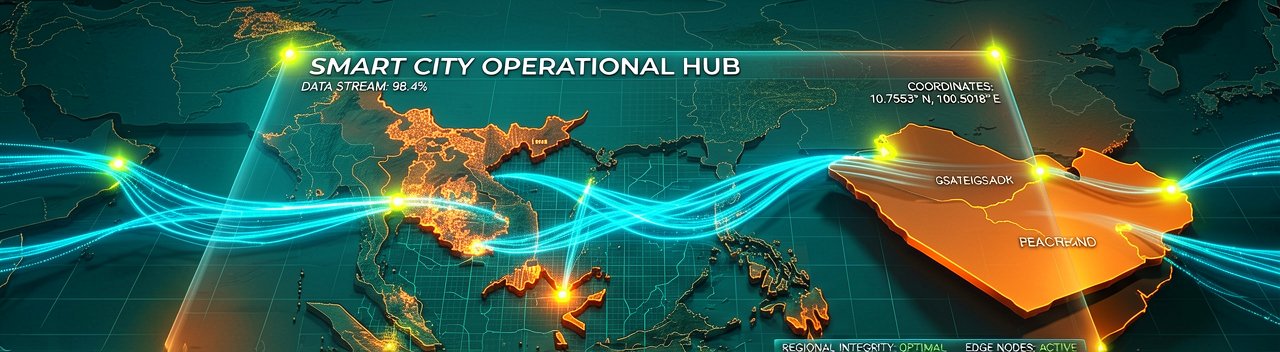
The core mechanism of China's international AI expansion is the next-generation iteration of the Digital Silk Road, which has evolved from a baseline telecommunications initiative into a comprehensive ecosystem framework. According to a detailed report from the Atlantic Council's Digital Forensic Research Lab, the strategy has moved decisively from hard connectivity toward "soft connectivity," which directly encompasses AI governance diplomacy, localized capacity building, and service-layer software platforms. Chinese enterprises are actively offering highly cost-effective, cloud-integrated AI solutions that appeal to governments navigating tight fiscal constraints and infrastructure deficits.
This approach allows Chinese firms to bypass the high-cost deployment barriers typical of Western AI architectures. By integrating AI capability directly into existing smart city platforms, mobile payment systems, and local cloud nodes, companies like Huawei and Alibaba are creating highly localized applications. Analysts at the Center for Strategic and International Studies note that low- and middle-income countries are faced with a choice between tortuous, expensive Western deployments and accessible, bundle-packaged Chinese alternatives. This creates an ecosystem where recipient nations adopt Chinese technology standards by default, embedding these systems into their national infrastructure architectures.
Establishing Norms and Institutionalizing AI as a Public Good
Geopolitically, the shift is supported by aggressive diplomatic positioning that frames Chinese technology as an instrument of equitable development rather than corporate profit. This narrative has been institutionalized through major multilateral frameworks, including China's formal co-sponsorship of the UN AI Capacity-Building Action Plan for Good and for All. As highlighted by China Diplomacy, this framing positions Beijing as a collaborative partner rather than a proprietary vendor, presenting a distinct alternative to Silicon Valley’s market models that often lock developing states into rigid software licensing regimes.
This diplomatic strategy directly complements China's domestic industrial roadmaps, including the newly rolled-out 15th Five-Year Plan. As documented by The Diplomat, China's policy planning explicitly mandates accelerating its international influence over emerging technology governance and internet protocols. By deploying functional, highly optimized open-source and lightweight models across regions like Central Asia and the Gulf, China is actively decentralizing AI utility. While Western firms remain focused on building massive foundational models, the Chinese tech sector is dominating the practical, day-to-day application layers that keep developing economies running.
Under the Hood of the Localization Machine
Behind the Scenes: China’s real advantage in the Global South does not stem from sovereign state decrees, but from an unparalleled willingness to customize technology for highly fragmented local ecosystems. While major American AI firms often deliver rigid, English-centric software-as-a-service APIs with limited local optimization, Chinese tech giants operate on a high-touch, hyper-localized service model. They routinely deploy large teams of engineers directly into regional capitals across Southeast Asia and Africa to co-develop models in native languages, train municipal employees, and modify AI architectures to run efficiently on lower-tier domestic hardware.
This hands-on regional integration creates deeply institutionalized networks that are incredibly difficult to displace. Local bureaucrats and engineers are being trained within technical frameworks designed entirely by Chinese corporations, creating an entire generation of tech professionals whose foundational expertise is tethered to Chinese codebases, data structures, and hardware ecosystems. Consequently, even if a Western alternative later emerges with superior raw computational benchmarks, the high switching costs, localized code dependencies, and retraining requirements create an effective barrier to entry.

Simultaneously, Chinese AI vendors are successfully decoupling their international growth from the high-end semiconductor supply chain vulnerabilities that complicate their domestic operations. By focusing heavily on the deployment of highly optimized, lightweight edge-computing models and open-source frameworks, these firms can deliver sophisticated computer vision, smart-city, and logistics automation tools that run on readily available, legacy-node silicon. This practical approach transforms geopolitical export controls from an immediate bottleneck into a driver for lean, pragmatic software engineering that perfectly matches the constrained computing environments of developing nations.
The geopolitical dividend of this market strategy is a steady accumulation of diplomatic capital and normative influence. While the West continues to debate global AI safety standards inside exclusive, high-level forums, Beijing’s active deployment of functional public utilities builds a powerful voting bloc of supportive nations in international bodies like the International Telecommunication Union. This expanding alignment ensures that when global standards for data sovereignty, algorithmic governance, and cross-border data flows are eventually codified, the foundational architecture will be heavily influenced by China's decentralized, state-integrated vision of the digital world.
The Friction of Pragmatism: Cracks in the Exported Architecture
Reading Between the Lines: This massive geopolitical pivot toward the Global South is frequently framed by industry observers as a seamless, uncontested expansion. However, a deeper structural critique reveals a fundamental friction embedded within this localized, hardware-light strategy. While Chinese AI firms excel at deploying practical software layers over existing municipal grids, their deliberate avoidance of the frontier compute race is not entirely voluntary. It represents a pragmatic concession to Western semiconductor supply constraints, creating a strategy that is highly vulnerable to rapid shifts in local trust and hardware reliability over the long term.
Furthermore, as these tech ecosystems deepen across emerging markets, they are increasingly meeting localized institutional resistance. According to a comprehensive analysis by the Atlantic Council's Digital Forensic Research Lab, the long-term durability of China's Digital Silk Road is complicated by a mounting trust deficit, driven by persistent concerns over data sovereignty, opaque local collateralization practices, and an over-reliance on centralized Chinese cloud architectures. Sovereign nations that initially welcomed low-cost, bundled AI applications are progressively waking up to the realities of severe vendor lock-in, where their national security pipelines and commercial data frameworks become entirely dependent on foreign software upkeep.
This reality exposes a glaring contradiction between Beijing’s diplomatic narrative of "inclusive human development" and the practical execution of its corporate tech deployments. While official communications at international forums heavily emphasize mutual capacity building and technological autonomy for developing economies, the operational structures tell a different story. In practice, the core intellectual property, algorithmic weights, and cloud backbones remain firmly anchored within mainland infrastructure, turning recipient nations into data providers and consumer endpoints rather than true co-creators of artificial intelligence. If Western hyperscalers manage to successfully lower their own deployment costs or open-source their frontier weights more aggressively, Beijing's current advantage in these regional markets could quickly erode, exposing a reliance on temporary economic conveniences rather than permanent ideological alignments.
"Ultimately, Beijing’s masterful AI pivot proves that while you might not be able to sell a trillion-parameter foundational model to a cash-strapped municipality, you can easily sell them an automated traffic system that runs flawlessly on a decade-old microchip—provided they do not mind where the data parks at night."
Artūras Malašauskas is an AI Systems Integrator with 20+ years of production-grade web engineering experience. He has designed, shipped, and scaled enterprise Python/PHP systems for logistics, SaaS, and public-sector clients. For the past year, he has focused exclusively on AI integrations: deploying open-source LLMs, building generative media pipelines (image, audio, video), and engineering multi-agent workflows for real production environments. His standard: reproducibility, security, cost-efficient inference—no vaporware. He documents and evaluates emerging AI tooling, separating verified capabilities from marketing noise. Technical editor at: muza-ai.eu, ai-verslas.lt, ai-naujinos.lt Connect on LinkedIn
Comments