Dell and Nvidia Unveil AI Factory 2.0 at Conference - Let's Data Science
The enterprise AI infrastructure landscape is shifting again. Dell and Nvidia are set to unveil what's being called AI Factory 2.0 during a joint keynote at Dell Technologies World on May 18, 2026. The presentation, scheduled for 10 a.m. PT at The Venetian in Las Vegas, will feature Michael Dell and Jensen Huang taking the stage together.
According to the official Dell press release, this marks the two-year anniversary of the Dell AI Factory with Nvidia. The company reports over 4,000 customers have already deployed the platform, with early adopters seeing up to 2.6x ROI within the first year. That's a bold claim in an industry where pilot purgatory is the norm.
The hardware updates are where things get dense. Coverage from Let's Data Science details an expanded PowerEdge line including the XE9780 and XE9785, plus liquid-cooled variants XE9780L and XE9785L. These systems support up to 192 Nvidia Blackwell Ultra GPUs per system, configurable to 256 GPUs per Dell IR7000 rack. That's extreme density for a reason—large model training demands it.
Dell claims these servers deliver up to four-times faster large language model training compared with the PowerEdge XE9680. The PowerEdge XE9712 will include the Nvidia GB300 NVL72, which Dell says offers 50 times more AI reasoning inferencing output. Meanwhile, the PowerEdge XE7745 will offer the Nvidia RTX Pro 6000 Blackwell Server Edition when it ships in July 2025. (Shipment dates matter more than launch dates, frankly.)
The software side matters just as much as the silicon. Nvidia AI Enterprise will be available directly through Dell, bundling the accelerator architectures with Dell's server, storage, and services. This integrated approach aims to reduce customer integration burden—moving from discrete components to hardware-software-service bundles. Varun Chharba, SVP of infrastructure and telecom marketing at Dell, stated this is "going to really help customers adopt AI servers faster than ever before."
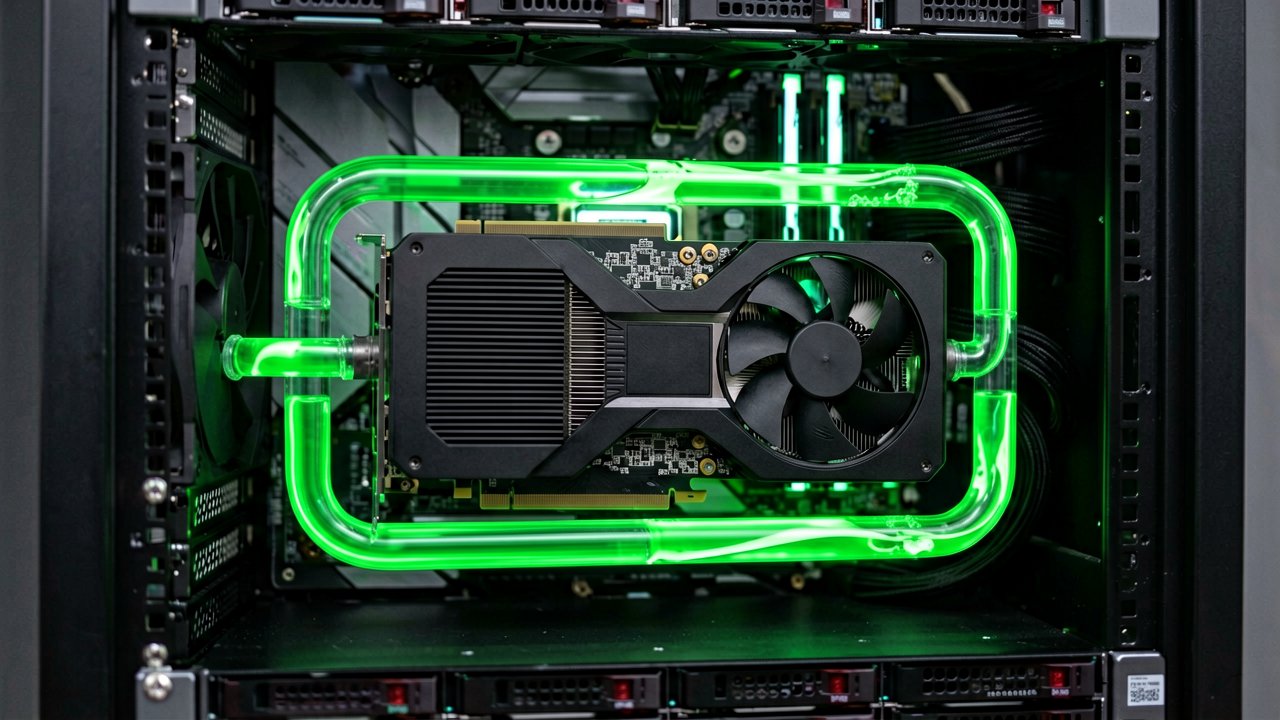
Physical reality check: liquid cooling isn't optional at this scale. The direct-to-chip cooling in the XE9780L and XE9785L handles the thermal load that air cooling simply cannot manage at 192-GPU densities. Data center operators will need to plan for the plumbing, power distribution, and maintenance overhead that comes with liquid-cooled racks. It's not just plugging in a server anymore.
The Dell AI Data Platform with Nvidia addresses the data foundation, combining Dell's high-performance storage, modular data engines, and Nvidia accelerated computing with CUDA-X libraries. It handles workloads from retrieval-augmented generation (RAG) and multimodal search to agentic workflows. The goal is turning institutional knowledge into AI fuel without the usual data wrangling headaches.
Desktop AI development gets attention too. Dell is the first OEM to ship a desktop with the Nvidia GB300 Grace Blackwell Ultra Desktop Superchip, delivering up to 20 petaFLOPS of FP4 performance and 748GB of coherent memory. With Nvidia OpenShell, enterprises can build safe, autonomous, long-running agents at the desk with local AI that keeps data secure and private.
What to watch after the keynote: independent benchmarks validating the four-times and 50x vendor claims, actual shipment dates and regional availability, and when Nvidia AI Enterprise images and managed-service SLAs appear in Dell's catalog with disclosed pricing. Vendor demos and case studies at and after the event will show how the integrated stacks perform against end-to-end enterprise requirements.
The Dell-Nvidia collaboration extends a pattern: vendors moving from selling discrete components to offering integrated bundles. Dell brings server, storage, and services, while Nvidia provides accelerator architectures and software. The impact is significant for datacenter planning but depends on independent validation and availability, limiting immediate transformative effect.
Whether enterprises actually pay for the integrated stack versus building their own remains the real question. The hardware is impressive, but the ROI claims need third-party verification before CIOs start signing checks. Time will tell if this works in production, not just on a demo stage.
Artūras Malašauskas is an AI Systems Integrator with 20+ years of production-grade web engineering experience. He has designed, shipped, and scaled enterprise Python/PHP systems for logistics, SaaS, and public-sector clients. For the past year, he has focused exclusively on AI integrations: deploying open-source LLMs, building generative media pipelines (image, audio, video), and engineering multi-agent workflows for real production environments. His standard: reproducibility, security, cost-efficient inference—no vaporware. He documents and evaluates emerging AI tooling, separating verified capabilities from marketing noise. Technical editor at: muza-ai.eu, ai-verslas.lt, ai-naujinos.lt Connect on LinkedIn
Comments