Planview Launches Agent Resource Management for AI-Human Workforce Governance

The enterprise portfolio management space just got more complicated. Planview announced new Agent Resource Management capabilities designed to track AI agents alongside human workers in a single system. This isn't just another AI feature bolted onto existing software. It represents a fundamental shift in how organizations will account for work output when the "who" doing the work might be a machine.
According to the company's official press release, the system gives resource managers visibility into compute costs, token spend, and agent activity attribution. Leaders can see human resources and AI agents side-by-side at assignment time. They can model different human-to-agent mixes before committing to any particular configuration. The audit trail requirement means every agent action has a human decision-maker attached to it.
That last point matters more than it sounds on first read. When an AI agent makes a mistake, someone needs to be accountable. Planview's approach enforces policy at runtime to prevent agents from exceeding their boundaries. Actions that cross those lines halt before they commit, with automatic escalation to the accountable human. (This is the kind of guardrail most enterprises have been asking for but rarely get.)
The market timing aligns with broader enterprise AI adoption trends. Gartner predicts 40% of enterprise applications will include integrated task-specific AI agents by the end of 2026. That's a 700% increase from 2025. Meanwhile, Deloitte's Q4 2025 CFO Signals Survey found 54% of chief financial officers prioritizing AI agent integration in 2026. The financial pressure is real, and it's coming from the top.
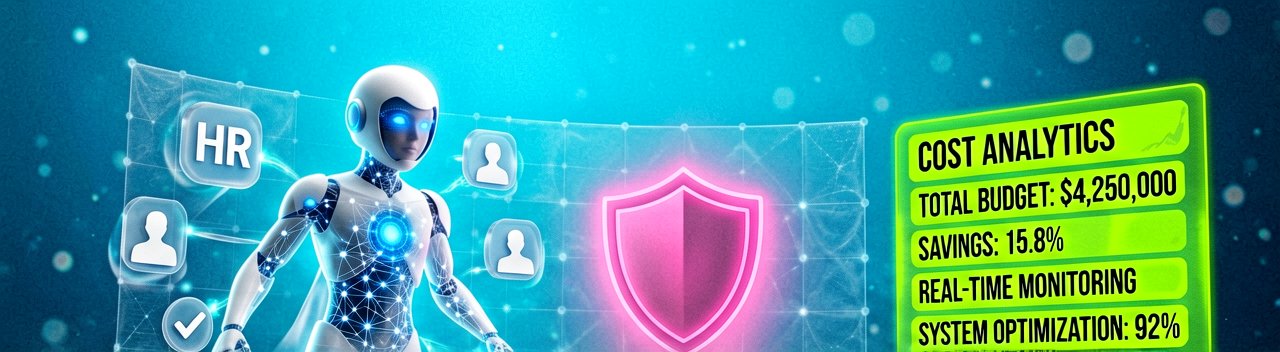
Planview's official announcement details three purpose-built agents shipping with the platform. The PM Agent handles status updates, flags blockers, and generates standup updates on demand. The Backlog Agent runs a "definition of ready" check on every assigned card, scoring description clarity and acceptance criteria. Forecasting Agents flag risks based on delivery confidence and historical velocity.
These aren't experimental features. They're assignable, cost-tracked resources governed alongside human resources from day one. That distinction separates this from the wave of AI assistants that populate most productivity suites. Those tools suggest, recommend, or draft. Planview's agents execute work that shows up on capacity dashboards with associated costs.
The physical reality of using this system involves clicking through resource allocation screens where AI agents appear as line items next to human team members. You'll see token spend numbers alongside salary costs. You'll set budget ceilings and escalation paths at the moment of assignment. The interface treats agent capacity the same way it treats human capacity, which is both the innovation and the potential friction point.
Matt Zilli, CEO of Planview, framed the problem clearly in the announcement. "Agentic AI has reshaped how businesses get work done. Enterprises now run blended human and agent workforces, but most leaders lack insight into whether those resources are allocated to the right work and who is accountable when something goes wrong." The question every executive team is asking: what is agentic AI actually costing us, and is it delivering the outcomes we need?

SD Times covered the launch with similar emphasis on the governance angle. The outlet noted that Planview's approach extends the existing resource model to include AI agents and their total cost. Resource managers see the true cost of every capacity decision before they make it. They know who assigned the work.
This matters because most portfolio management tools weren't built for this. They track human hours, project budgets, and milestone dates. They don't track token consumption or compute costs. They don't have audit trails for AI agent actions. They can't model what happens when you swap three human developers for two AI agents plus one human reviewer.
Louise Allen, Planview Chief Product Officer, emphasized the company's experience managing enterprise resource capacity at scale. "That experience — how resources are actually allocated, how blended workforces operate in practice, how agent capacity should be governed — defines our agent resource management. No horizontal AI platform offers this combination of resource management history, portfolio context, and enterprise trust."
The availability timeline is Fall 2026. Customers interested in early access can contact their Planview account team. That's a long lead time for something addressing an immediate problem, but enterprise software deployment cycles are notoriously slow. Organizations will need time to configure policies, train resource managers, and integrate the new tracking into existing financial systems.
There's also the question of whether this solves the real problem or just makes it more visible. Tracking AI agent costs doesn't automatically optimize them. Governance doesn't guarantee good outcomes. The system provides data, but leaders still need to make decisions about what work deserves AI attention versus human attention.
Some organizations might find the added complexity burdensome. Others will see it as necessary infrastructure for scaling AI deployment responsibly. The difference comes down to how mature their AI strategy is and how much they value accountability over speed.
Whether CFOs actually use this data to make different decisions remains the real question.
Artūras Malašauskas is an AI Systems Integrator with 20+ years of production-grade web engineering experience. He has designed, shipped, and scaled enterprise Python/PHP systems for logistics, SaaS, and public-sector clients. For the past year, he has focused exclusively on AI integrations: deploying open-source LLMs, building generative media pipelines (image, audio, video), and engineering multi-agent workflows for real production environments. His standard: reproducibility, security, cost-efficient inference—no vaporware. He documents and evaluates emerging AI tooling, separating verified capabilities from marketing noise. Technical editor at: muza-ai.eu, ai-verslas.lt, ai-naujinos.lt Connect on LinkedIn
Comments