Coinbase’s AI Agent Platform Signals Shift to Autonomous Financial Ecosystems

The financial services sector is transitioning toward machine-driven operations following the launch of the "Coinbase for Agents" platform by Coinbase. This framework links artificial intelligence models directly to retail and institutional exchange accounts, enabling autonomous software to trade digital assets, rebalance portfolios, and execute complex workflows within preset risk parameters. By providing large language models (LLMs) with execution capability alongside standard financial reasoning, this infrastructure marks an evolution from human-dependent fintech apps to a native agent economy.
Autonomous commerce has long been constrained by legacy banking rails that require manual credit card entries and multi-factor authentication. Coinbase addresses this bottleneck by integrating its platform with the Coinbase Institute x402 payment protocol, a standard co-developed with Cloudflare to revive the dormant HTTP 402 "Payment Required" status code for machine-to-machine microtransactions. Using stablecoins like USDC for instant cryptographic settlement, AI agents can now independently bypass paywalls, license proprietary datasets, and procure distributed GPU compute power without human oversight.
This initiative expands on earlier tools like AgentKit and the "Based Agent" template, embedding autonomous software into the core liquidity pool of a major regulated exchange. The strategic roadmap extends beyond crypto into equities, commodities, and prediction markets, positioning the platform as a general-purpose financial engine. As digital assistants evolve from data aggregators into sovereign economic actors, establishing secure execution boundaries and built-in transaction monitoring will determine which platform captures the bulk of future machine-to-machine transaction volumes.
The Architecture of Machine-to-Machine Commerce
The operational framework of this ecosystem relies on a three-tier system: the intelligence layer where LLMs process financial data, the wallet layer managing non-custodial cryptographic keys, and the transaction layer powered by the x402 protocol. This structure allows software entities to discover, negotiate, and settle payments instantly on public ledgers. Traditional banking rails are fundamentally ill-suited for high-frequency machine interactions due to latency and fraud mitigation delays, making on-chain stablecoins the default medium for digital assistant commerce.

Risk Mitigation and Institutional Compliance
Deploying autonomous agents into public markets introduces unique regulatory and capital risks that necessitate strict operational guardrails. Coinbase addresses these liabilities by allowing users to restrict agents to isolated portfolios, enforce spending caps, and define specific limits on trade sizes. Compliance is maintained by routing all automated transactions through the same Know Your Transaction (KYT) infrastructure and real-time monitoring tools that power the exchange's main consumer applications, ensuring machine activity adheres to financial safety standards.
Market Implications for the Digital Economy
The emergence of agent-first financial networks is altering consumer and enterprise internet monetization strategies. Corporate applications are shifting from user-based subscriptions to consumption-driven models, where automated software discovers and pays for APIs on-demand. While decentralized systems offer unparalleled transaction finality, early market implementations require ongoing oversight to mitigate algorithmic errors, manage paper gains, and prevent capital inefficiencies across multi-agent environments.
The Hidden Race for Autonomous Capital Routing
What Most Reports Miss: The launch of Coinbase for Agents is not merely a product expansion; it is an aggressive land grab to control the primary routing protocols of a multi-billion-dollar automated financial infrastructure. While legacy banking platforms struggle to integrate AI within outdated regulatory guidelines, digital asset entities are aggressively shipping developer frameworks to capitalize on a critical structural opening. The true battlefield lies in capturing the initial distribution networks of autonomous software wallets before standard enterprise APIs adapt to multi-agent interactions.
This dynamic has triggered a direct architectural confrontation between major financial competitors. Tech industry giants like have moved aggressively into the same territory, leveraging acquisitions of stablecoin infrastructure layers like Bridge to build competing networks capable of processing friction-free web payments. The emerging competitive landscape pits specialized web3 execution layers directly against established merchant payment processing giants, turning the race to define the core technical standards of autonomous commerce into a highly volatile winner-take-all environment.
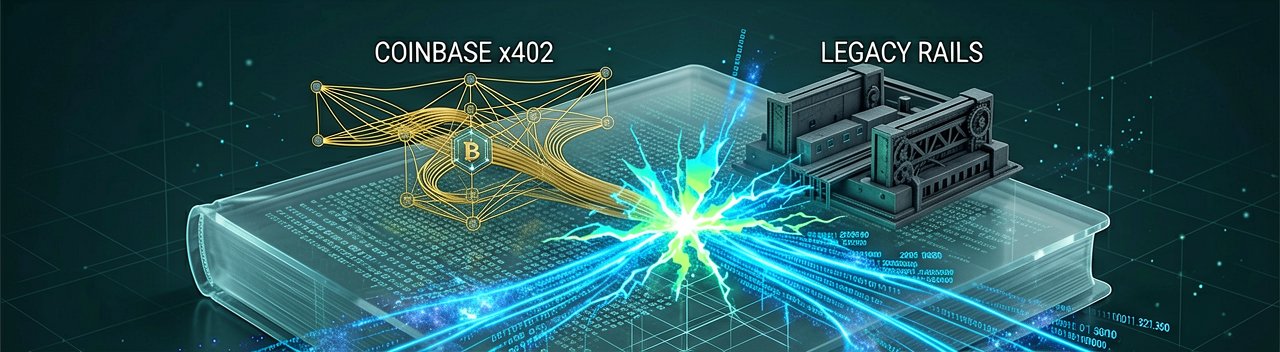
The operational logic driving this shift is rooted in the transition from basic automation to complete system autonomy. Standard programmatic software typically functions inside narrow boundaries determined by predefined triggers and sequential workflows, whereas agentic installations plan multi-step actions, adapt to evolving real-time data feeds, and dynamically manage their own budgets. Giving autonomous models direct software-native wallet capabilities converts them from isolated text processors into independent capital aggregators that can procure server power and data licenses without human authorization.
However, this structural shift introduces unprecedented systemic vulnerabilities that extend far beyond normal software development errors. Financial institutions are encountering severe challenges in logging, auditing, and maintaining real-time visibility into distributed multi-agent logic chains, exposing capital pools to flash crashes and systemic loop failures. As these autonomous agents continuously interact across public decentralized networks, the absence of standardized algorithmic circuit breakers could lead to unpredictable market feedback loops that challenge existing risk management paradigms.
The Friction Between Autonomous Assets and Legacy Law
Reading Between the Lines: The industry enthusiasm surrounding autonomous agent networks glosses over a fundamental contradiction in modern corporate legal frameworks. Tech firms and exchanges boast about software entities that can independently sign contracts, lease server capacity, and route capital across international borders. Yet, international commercial law recognizes only natural persons and registered corporate structures as valid legal actors. This structural mismatch means that when an autonomous agent inevitably drains its balance sheet due to a flawed model update, the legal liability will immediately default back to the human developer or the enterprise that initialized the software wallet.
This dynamic exposes a severe operational bottleneck within the broader developer economy. Silicon Valley platforms are racing to ship developer kits like AgentKit and specialized software adapters, but traditional compliance departments are quietly pushing back behind closed doors. Anti-money laundering (AML) frameworks and identity verification standards require an identifiable individual or corporation to anchor every financial transaction. Forcing a non-human entity into a regulatory apparatus built specifically for human identification creates an ongoing friction point that technical code cannot easily resolve without heavy human interventions.
Furthermore, the claim that autonomous agents will democratize financial market access ignores the reality of data monopolies. The actual performance of an autonomous asset manager relies heavily on the quality and freshness of the underlying dataset used to fine-tune the model. While any independent developer can deploy a basic financial agent to an open ledger, institutional desks retain exclusive access to private order books and low-latency infrastructure. This advantage ensures that enterprise agents will consistently outperform independent public software, threatening to concentrate market liquidity into fewer corporate hands than ever before.
The long-term consequence of this shift is not the total eradication of financial intermediaries, but rather their complete reinvention. Legacy clearinghouses and settlement desks will gradually be replaced by automated verification platforms, code auditing networks, and real-time transaction monitoring suites. The true financial authority will no longer belong to the entity with the most capital, but to the specialized engineering organizations that control the foundational prompt architecture, the underlying model training runs, and the automated risk parameters governing the code.
We are rapidly approaching a financial landscape where your digital assistant will negotiates micro-payments with a server cluster owned by another digital assistant, all to fetch data curated by a third digital assistant. Human investors will finally achieve the ultimate dream of high finance: being completely left out of the loop while our software confidently mismanages our portfolios at near-instantaneous speeds.
Artūras Malašauskas is an AI Systems Integrator with 20+ years of production-grade web engineering experience. He has designed, shipped, and scaled enterprise Python/PHP systems for logistics, SaaS, and public-sector clients. For the past year, he has focused exclusively on AI integrations: deploying open-source LLMs, building generative media pipelines (image, audio, video), and engineering multi-agent workflows for real production environments. His standard: reproducibility, security, cost-efficient inference—no vaporware. He documents and evaluates emerging AI tooling, separating verified capabilities from marketing noise. Technical editor at: muza-ai.eu, ai-verslas.lt, ai-naujinos.lt Connect on LinkedIn
Comments