Rubrik Launches Agent Cloud for Enterprise AI Governance on Google Cloud

Enterprise AI governance just got a physical control layer. Rubrik launched Rubrik Agent Cloud (RAC) on April 22, 2026, targeting organizations deploying autonomous agents on Google Cloud's Gemini Enterprise Agent Platform. The announcement came via official press release, positioning the tool as a bridge between AI speed and security compliance.
The core problem Rubrik is addressing is straightforward: enterprises want AI agents that can act autonomously, but they don't want those agents to accidentally delete production databases or leak sensitive customer data. Legacy security systems rely on deterministic rules that cannot comprehend natural language nor adapt to dynamic actions taken by agents. Rubrik's solution replaces static oversight with intent-driven governance.
According to the company's official documentation, RAC is powered by the Semantic AI Governance Engine (SAGE), which Rubrik first unveiled at RSAC 2026 in March. SAGE uses a custom Small Language Model (SLM) to interpret the semantic meaning of policies in real time. This matters because keyword-based filters miss context. A policy saying "Do not give financial advice" needs to understand what financial advice actually looks like in practice, not just flag the word "finance."
The integration includes four core capabilities that administrators will actually interact with daily. First, Agent Inventory automatically discovers agents running on Gemini Enterprise Agent Platform Runtime, providing visibility into risk, access permissions, and policy violations. Second, the Unified AI Control Pane lets security teams manage AI policies from the same interface used for Google Workspace and hybrid cloud data. Third, SAGE provides real-time guardrails that monitor agent behavior as it happens. Fourth—and perhaps most distinctive—Agent Rewind can instantly and precisely undo an autonomous agent's destructive action.
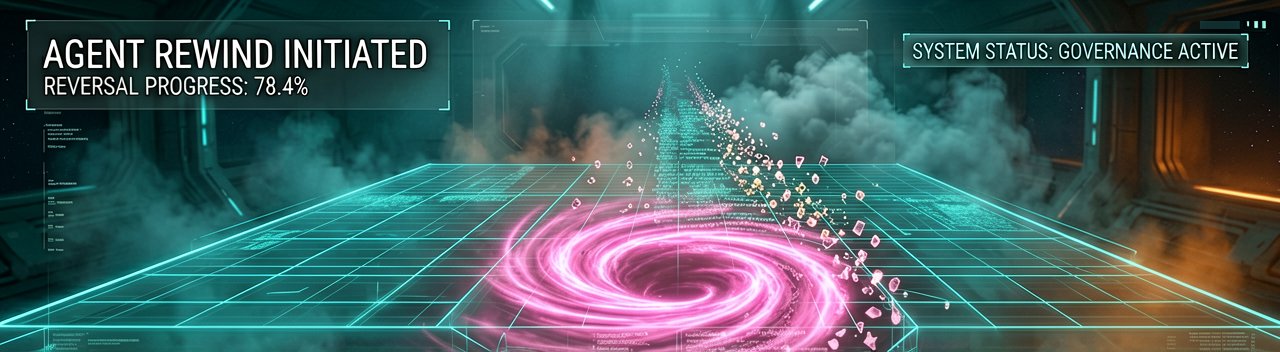
That last feature deserves attention. When an AI agent makes a mistake, traditional recovery means restoring from backups, which can take hours or days. Agent Rewind is designed to reverse specific actions immediately. Think of it like Ctrl+Z for enterprise AI, but at the database level. The physical reality here is that IT teams no longer wait through restore windows while business operations stall.
Rubrik's official press release states the company benchmarked SAGE against OpenAI's GPT-5.2. In their testing, Rubrik's custom SLM processed messages five times faster and detected violations correctly more often than the generalized model. The compute overhead was also significantly reduced. Whether independent verification will match these claims remains to be seen (though security vendors have a long history of optimistic internal benchmarks).
Devvret Rishi, General Manager for AI at Rubrik, framed the launch around removing governance bottlenecks. "Enterprises want the speed of Google Cloud's AI technologies, but also require the safety of Rubrik's cyber resilience," he said. The collaboration aims to let customers speed AI agents into production without compromising enterprise security or integrity.
Satish Thomas, Vice President for Applied AI and Platform Ecosystem at Google Cloud, echoed the security angle. "As enterprises move into the autonomous era with Gemini Enterprise, security and governance are top of mind," Thomas stated. "Rubrik helps to provide a unified control layer for agent deployment and security that is critical for AI success."

Market context matters here. Gartner predicts that 40% of enterprise applications will be integrated with task-specific AI agents by the end of 2026. That's not a distant future problem—it's happening now. Organizations are already deploying agents that can modify code, access customer records, and execute transactions. The governance infrastructure needs to keep pace.
Digital Watch Observatory covered the launch, noting the integration adds semantic governance and operational resilience through real-time, intent-based guardrails. The outlet's reporting aligns with Rubrik's official messaging on core features and capabilities.
The technical architecture is worth unpacking. SAGE translates natural language instructions into machine logic, recognizing context that static filters miss. It also includes adaptive policy improvement, proactively identifying ambiguous guardrails and suggesting refinements before violations occur. This shifts AI security from reactive monitoring to active, semantic enforcement.
For IT administrators, the user experience changes significantly. Instead of reviewing logs after incidents occur, they get a command center for agentic operations. The interface integrates with existing Rubrik platforms, meaning teams don't need to learn entirely new tools. That's a practical consideration—security teams are already stretched thin.
There are limitations worth noting. The press release includes a safe harbor statement indicating some referenced services may not be made generally available on time or at all. Customers should make purchase decisions based on currently available features. Additionally, the GPT-5.2 benchmark comparison comes from Rubrik's internal testing, not third-party validation.
Competition in this space is heating up. Other security vendors are building similar governance layers, though Rubrik's Agent Rewind capability appears unique in the market. The ability to instantly undo destructive actions rather than restore from backups represents a meaningful operational advantage—if it works as advertised in production environments.
For organizations already running Gemini Enterprise Agent Platform, the integration path appears straightforward. Rubrik is demonstrating the platform at Google Cloud Next 2026 in Las Vegas, booth #7509, from April 22-24. The company also offers demo requests for customers evaluating the solution.
The real question isn't whether AI governance tools are needed—they clearly are. The question is whether semantic governance engines can actually keep pace with increasingly autonomous agents that learn and adapt faster than policy teams can write rules. Rubrik's approach is ambitious, but the market will judge based on real-world performance, not press release benchmarks.
Whether enterprises actually pay for this layer of protection, or whether they'll continue deploying agents with inadequate governance until incidents force their hand, remains the real question. Security budgets are tight, and the cost of inaction is often invisible until it's too late.
Artūras Malašauskas is an AI Systems Integrator with 20+ years of production-grade web engineering experience. He has designed, shipped, and scaled enterprise Python/PHP systems for logistics, SaaS, and public-sector clients. For the past year, he has focused exclusively on AI integrations: deploying open-source LLMs, building generative media pipelines (image, audio, video), and engineering multi-agent workflows for real production environments. His standard: reproducibility, security, cost-efficient inference—no vaporware. He documents and evaluates emerging AI tooling, separating verified capabilities from marketing noise. Technical editor at: muza-ai.eu, ai-verslas.lt, ai-naujinos.lt Connect on LinkedIn
Comments