Pixazo API Launches HappyHorse 1.0 – Alibaba's #1-Ranked Video Model Now Available
Pixazo announced the launch of the HappyHorse 1.0 API on April 29, 2026, bringing Alibaba's top-ranked AI video generation model to developers through its API marketplace. The announcement follows fal.ai's earlier launch of the same model on April 27, 2026, marking HappyHorse 1.0's first wave of official API distribution.
HappyHorse 1.0 currently holds the #1 Elo ranking on the Artificial Analysis Video Arena in both Text-to-Video and Image-to-Video categories, based on blind human preference votes. The model was developed by Alibaba's Taotian Future Life Lab under the Alibaba Token Hub division, led by Zhang Di—a 15-year AI veteran who previously served as VP at Kuaishou and technical architect of Kling AI before rejoining Alibaba in late 2025.
The API exposes four distinct endpoints: Text-to-Video, Image-to-Video, Video-to-Video, and Lip Sync. Text-to-Video transforms written prompts into 1080p video with synchronized native audio, while Image-to-Video animates static images with natural motion. Video-to-Video enables style transfers and modifications on existing footage, and the Lip Sync version delivers precise facial synchronization with audio across seven languages—English, Mandarin, Cantonese, Japanese, Korean, German, and French.
Integration follows a standard RESTful pattern. Developers submit HTTP POST requests, receive asynchronous responses with status polling, and can optionally configure webhook callbacks for production workflows. The API supports reproducible generations through seed values and configurable watermark settings. Generation time reportedly clocks in at approximately 38 seconds for 1080p output on a single NVIDIA H100 GPU (a significant speed advantage over current alternatives).
What makes HappyHorse 1.0 technically notable is its unified 40-layer self-attention Transformer architecture. Unlike competing models that generate video and audio separately, this model produces synchronized audiovisual output in a single forward pass with no cross-attention modules and no separate audio post-processing step. The result is native lip-sync and Foley sounds baked directly into the generation pipeline.
Aspect ratios include 16:9, 9:16, 1:1, 4:3, and 3:4, with video durations ranging from 3 to 15 seconds. The model supports camera direction fidelity—cues like "slow dolly push-in," "overhead crane shot," and "breeze versus strong wind" are reportedly understood by the system. Video editing capabilities allow local or global modifications using up to five reference images.
Pixazo, developed by Appy Pie LLP, positions this launch as part of its broader strategy to unify leading generative AI models under one platform. The company also announced the availability of the Minimax Music 2.6 API alongside HappyHorse 1.0, offering developers a single API key for multimodal AI applications. To celebrate, Pixazo is offering Minimax Music 2.6 completely free for a limited time.
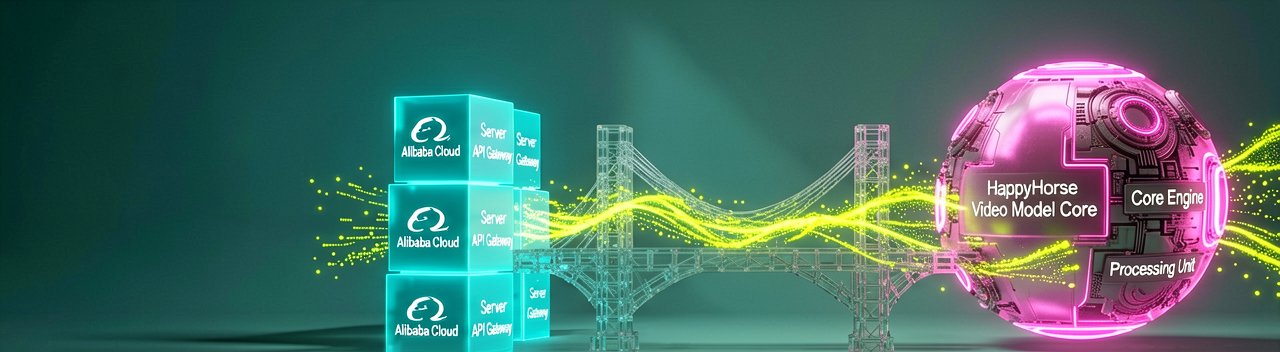
HappyHorse 1.0 is closed source and will not be open-sourced or licensable for independent deployment. This contrasts with some industry players who have suggested open-source availability. Developers must access the model through official API partners like fal.ai or Pixazo API, which means infrastructure costs and rate limits are managed by the platform providers rather than end users.
The commercial rights structure is straightforward: API providers guarantee full commercial rights for all generated outputs. This matters for businesses building product promos, social content, or multi-shot sequences with consistent character identity across frames. Whether users actually pay for it remains the real question—especially with free tiers and promotional offers flooding the market.
For developers evaluating the platform, the technical documentation includes Python and JavaScript SDKs, plus a REST API for any language. The client API handles request submission, status updates, and returns the final video URL when generation completes. No GPU management or infrastructure setup is required—just an API key and a prompt.
Whether HappyHorse 1.0 maintains its #1 ranking as more votes accumulate on the Artificial Analysis Video Arena remains to be seen. Early vote counts showed strong performance, but rankings can shift as the benchmark matures. The real test will be whether developers find the model's capabilities match its marketing claims in production environments.
Artūras Malašauskas is an AI Systems Integrator with 20+ years of production-grade web engineering experience. He has designed, shipped, and scaled enterprise Python/PHP systems for logistics, SaaS, and public-sector clients. For the past year, he has focused exclusively on AI integrations: deploying open-source LLMs, building generative media pipelines (image, audio, video), and engineering multi-agent workflows for real production environments. His standard: reproducibility, security, cost-efficient inference—no vaporware. He documents and evaluates emerging AI tooling, separating verified capabilities from marketing noise. Technical editor at: muza-ai.eu, ai-verslas.lt, ai-naujinos.lt Connect on LinkedIn
Comments