Lionsgate's Runway Stake Signals Shift to AI-Driven Franchise Expansion

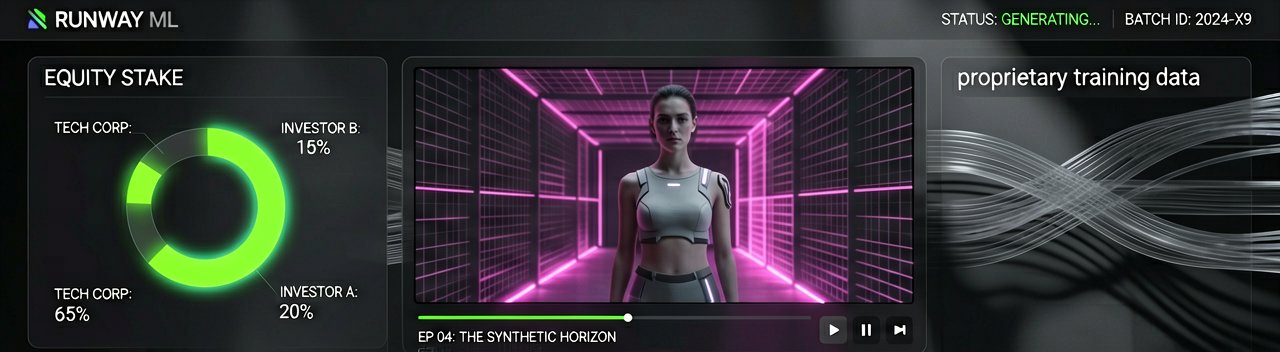
Lionsgate has dramatically intensified its integration of generative artificial intelligence by acquiring an equity stake in Runway. This milestone transaction transforms their existing infrastructure agreement into a deeply integrated development alliance. Under this expanded framework, the studio will establish a joint development program specifically engineered to mine its vast catalog of over 20,000 film and television titles. The immediate commercial roadmap includes deploying Runway’s multi-modal video models to co-develop original intellectual property, commencing with a slate of short-form episodic series derived from landmark legacy franchises.
This capital allocation represents a pivotal transition in how legacy entertainment companies monetize archival content amidst shifting streaming economics. Rather than treating artificial intelligence exclusively as a backend utility for localized workflows, previsualization, or cost containment, Lionsgate is positioning generative tech as a primary engine for pipeline expansion. According to reports from Variety, the strategic pivot effectively re-imagines the studio-vendor dynamic, evolving from basic asset licensing into a shared equity structure. By engineering content native to these models, the studio circumvents traditional developmental bottlenecks, positioning itself to rapidly spin up experimental content and test the commercial viability of spin-offs in a fraction of traditional production timelines.
The Structural Mutation from Tooling to Co-Ownership
The transition from a vendor-client dynamic to a formal shareholder model represents a major structural shift in studio operations. When the initial agreement was signed in September 2024, the mandate focused heavily on tool optimization—specifically utilizing applied AI to compress expenditures across storyboarding and post-production workflows. By securing an equity interest in a tech company recently valued at $5.3 billion, Lionsgate protects itself from rising software licensing costs while directly capitalizing on the valuation growth of the underlying tech infrastructure.
Navigating Technical Limits and Rights Management
This aggressive institutional expansion directly follows a period of friction during which the studio encountered severe operational limits attempting to generate full-scale feature films from proprietary training sets. Media analysis from TheWrap revealed that early attempts to construct massive custom models faced significant boundaries due to catalog size limitations and intricate talent-compensation guidelines. Pivoting to an episodic, short-form delivery format serves as a calculated tactical reset. This approach optimizes the capabilities of current video generation models while mitigating legal exposure regarding name, image, and likeness rights associated with legacy cinematic assets.
The Competitive Landscape of Proprietary Model Alliances
Lionsgate’s capital alignment has intensified a broader, high-stakes platform war across the media ecosystem as tech conglomerates look to lock down premium training inputs. The current distribution paradigm is rapidly bifurcating between studios building native AI content engines and those framing the technology as supplementary creative assistance. For example, as reported by The Hollywood Reporter , Google DeepMind established a multi-year partnership with A24 to integrate its Veo video generation software into auteur-driven creative workflows. Where A24 leverages Big Tech to reinforce traditional human-centric filmmaking, Lionsgate’s equity integration with Runway emphasizes a aggressive, capital-efficient approach designed to scale franchise footprint and maximize catalog monetization.
What Most Reports Miss: The Structural Strain on Talent Relations
While the initial financial disclosures focus heavily on equity percentages and data-lake valuation, the real friction point lies in the quiet renegotiation of legacy talent contracts. Hollywood’s guild agreements were hammered out before studios began viewing their completed film vaults as training telemetry for foundational models. Lionsgate's shift to generating short-form derivative works introduces a complex legal puzzle regarding residual structures. Traditional formulas rely on downstream licensing revenue, but generating entirely new, model-synthesized episodic content from an actor’s past likeness or a writer's structural tropes challenges the legal definition of a derivative work.
Behind closed doors, entertainment attorneys are already warning that this equity model sets a challenging precedent for the industry. When a studio owns a piece of the AI developer, the financial incentives shift from purchasing third-party software to maximizing the internal utility of the platform. This creates an environment where legacy talent must fight for transparency regarding exactly which frames of their past performances are being ingested, compressed, and spit back out as promotional or short-form content. Representatives for several high-profile creators have noted that tracking intellectual property infringement becomes nearly impossible once an asset is absorbed into a proprietary neural network.
Furthermore, this strategy exposes a stark reality about the current limits of generative video technology. Despite the optimistic executive rhetoric surrounding automated feature-length production, current generative models struggle with long-term temporal consistency, complex narrative pacing, and detailed character asset persistence across multiple scenes. By steering the Runway partnership toward short-form, bite-sized episodic franchises, Lionsgate is effectively turning a technical limitation into a targeted product feature. These smaller, lower-stakes formats act as a live laboratory to stress-test character consistency and viewer engagement without risking the hundred-million-dollar budgets of traditional theatrical releases.

This initiative also highlights a shifting balance of power among mid-tier Hollywood studios looking for a competitive edge against dominant streaming platforms. Lacking the massive global subscriber bases or tech budgets of companies like Apple or Amazon, studios like Lionsgate must rely on radical operational efficiency to keep their intellectual property relevant. Transforming static archival assets into dynamic, low-cost marketing and entertainment engines allows smaller catalogs to punch above their weight class. The goal is no longer just to sell streaming rights to the highest bidder, but to build a self-sustaining ecosystem where legacy IP constantly refreshes itself through automated content pipelines.
Reading Between the Lines: The Valuation Paradox of Automated IP
The studio’s aggressive embrace of synthetic franchise expansion rests on a fundamental paradox regarding the intrinsic value of intellectual property. Hollywood has spent over a century operating on the principle that the scarcity of premium content, combined with high creative barriers to entry, drives consumer demand and premium licensing fees. By building an automated content pipeline designed to flood digital channels with low-cost, short-form spin-offs, Lionsgate risks commodifying the exact legacy brands it is trying to revitalize. When the barriers to content creation fall to near zero, the psychological value that audiences place on a franchise often erodes alongside production timelines.
There is also a glaring contradiction in the strategy's reliance on historical data to secure future financial success. Generative video models function by mapping patterns from existing media assets, meaning Runway’s output is structurally constrained by the tone, style, and visual language of past Lionsgate hits like *The Hunger Games* or *John Wick*. Relying on these systems to engineer entirely new franchises creates an operational loop where future content is merely a statistical average of past successes. This feedback loop actively works against the eccentric, high-risk creative gambles that historically gave birth to these lucrative properties in the first place.
Furthermore, the financial stability promised by this equity stake may prove elusive due to the volatile economics of the artificial intelligence sector. Silicon Valley’s multi-billion-dollar AI valuations are heavily subsidized by venture capital and premised on the assumption of rapid, exponential technological breakthroughs. If the underlying technology hits a developmental plateau—particularly regarding character consistency and narrative logic—Lionsgate will find itself holding an expensive equity stake in a vendor whose core product cannot scale to meet feature-length theatrical demands. In trying to insulate itself from high software licensing fees, the studio has instead tethered its corporate valuation to the speculative swings of the tech market.
Ultimately, this corporate pivot forces a reckoning over what actually constitutes consumer engagement in a fragmented digital landscape. Flooding the market with automated episodic content may provide a short-term bump in platform metrics, but it runs the risk of accelerating viewer fatigue. Audiences are already showing signs of exhaustion toward algorithmically driven franchise fatigue; automating the generation of these derivative works treats the symptom of high production costs while potentially worsening the disease of audience apathy.
"In its quest to unlock the hidden value of its vault, Hollywood may soon discover that an infinite supply of automated content yields a finite amount of human attention, leaving executives to marvel at an empty theater filled with perfectly rendered, cost-efficient pixels."
Artūras Malašauskas is an AI Systems Integrator with 20+ years of production-grade web engineering experience. He has designed, shipped, and scaled enterprise Python/PHP systems for logistics, SaaS, and public-sector clients. For the past year, he has focused exclusively on AI integrations: deploying open-source LLMs, building generative media pipelines (image, audio, video), and engineering multi-agent workflows for real production environments. His standard: reproducibility, security, cost-efficient inference—no vaporware. He documents and evaluates emerging AI tooling, separating verified capabilities from marketing noise. Technical editor at: muza-ai.eu, ai-verslas.lt, ai-naujinos.lt Connect on LinkedIn
Comments