NAB Show 2026 Puts AI at Center of Broadcast Technology
The National Association of Broadcasters wrapped its 2026 flagship event in Las Vegas this week, marking a clear inflection point for how artificial intelligence is being deployed across media production. The Hawaii News Now reported that the convention ran from April 18 to 22, drawing more than 58,000 registered attendees and featuring over 1,000 exhibitors from 132 countries.
That's a lot of people in one building (and a lot of coffee consumed in the process). The event included 530 conference sessions with nearly 900 speakers, making it one of the largest gatherings of broadcast technology professionals in the industry calendar.
What's notable isn't just the scale—it's the shift in how AI is being positioned. According to the official NAB press release, artificial intelligence is no longer treated as a future-facing concept. It is now embedded across production, post, distribution and newsroom workflows, with direct implications for efficiency, cost and revenue.
Major technology companies including Adobe, AWS, Microsoft, NVIDIA and Google Cloud demonstrated how AI is being applied across the full content lifecycle. The focus has shifted toward measurable impact, from workflow automation to new monetization models, alongside growing questions around trust, authenticity and content ownership.
This year's show floor showcased new companies and applied innovation, almost doubling the number of AI exhibitors from 2025, including two dedicated AI Pavilions. Artificial Intelligence exhibitors also included Gyrus AI, Imagen Video, Speechmatics, TwelveLabs, Veritone and Vizrt.
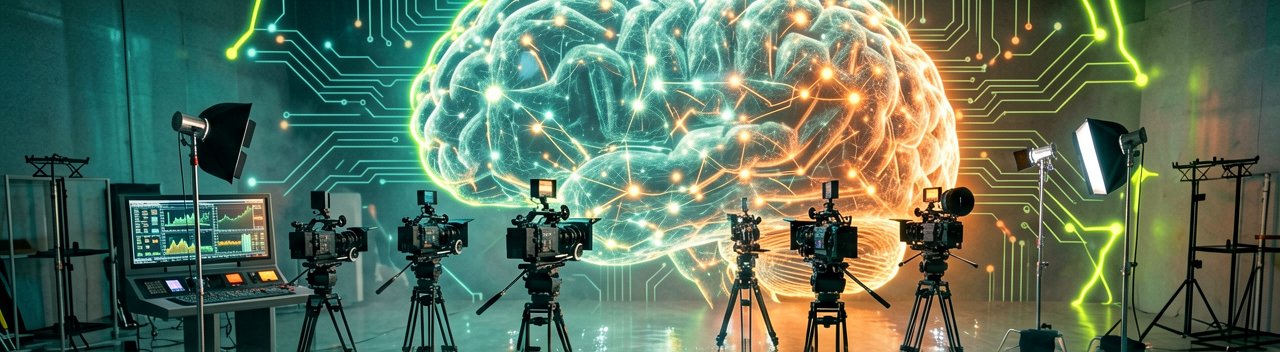
On the hardware side, the conference featured multiple halls showcasing broadcast technology, including AI applications, robotic cameras, and lighting equipment. Participants could interact with cameras used in studio movie productions such as "Avatar." The tactile experience of handling that equipment—feeling the weight of a cinema-grade camera, testing the responsiveness of robotic gimbal systems—grounds these abstract AI concepts in physical reality.
The conference also featured technology used in NFL broadcasts to make scoreboards appear to float above the playing field. This augmented reality overlay isn't just a visual trick; it requires precise tracking, real-time rendering, and seamless integration with live broadcast feeds. The latency has to be near-zero, or the effect breaks entirely.
Sessions explored subjects including how to turn AI from pilot projects into scalable, revenue-driving media workflows, and how to identify high-value AI use cases, avoid common pitfalls and scale what actually works in your business. That's the real challenge—moving from demo to deployment.
Live sports remains one of the most valuable assets in media, but the structures around rights, distribution and ownership are changing rapidly. Leagues, teams and athletes are increasingly acting as media companies, using technology to reach audiences directly, while venues play a pivotal role in creating immersive live fan experiences.
NAB Show's expanded four-day Sports Summit brought together leaders from leagues, teams, broadcasters, streaming platforms and investment firms to examine how capital, partnerships and platform fragmentation are reshaping the market. Key discussions focused on media rights strategy, the role of private equity and sovereign investment, athlete-led business models and the evolution of the fan experience across streaming, data and live environments.
Exhibiting companies demonstrating their innovative technologies in sports included Canon, DJI, Dolby, EVS, Lumen, Ross, Shure and Sony. AWS also had a Cloud Court Challenge activation in the West Hall Lobby, an AI-enabled, digital basketball shooting experience that analyzed participants' shots in real time and generated personalized performance insights.
The creator economy is entering a more structured phase, as creators move beyond audience-building to develop scalable businesses, own intellectual property and compete for distribution and revenue. The expanded Creator Lab, now located in Central Hall, reflects that shift, bringing together content creators with the tools and platforms they need to scale.
Whether this translates to sustainable business models for most creators remains the real question. The technology is ready; the economics are still being figured out.
Artūras Malašauskas is an AI Systems Integrator with 20+ years of production-grade web engineering experience. He has designed, shipped, and scaled enterprise Python/PHP systems for logistics, SaaS, and public-sector clients. For the past year, he has focused exclusively on AI integrations: deploying open-source LLMs, building generative media pipelines (image, audio, video), and engineering multi-agent workflows for real production environments. His standard: reproducibility, security, cost-efficient inference—no vaporware. He documents and evaluates emerging AI tooling, separating verified capabilities from marketing noise. Technical editor at: muza-ai.eu, ai-verslas.lt, ai-naujinos.lt Connect on LinkedIn
Comments