Gemma 4 VLA Demo Runs on Jetson Orin Nano Super
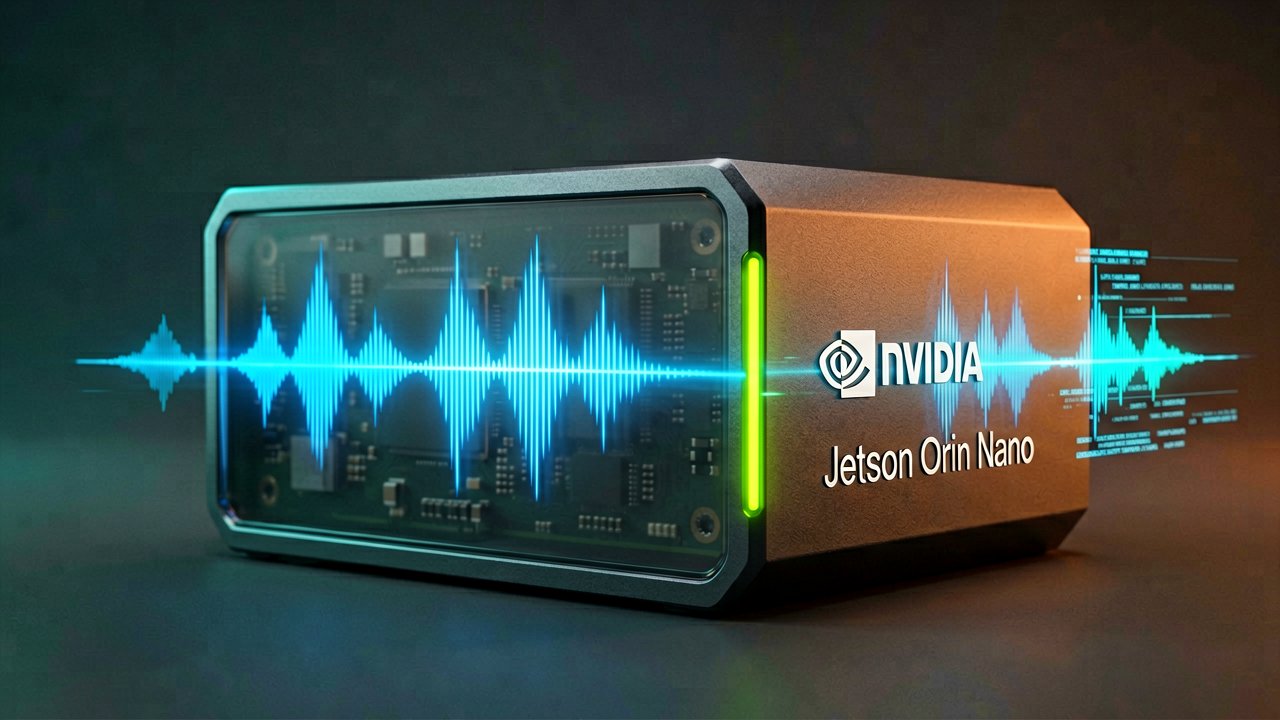
The landscape of edge AI just shifted. Google's Gemma 4 multimodal model is now demonstrable on NVIDIA's Jetson Orin Nano Super board, running a complete Voice-Language-Action pipeline entirely on-device. No cloud calls. No latency spikes from network handshakes. Just a small computer, a webcam, and a model that decides when to look at the world around it.
This isn't a theoretical benchmark. The demo is live, documented, and reproducible. The pipeline chains Parakeet STT for speech recognition, Gemma 4 via llama.cpp for reasoning and optional vision processing, and Kokoro TTS for audio output. The model autonomously determines whether visual context is needed based on what you ask. If your question requires it, the system takes a photo, interprets it, and answers using that visual information. It's not describing the picture—it's answering your actual question with what it saw.
According to the official tutorial on Hugging Face's blog, the setup requires pressing SPACE to record, SPACE again to stop. No keyword triggers. No hardcoded logic. The model itself decides when to open its eyes.
Hardware requirements are specific but accessible. The demo used an NVIDIA Jetson Orin Nano Super with 8 GB of RAM, a Logitech C920 webcam with built-in mic, a USB speaker, and a USB keyboard. The tutorial notes that any webcam, USB mic, and USB speaker that Linux recognizes should work. The physical reality here matters: you're holding a keyboard, pressing a key, waiting for audio to process, and hearing a response. There's tactile feedback in the spacebar press, the slight delay while the model loads, the fan spinning up on the Jetson board.
The code lives on GitHub in the asierarranz/Google_Gemma repository. A single file—Gemma4_vla.py—handles everything. It pulls the STT and TTS models plus voice assets from Hugging Face on first run. You can clone the whole repo or download just the script. The choice is yours, though cloning gives you access to the Gemma 2 demos as well.
System preparation is non-trivial. The tutorial recommends installing system packages including git, build-essential, cmake, ffmpeg, and various audio utilities. A Python virtual environment is created, then dependencies like opencv-python-headless, onnx_asr, kokoro-onnx, and huggingface-hub are installed. Memory management becomes critical on an 8 GB board. The author suggests adding swap space—8 GB in this case—as a safety net during model loading to avoid OOM kills at the worst moment. Docker containers and background processes should be killed. Every megabyte counts (which is frustrating when you're trying to run a capable model on consumer hardware).
Model quantization is the real constraint. The tutorial recommends Q4_K_M for native builds and Q4_K_S for Docker deployments. Both run comfortably on the 8 GB board after cleanup. If memory is still tight, you can drop to Q3 quantization—same model, slightly less capable, noticeably lighter. The author bluntly advises sticking with Q4_K_M if possible. It's the sweet spot.
Behind the demo, Gemma 4 itself represents a significant expansion of Google's open model family. The NVIDIA Developer blog details the full model lineup. Four variants exist: Gemma-4-31B (dense transformer), Gemma-4-26B-A4B (MoE with 128 experts), Gemma-4-E4B, and Gemma-4-E2B. The E4B and E2B variants are specifically designed for on-device and mobile deployment, supporting text, audio, vision, and video modalities. The E2B model has 5.1 billion parameters with 2.3 billion effective parameters and a 128K context window.
These models support over 140 languages with out-of-the-box support for 35+ languages. They feature interleaved multimodal input—freely mixing text and images in any order within a single prompt. Native tool use and function calling are built in. The bundle can fit on a single NVIDIA H100 GPU, and NVFP4 quantized checkpoints are available for Blackwell developers using vLLM.
The Jetson Orin Nano Super sits in NVIDIA's edge AI positioning. According to NVIDIA's documentation, Jetson systems target edge AI and robotics use cases. Key highlights include near-zero latency due to architecture features like conditional parameter loading and per-layer embeddings that can be cached for faster inference and reduced memory use. This is distinct from DGX Spark (AI research and prototyping) and RTX/RTX PRO (desktop apps and Windows development).
Independent coverage from Daily.dev corroborates the pipeline architecture and deployment steps. The model's ability to run locally on edge hardware addresses growing demand for secure on-prem requirements, cost efficiency, and latency-sensitive use cases. Industries like healthcare and finance have strict security requirements that cloud-based AI cannot always satisfy.
The physical experience of running this demo reveals the constraints of edge AI. The Jetson board gets warm. The fan noise is audible. Response times vary based on whether vision processing is triggered. The webcam's focus and lighting conditions affect how well the model interprets visual context. These aren't abstract concerns—they're the daily reality of deploying AI on constrained hardware.
Whether this translates to practical applications beyond demos remains the real question. The technical achievement is clear: a multimodal VLA running entirely on an 8 GB edge device. But the gap between a tutorial and production deployment is wide. Developers will need to optimize further, handle edge cases, and manage the inevitable failures that come with running complex models on consumer-grade hardware. The code is open. The hardware is available. The rest is up to those willing to build something that actually works.
Artūras Malašauskas is an AI Systems Integrator with 20+ years of production-grade web engineering experience. He has designed, shipped, and scaled enterprise Python/PHP systems for logistics, SaaS, and public-sector clients. For the past year, he has focused exclusively on AI integrations: deploying open-source LLMs, building generative media pipelines (image, audio, video), and engineering multi-agent workflows for real production environments. His standard: reproducibility, security, cost-efficient inference—no vaporware. He documents and evaluates emerging AI tooling, separating verified capabilities from marketing noise. Technical editor at: muza-ai.eu, ai-verslas.lt, ai-naujinos.lt Connect on LinkedIn
Comments