Apple Unveils MacBook Pro with M5 Pro and M5 Max Chips
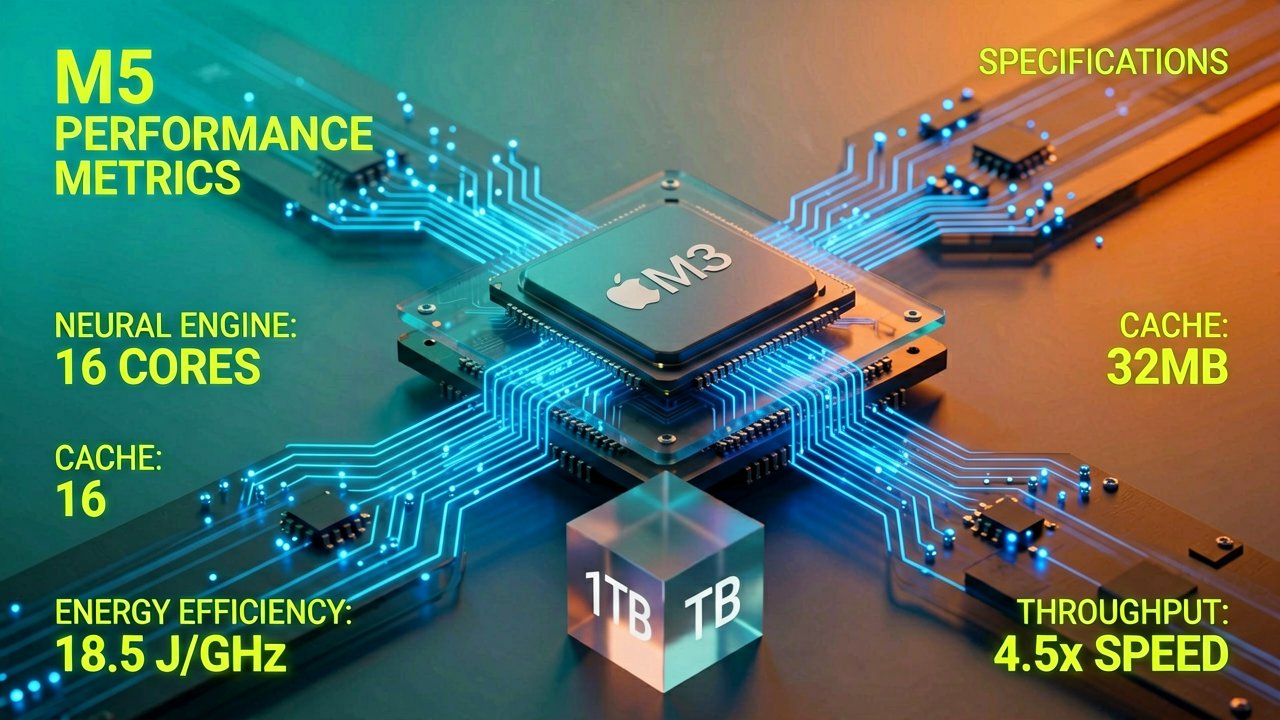
Apple today announced the latest 14- and 16-inch MacBook Pro models powered by the all-new M5 Pro and M5 Max chips, marking a significant leap in on-device AI capabilities and pro performance. The announcement, made via Apple's official press release, positions these models as the most advanced pro laptops for developers, creatives, and researchers requiring local AI processing.
The M5 Pro and M5 Max chips feature Apple's new Fusion Architecture, combining two dies into a single system-on-chip with a redesigned CPU and GPU. The M5 Pro includes an 18-core CPU (6 super cores and 12 performance cores) and a 20-core GPU, while the M5 Max offers up to 40-core GPU configurations. Crucially, both chips integrate Neural Accelerators in every GPU core, enabling "up to 4x AI performance compared to the previous generation" and "up to 8x AI performance compared to M1 models" as stated in Apple's documentation.
Apple's technical specifications highlight significant improvements in AI workloads: the new MacBook Pros deliver "up to 7.8x faster AI image generation performance" compared to M1 Pro models and "up to 6.9x faster LLM prompt processing" versus M1 Pro. These gains stem from the Neural Engine's enhanced capabilities and higher unified memory bandwidth (307GB/s for M5 Pro, up to 614GB/s for M5 Max), allowing professionals to run advanced language models and image generation tools directly on-device without cloud dependency.
Storage and pricing reflect Apple's strategic shift toward higher base configurations. The M5 Pro starts at 1TB of storage (up from 512GB in previous models), while the M5 Max begins at 2TB. This change aligns with Apple's decision to eliminate lower storage tiers, with the 14-inch M5 Pro starting at $2,199 (a $200 increase over the M4 Pro) and the 16-inch M5 Pro at $2,699. The M5 Max models begin at $3,599 (14-inch) and $3,899 (16-inch), featuring 36GB of RAM as standard.
Technical enhancements extend beyond raw performance. The new MacBook Pros include Apple's N1 wireless networking chip for Wi-Fi 7 and Bluetooth 6 connectivity, offering improved wireless reliability. The devices also boast "up to 2x faster SSD performance" and maintain Apple's signature 24-hour battery life claim for video streaming. The Liquid Retina XDR display remains a key feature, with optional nano-texture glass for reduced glare.
Industry analysts note that Apple's focus on on-device AI processing represents a strategic pivot from cloud-centric AI models. As reported by Mashable, the M5 Pro and M5 Max's Neural Accelerators enable "local training of custom models" for researchers and "AI-powered tools for video editing, music production, and design work" without internet dependency—a significant shift for privacy-conscious professionals.
Apple's engineering approach with the Fusion Architecture—combining two 3-nanometer dies into a single SoC—marks a departure from previous chip designs. This innovation allows for higher bandwidth between components while maintaining Apple's signature unified memory architecture. The M5 Pro's 18-core CPU (with 6 super cores) delivers "up to 30 percent faster performance" for pro workloads compared to M4 Pro, according to Apple's documentation.
For developers, the M5 Pro and M5 Max's architecture enables more efficient handling of complex workflows. The absence of efficiency cores in these pro chips (unlike the base M5) reflects Apple's focus on maximizing single-threaded performance for demanding applications. As noted in Apple's technical documentation, the new "super cores" represent the "world's fastest CPU core" for single-threaded tasks, while the 12 new performance cores optimize multithreaded workloads.
Availability begins March 11, 2026, with pre-orders opening March 4. The MacBook Pro's price increases—coupled with higher base storage—position it as a premium pro device, though Apple's education pricing and trade-in programs may mitigate cost concerns for existing users. The M5 Pro and M5 Max represent Apple's most significant pro laptop update since the M3 Pro launch, with AI capabilities now central to the product's value proposition rather than an afterthought.
Artūras Malašauskas is an AI Systems Integrator with 20+ years of production-grade web engineering experience. He has designed, shipped, and scaled enterprise Python/PHP systems for logistics, SaaS, and public-sector clients. For the past year, he has focused exclusively on AI integrations: deploying open-source LLMs, building generative media pipelines (image, audio, video), and engineering multi-agent workflows for real production environments. His standard: reproducibility, security, cost-efficient inference—no vaporware. He documents and evaluates emerging AI tooling, separating verified capabilities from marketing noise. Technical editor at: muza-ai.eu, ai-verslas.lt, ai-naujinos.lt Connect on LinkedIn
Comments