The Sovereign Paradox: European Parliament’s New AI Hub Exposes Deep-Seated Reliance on American Tech
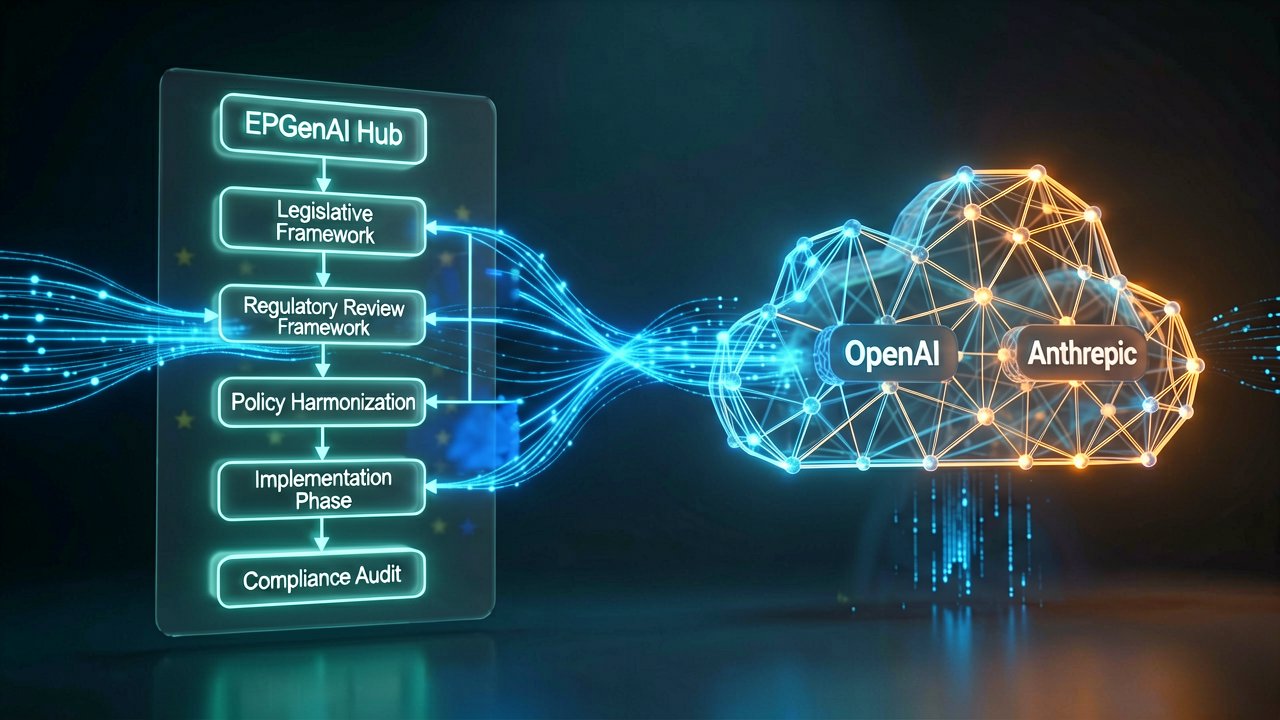
The European Parliament is taking institutional control over generative artificial intelligence by introducing its own internal ecosystem, the EPGenAI Hub. Intended to curb the unauthorized use of consumer-grade chatbots by lawmakers and staff, the secure platform provides a unified channel for drafting legislation, researching policies, and streamlining administrative work. However, the rollout has exposed an uncomfortable structural contradiction. Despite the European Union’s aggressive legislative focus on digital autonomy, its core legislative body is building its technological future upon foundational infrastructure developed by American corporations.
According to investigative analysis by Politico, the EPGenAI Hub provides access to prominent foreign proprietary engines including OpenAI, Anthropic, and Meta, alongside Europe's Mistral AI. While Brussels has actively fought to minimize its systemic dependence on foreign technology—historically migrating parliamentary search infrastructure away from Google and disabling automated tools on official tablets—the raw computational superiority and market readiness of U.S. large language models proved too distinct to ignore. This dependency highlights a broader market reality: European open-source initiatives still lag behind their heavily capitalized American counterparts in horizontal enterprise scalability.
The timing of this deployment introduces major geopolitical irony, as reported by The Next Web, because the very institution responsible for enforcing the rigorous oversight of the EU AI Act is struggling to find native sovereign architectures capable of sustaining its own workflows. Although parliamentary communications state that the current selection of models remains under review and that sovereign cloud-hosted infrastructure is slowly becoming available, the implementation signals a pragmatic concession. Real-world operational efficiency has temporarily overridden the strategic ideology of absolute digital sovereignty.
The Realities of the GenAI Infrastructure Divide
The immediate incorporation of U.S. proprietary systems reveals a massive commercial disparity between Silicon Valley and European ecosystem development. American technology giants benefit from concentrated compute clusters, deep financial scaling, and early-mover advantages that allow them to deliver highly optimized, production-ready enterprise APIs. For European institutions requiring immediate, industrial-grade data processing to handle legislative slop and draft complex amendments, waiting for localized public infrastructure is not operationally viable.
Strategic Shifts in Sovereign Cloud Procurement
Despite the current reliance on foreign models, European regulators are quietly shifting their underlying compute procurement strategy to build long-term independence. The European Commission has recently established cloud provider contracts designed to bring upcoming open-source and EU-sovereign models into a compliant framework. This suggests that the current architecture of the EPGenAI Hub is an interim stopgap rather than a permanent policy shift, as the continent aggressively tries to fund and scale localized public AI infrastructure to secure its digital supply chain.
An Institutional Catch-22 in the Corridors of Brussels
Behind the Bureaucratic Curtain: The deployment of the EPGenAI Hub reveals a profound tension between political idealism and the immediate needs of modern governance. For years, European policymakers have championed the concept of technological sovereignty, envisioning a continent self-reliant in critical software and digital infrastructure. Yet, when tasked with building a tool to handle the immense volume of legislative research and amendment tracking, the European Parliament’s IT leadership faced a stark reality: the institutional demand for high-context linguistic processing simply outpaced the operational readiness of fully European, open-source alternatives. This gap forced a compromise that places foreign proprietary engines at the center of the EU’s legislative engine.
Internal stakeholder perspectives highlight the complex security trade-offs that guided this decision. Security officials within the Parliament were acutely aware that lawmakers were already using consumer-facing versions of ChatGPT and Claude on personal devices, creating a massive risk of data leakage regarding unreleased policy drafts. By creating a centralized hub, the institution can at least route data through private, enterprise-grade cloud instances, ensuring that sensitive legislative deliberations are not used to train public models. However, this strategy replaces a data-exfiltration vulnerability with a vendor lock-in dependency, tying the daily operations of European democracy to the corporate roadmaps and licensing fees of Silicon Valley firms.
This dynamic mirrors historical struggles within the European Union’s digital procurement initiatives, which have repeatedly stumbled when trying to mandate native technologies. Past efforts to foster pan-European cloud alternatives, such as the Gaia-X project, became bogged down in architectural disagreements and bureaucratic delays, allowing American hyperscalers to solidify their dominance. The current reliance on U.S. large language models suggests that the AI sector is following a similar path, where the sheer velocity of American capital and computing deployment overwhelms Europe's regulatory efforts to cultivate a domestic market from the top down.
While the presence of France’s Mistral AI within the hub offers a nod toward regional representation, industry analysts note that even Europe's premier AI champions remain deeply intertwined with the American tech ecosystem. Mistral’s commercial scaling, for instance, has relied heavily on distribution partnerships and investments from U.S. giants. Consequently, even when European institutions choose a seemingly domestic model, the underlying computational fabric and commercial pipelines often trace back to Washington and California, complicating the very definition of a sovereign European technology stack.
Looking forward, the long-term viability of the EPGenAI Hub depends on a difficult transition toward localized infrastructure. European regulators are banking on a two-pronged strategy: enforcing strict adherence to the EU AI Act to level the playing field, while simultaneously funding initiatives like the EuroHPC Joint Undertaking to give regional developers access to world-class supercomputing power. Until these public investments yield horizontal, enterprise-ready systems capable of matching the reasoning capabilities of their American counterparts, Europe's governing bodies will remain in the paradoxical position of regulating the very technology they depend on to function.
The Sovereign Façade and the Reality of Capital
Reading Between the Lines: The rollout of the EPGenAI Hub uncovers a structural contradiction in how the European Union conceptualizes technological independence. Brussels frequently treats digital sovereignty as a regulatory milestone that can be achieved via sweeping legislative mandates like the EU AI Act. However, this approach mistakes regulatory authority for market capability. By embedding U.S. proprietary models into its legislative workflow, the European Parliament acknowledges that legislation cannot conjure computing power out of thin air, nor can it replicate the billions of dollars in private venture capital that fueled the American AI boom.
This reliance exposes a deep flaw in Europe's regional tech strategy, which favors open-source frameworks as a defense against corporate monopolies. While open-source AI is democratizing access, it remains heavily dependent on commercial hyper-scalers for the massive compute infrastructure required to train and run models at an institutional scale. By deploying these systems, the EU is effectively subsidizing the exact American tech ecosystem it spends billions of euros trying to fine and break up through antitrust actions. The geopolitical irony is dense: European regulators are drafting anti-monopoly laws using tools provided by the tech giants they aim to restrict.
Furthermore, the assumption that this dependence is a temporary stopgap minimizes the realities of institutional vendor lock-in. Once thousands of parliamentary staffers, researchers, and policymakers adapt their workflows, prompt libraries, and automated drafting habits to the specific nuances of OpenAI or Anthropic models, migrating to a purely sovereign European alternative becomes a monumental task. The history of enterprise software shows that convenience and operational habits almost always override geopolitical ideals, meaning the current "interim" solution is likely to become a permanent foundation.
The long-term implication is a subtle shift in how policy is formed. Models trained on predominantly American data corpora inevitably reflect the cultural, legal, and economic biases of their origin. When European lawmakers rely on these systems to summarize reports or benchmark policy proposals, they risk subtly importing American frameworks of risk, fair use, and commercial priority into the very laws meant to defend European exceptionalism. Absolute digital autonomy is a luxury that vanishes the moment an institution prioritizes operational speed over systemic independence.
Europe has successfully mastered the art of regulating the future before it arrives, creating a fascinating bureaucratic paradox where the rules governing artificial intelligence are drafted with the enthusiastic assistance of the very American chatbots they are designed to tame.
Artūras Malašauskas is an AI Systems Integrator with 20+ years of production-grade web engineering experience. He has designed, shipped, and scaled enterprise Python/PHP systems for logistics, SaaS, and public-sector clients. For the past year, he has focused exclusively on AI integrations: deploying open-source LLMs, building generative media pipelines (image, audio, video), and engineering multi-agent workflows for real production environments. His standard: reproducibility, security, cost-efficient inference—no vaporware. He documents and evaluates emerging AI tooling, separating verified capabilities from marketing noise. Technical editor at: muza-ai.eu, ai-verslas.lt, ai-naujinos.lt Connect on LinkedIn
Comments