Alibaba Escalates the Chinese AI Arms Race with a 2.4 Trillion-Parameter Model Preview Following Moonshot's Open-Weight Breakthrough

The domestic race for artificial intelligence supremacy in China has escalated into a multi-trillion-parameter clash. On July 19, 2026, tech giant Bloomberg reported that Alibaba Group Holding Ltd. launched a preview version of its new flagship multimodal system, Qwen3.8-Max, via social platform X. Boasting a staggering 2.4 trillion parameters, this sparse Mixture-of-Experts (MoE) system handles text, images, video, and documents, featuring a massive 1-million-token context window. This launch marks Alibaba’s first multimodal model to surpass the 1-trillion-parameter threshold, with a paid preview currently live on its Token Plan, Qoder, and QoderWork developer platforms.
This aggressive rollout was triggered directly by startup Moonshot AI, which blindsided the market days earlier on July 16, 2026, by releasing Kimi K3—the world's largest open-weight model at 2.8 trillion parameters. According to details shared by VentureBeat , Kimi K3 achieved frontier-level results, scoring neck-and-neck with top U.S. proprietary systems on software engineering benchmarks. Fascinatingly, Alibaba holds a 36% stake in Moonshot AI after leading its $800 million funding round. Alibaba's quick deployment of Qwen3.8-Max represents an aggressive countermove to reassert its dominant position in the open ecosystem, as it pledged to release the open-weight version of its 2.4T flagship globally by the end of July.
The sudden arrival of consecutive multi-trillion-parameter systems signals a foundational paradigm shift in the global AI landscape. By offering these gargantuan systems under an open-weight framework, Chinese labs are closing the capability gap with American frontrunners like OpenAI and Anthropic. More importantly, as detailed by Pandaily , these releases fundamentally challenge the pricing power of closed-source proprietary APIs. When free-to-host models reach close proximity to commercial frontiers, the massive economic premium demanded by U.S. tech firms becomes difficult to justify for enterprise and developer segments.
Market Impact and Strategic Implications
Alibaba's strategic posture has immediately resonated across global equity markets. Its U.S.-listed shares climbed over 3% in pre-market trading, reflecting optimism over its accelerating cloud ecosystem. Alibaba Cloud recently reported a 40% year-over-year surge in external revenue, driven largely by AI-related infrastructure demand. By combining its massive hardware advantages with an imminent open-weight model release, Alibaba is solidifying its lock on corporate developer toolchains. This strategy is further reinforced by its international partnerships; Apple recently cleared regulatory hurdles to integrate Alibaba's Qwen AI technology directly into the Chinese localized edition of Apple Intelligence.

The Frontier Battleground and Vendor Claims
While the scale of these architectures is undeniable, the immediate battle is fought on performance claims and real-world deployment challenges. Alibaba has boldly asserted that Qwen3.8-Max is "second only to Anthropic's Claude Fable 5" in comprehensive capabilities, highlighting its exceptional proficiency in front-end development, 3D rendering, and agentic workflows. However, tech analysts warn that the initial preview lacked an official model card or independent benchmark verification. Early multi-turn agent testing shows some inconsistent behaviors over extended sessions, a reminder that massive parameter counts do not automatically translate to a seamless user experience. Nevertheless, the simultaneous push by Alibaba and Moonshot AI has permanently elevated the baseline for open-source AI, shifting the conversation from a race to catch up to a battle to dictate industry economics.
Anatomy of a Corporate Conflict: Investment vs. Domination
Beneath the Headline Metrics: A fascinating paradox lies in the ownership structures powering China's artificial intelligence ecosystem. Alibaba is not merely competing with Moonshot AI; it is effectively funding its fiercest rival. By anchor-investing in Moonshot's massive $800 million funding round earlier this year, Alibaba secured a significant equity stake in the startup. Yet, the rapid-fire release of Kimi K3 and Qwen3.8-Max demonstrates that strategic capital does not guarantee corporate alignment. Moonshot’s decision to open-weight a 2.8 trillion-parameter model blindsided Alibaba's cloud division, forcing an emergency acceleration of the Qwen roadmap to prevent a total migration of the open-source developer community to a rival ecosystem.
This internal friction highlights the broader commoditization crisis facing Chinese cloud vendors. Infrastructure providers originally backed generative AI startups to secure long-term cloud compute contracts. However, as these startups mature and achieve algorithmic breakthroughs, they are aggressively pushing their own independent brand identities and monetization channels. Alibaba’s frantic deployment of Qwen3.8-Max proves that the tech giant cannot afford to be viewed merely as the silent compute backbone for agile startups. To protect its high-margin enterprise cloud business, Alibaba must consistently prove that its in-house foundational models remain at the absolute frontier of capability.
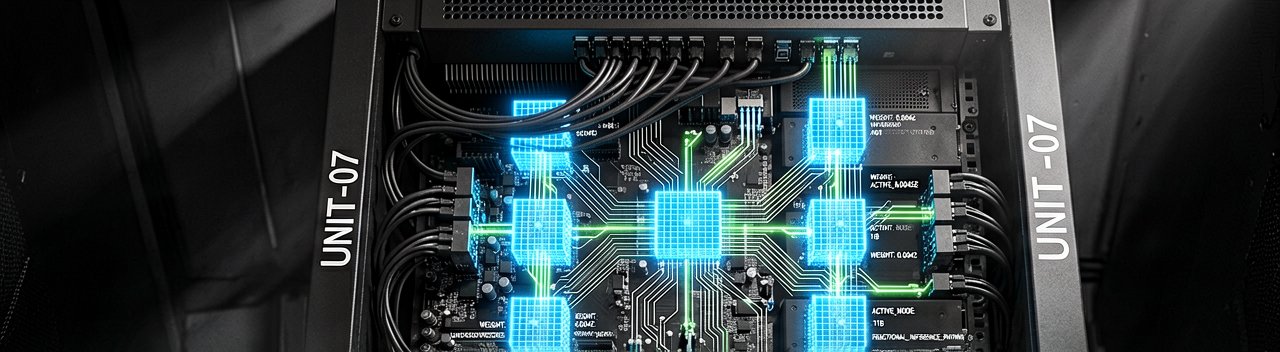
Furthermore, the shift toward multi-trillion-parameter sparse Mixture-of-Experts (MoE) architectures represents a calculated engineering response to severe domestic constraints. Faced with stringent international restrictions on advanced semiconductor exports, Chinese engineering teams have pivoted away from dense model architectures. Instead, they are mastering sophisticated routing algorithms that activate only a fraction of a model's total parameters during any single inference cycle. This approach allows systems like Qwen3.8-Max to offer immense contextual awareness and multimodal reasoning capabilities while operating within the compute budgets and hardware clusters available natively in local data centers.
The global implications of this open-weight escalation are already rattling Western corporate boardrooms. Historically, U.S. frontrunners relied on massive capital advantages to maintain a wide capability moat through closed-source APIs. As Chinese alternatives bridge the performance gap without charging premium access fees, the economic calculus for enterprise software integration changes completely. Multinational corporations operating in Asia are shifting away from proprietary American platforms in favor of locally deployed, customizable open-weight models that guarantee data sovereignty and vastly lower operational overhead. Alibaba's rapid pivot ensures that it remains the primary beneficiary of this enterprise migration, altering the global balance of AI influence.
The Paper Moats of Parameter Escalation
Reading Between the Lines: The breathless rush to claim multi-trillion-parameter milestones masks a fundamental vulnerability in the current wave of Chinese AI breakthroughs. In the scramble to dominate headlines, parameter counts have become a superficial proxy for genuine architectural advancement. While Alibaba and Moonshot AI trade blows with astronomical figures like 2.4 trillion and 2.8 trillion parameters, engineering realities suggest these numbers are highly optimized for public relations. Because these systems utilize sparse Mixture-of-Experts architectures, only a fraction of the model is engaged at any single moment. Treating these totals as equivalent to dense parameter scale distorts the actual computing efficiency and misleads enterprises trying to calculate real-world operational costs.
Moreover, the sudden pivot to the open-weight model framework reveals an uncomfortable truth about market monetization. In China's fiercely competitive hyper-fragmented tech sector, proprietary API price wars have driven margins down to near-zero, forcing companies to give away their crown jewels just to retain developer mindshare. Alibaba’s aggressive pledge to release Qwen3.8-Max globally is less an act of open-source altruism and more a scorched-earth tactical maneuver. By flooding the ecosystem with high-caliber, free-to-use weights, Alibaba effectively starves smaller independent AI startups of venture capital, ensuring that the only viable business model left standing is selling the underlying cloud infrastructure required to run these monstrous workloads.
This relentless focus on local supremacy also exposes a growing disconnect between domestic capability and international viability. Chinese tech giants are constructing increasingly complex models tailored specifically to clear domestic compliance frameworks and local smartphone integrations, such as the regional variant of Apple Intelligence. However, this hyper-localization risks turning these multi-trillion-parameter systems into localized anomalies. Isolated from global datasets and restricted by severe hardware constraints, these models risk becoming incredibly advanced solutions tailored for an increasingly siloed market, even as the global AI frontier begins shifting its focus from raw model size to autonomous agentic infrastructure.
"Ultimately, the great AI arms race resembles a high-stakes poker game where everyone is playing with house money and bragging about the size of their chips, while quietly praying nobody asks to see their actual margins before the cloud bill arrives."
Artūras Malašauskas is an AI Systems Integrator with 20+ years of production-grade web engineering experience. He has designed, shipped, and scaled enterprise Python/PHP systems for logistics, SaaS, and public-sector clients. For the past year, he has focused exclusively on AI integrations: deploying open-source LLMs, building generative media pipelines (image, audio, video), and engineering multi-agent workflows for real production environments. His standard: reproducibility, security, cost-efficient inference—no vaporware. He documents and evaluates emerging AI tooling, separating verified capabilities from marketing noise. Technical editor at: muza-ai.eu, ai-verslas.lt, ai-naujinos.lt Connect on LinkedIn
Comments