Specialization Beats Scale: How Datalab Lift Reordered the Document Extraction Hierarchy

For years, the tech industry treated document parsing as a brute-force problem, assuming that ever-larger general large language models would eventually swallow the challenge whole. However, a significant shift toward specialized architectures just remapped the competitive landscape. On June 18, 2026, the artificial intelligence development team at Datalab shook up the status quo by introducing Lift, a 9-billion parameter schema-first structured extraction model. Released under an open-weights model, it represents a deliberate departure from heavy, jack-of-all-trades systems toward nimble, single-purpose engineering.
The newcomer did not just enter the market; it instantly dominated the competitive leaderboard in a series of rigorous, head-to-head extractions against established enterprise tools. Datalab pitted Lift against an aggressive lineup of specialized parsing and document processing tools, including NuExtract3, LlamaExtract, Marker, and IBM Research's Docling. While these systems represent some of the finest open-source and proprietary methods for conquering messy PDFs and multi-page layouts, Lift managed to outperform them in a brutal, deterministic exact-match evaluation framework designed to mimic real-world deployment challenges.
The Architecture of a Leaderboard Coup
The core baseline difference between Lift and its competitors lies in its structural philosophy. Traditional tools like Marker lean heavily on multi-stage vision transformer pipelines to segment pages, run optical character recognition, and reconstruct text boxes sequentially. IBM's Docling approaches the problem by excelling as a structural all-rounder for layout fidelity and local enterprise control. Conversely, Datalab designed Lift as a single-pass, multi-page vision model natively engineered to map entire complex documents to a developer-provided JSON schema in one go. By employing schema-constrained decoding, it inherently guarantees valid, well-typed data arrays that traditional models often corrupt during long context shifts.
This architectural gamble paid off handsomely during benchmarking. Evaluated across 225 highly complex documents featuring up to 64 pages each, Lift secured a formidable 90.2% field accuracy across roughly 11,000 scored data points. To put this in perspective, the 4-billion parameter NuExtract3 topped out at an 81.5% field accuracy rate on identical data structures. Lift handled planted adversarial edge cases—ranging from near-miss distractors and cross-page value splices to mandatory null assignments—with a level of precision that previously required expensive proprietary commercial APIs. By outstripping the competition, the model underscores a broader industry evolution: when it comes to enterprise data pipelines, specialized, high-precision small architectures are proving far more viable than generic enterprise behemoths.
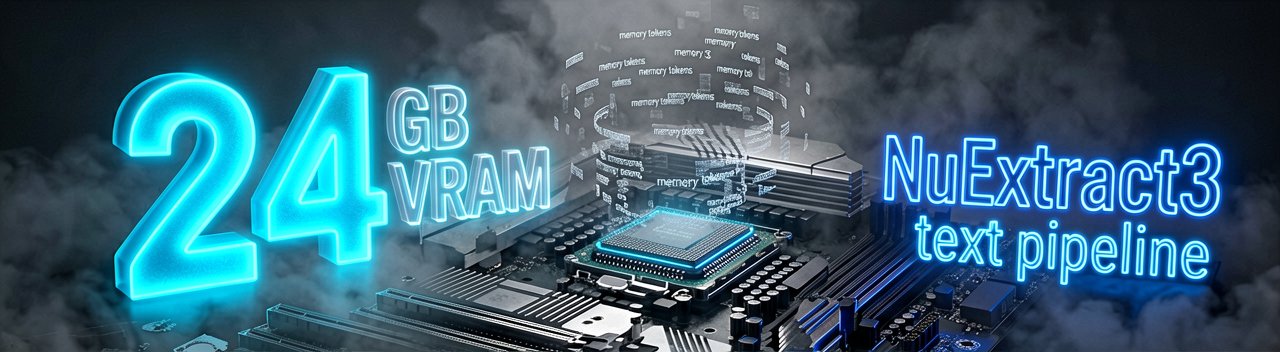
Technical Specifications Matrix
| Model Name | Model Size / Parameters | Speed / Latency Profile | Minimum Hardware Requirements |
|---|---|---|---|
| Datalab Lift | 9 Billion | High throughput single-pass execution | 24GB VRAM (e.g., RTX 3090/4090) |
| NuExtract3 | 4 Billion | Ultra-low text-based latency | 12GB VRAM (e.g., RTX 4070) |
| Docling | Modular (OCR + LayoutLM variants) | Deterministic pipeline bound by CPU/GPU scaling | Standard CPU or 8GB VRAM edge acceleration |
| Marker | Multi-model ensemble (~1-2 Billion combined) | Variable depending on layout complexity | 8GB to 16GB VRAM configurations |
Decoding the Hardware and Execution Divergence
The stark variation in hardware footprints among these extraction tools stems entirely from how they process visual information. Datalab Lift requires a more substantial 24GB VRAM baseline because it treats multi-page documents as continuous visual inputs. Instead of stripping away the formatting or running a separate layout parser, Lift maps pixels directly to structured data. Keeping these dense visual tokens alive across dozens of pages requires a larger memory buffer, but it eliminates the need to run multiple disparate software libraries in parallel.
On the opposite end of the spectrum, NuExtract3 operates with a much leaner 4-billion parameter footprint. It achieves this efficiency by decoupling the raw text extraction from the schema alignment phase. Because it does not ingest the raw pixels of a PDF natively, it bypasses the heavy memory overhead that vision transformers demand. The trade-off is a distinct reliance on a clean upstream text pipeline, making its hardware requirements incredibly accessible for edge deployments or mid-tier consumer graphics cards.
Meanwhile, Docling and Marker present a completely different engineering philosophy. Rather than relying on a single large neural network to make sense of a document, they deploy localized, ensemble pipelines. Docling utilizes highly efficient layout analysis and specialized optical character recognition systems that can easily saturate a multi-core CPU without demanding a dedicated corporate graphics cluster. Marker splits its workloads across separate text detection, reading, and formatting models, distributing the compute burden across a multi-stage operational chain.
This structural variance changes how latency scales in production environments. For short, text-heavy PDFs, lightweight text models like NuExtract3 deliver lightning-fast iterations because they only process characters. However, as documents grow to fifty pages and incorporate complex, multi-tiered tabular grids, multi-stage pipelines encounter severe bottlenecks during the layout reconstruction phase. By handling the layout analysis and data extraction simultaneously, Lift maintains a predictable linear throughput over massive documents that frequently bogs down traditional multi-stage systems.
Artūras Malašauskas is an AI Systems Integrator with 20+ years of production-grade web engineering experience. He has designed, shipped, and scaled enterprise Python/PHP systems for logistics, SaaS, and public-sector clients. For the past year, he has focused exclusively on AI integrations: deploying open-source LLMs, building generative media pipelines (image, audio, video), and engineering multi-agent workflows for real production environments. His standard: reproducibility, security, cost-efficient inference—no vaporware. He documents and evaluates emerging AI tooling, separating verified capabilities from marketing noise. Technical editor at: muza-ai.eu, ai-verslas.lt, ai-naujinos.lt Connect on LinkedIn
Comments