The AI Reckoning: Core AI Holdings Slams into Negative Equity as Q1 Losses Spark Investor Panic
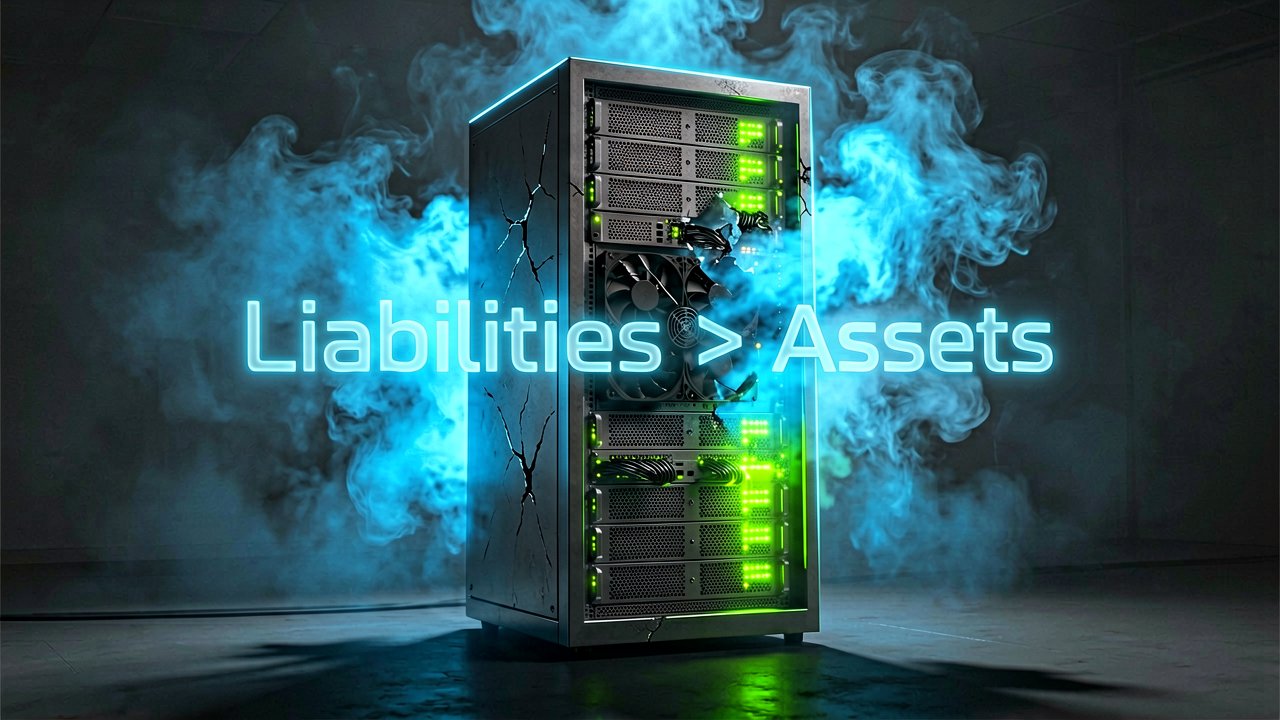
The tech industry's unrelenting optimism surrounding artificial intelligence just hit a massive roadblock on Wall Street. In a stunning financial update that has sent shockwaves through the venture and public markets alike, Core AI Holdings Inc. [NASDAQ: CHAI] reported a devastating net loss of roughly $5.4 million for the first quarter of 2026. This downward spiral has culminated in the company's first-ever slide into negative equity, an unprecedented milestone in its corporate history that has forced an abrupt reckoning over the true cost of scaling AI infrastructure.
Faced with an escalating cash burn that far outpaces its $3.77 million in quarterly revenue, the company's balance sheet has fundamentally buckled. To cushion the blow and secure short-term breathing room, executives rushed to execute a highly dilutive $5.4 million registered direct offering in mid-June. According to market data tracked by Investing.com , the sudden issuance of millions of new common shares and pre-funded warrants caused panic among existing shareholders, prompting a sharp 28.5% single-day collapse in the stock price as investors rushed to escape the impending dilution.
Thin Margins and Heavy Hype
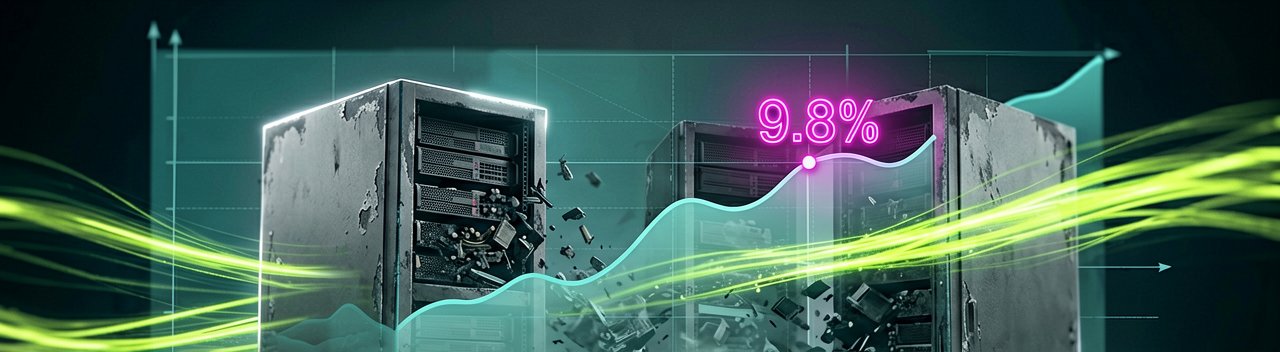
For months, the market treated the company as a high-flying vehicle for momentum trading, driving wild intraday price spikes. However, the underlying numbers reveal a deeply structural issue that marketing hype can no longer conceal. Core AI's gross margin has eroded to a razor-thin 9.8%, a figure that financial analysts warn is dangerously low for a business tasked with maintaining expensive high-performance computing data centers. With profit margins deeply negative and returns on equity plunging past the negative 100% threshold, the firm's operational foundation is looking increasingly fragile.
The Broader Capital Crisis in AI Infrastructure
What makes this collapse so concerning to institutional investors is that it is not happening in a vacuum. The broader tech sector has recently exhibited severe jitters regarding the immense capital expenditures required to sustain the artificial intelligence boom. Just weeks ago, wider market liquidations wiped out nearly $1 trillion in market capitalization across chipmakers and AI infrastructure firms, catalyzed by shrinking margins at major hardware players and a growing consensus that AI spending is failing to yield immediate profitability. By aggressively pivoting away from legacy businesses to build out data center campuses, Core AI effectively tied its financial health to an incredibly resource-intensive ecosystem right as the market's patience began to run out.
The company's leadership remains public about its ambitious long-term roadmap, pointing to active joint ventures intended to develop high-density colocation spaces for heavy AI workloads. Yet, balancing long-term infrastructure delivery against immediate balance sheet insolvency is a tightrope walk that few startups survive. For now, Core AI's financial distress serves as a loud, explicit warning to Wall Street: when the cost of electricity and specialized computing chips dwarfs incoming software revenues, even the most promising tech narratives eventually run out of runway.
Beneath the Balance Sheet: The financial distress paralyzing Core AI Holdings is the logical conclusion of a broader, structural delusion that has gripped Silicon Valley for the past three years. For too long, the tech industry has operated under the assumption that AI infrastructure behaves exactly like traditional software-as-a-service (SaaS) models. In the old SaaS playbook, gross margins frequently exceeded 80% because duplicating code costs next to nothing once the initial product is built. Core AI’s disastrous 9.8% gross margin exposes the brutal reality that generative AI is fundamentally a capital-intensive manufacturing business disguised as software, where every single query incurs a tangible cost in silicon wear and electricity.
Industry insiders have quietly watched this trainwreck develop for months. While retail investors chased massive, speculative intraday gains, institutional short-sellers began targeting Core AI's aggressive pivot away from its stable legacy operations. The transition to high-density AI colocation facilities required a massive upfront outlay for cooling systems, specialized power transformers, and Nvidia hardware. Because the company lacks the massive balance sheets of hyperscalers like Microsoft or Alphabet, it had to fund this transition through expensive debt and relentless equity dilution, effectively betting the entire enterprise on a flawless operational execution that never materialized.
The Realities of the Hardware Bottleneck
The core vulnerability for smaller infrastructure providers lies in the secondary market for computing power. As major tech companies begin optimizing their own custom silicon, third-party hosting providers are finding themselves squeezed between fixed, astronomical energy contracts and falling prices for raw compute tokens. Stakeholders close to the company indicate that Core AI locked in long-term lease commitments for data center space at peak market rates, mistakenly predicting that demand would allow them to dictate premium pricing to enterprise clients. Instead, corporate spending on AI has decelerated into a phase of cautious experimentation, leaving Core AI with massive empty racks and zero pricing power.

This dynamic has triggered a fierce debate among venture capitalists about the long-term viability of mid-tier AI companies. Critics argue that firms like Core AI are structurally doomed to be crushed by the immense scale of big tech monopolies, who can easily subsidize their own infrastructure losses using highly profitable advertising and enterprise cloud businesses. On the other side, defenders of the startup ecosystem maintain that independent data centers are vital to prevent a total monopoly on compute, though they concede that the capital structure of these independents must shift drastically away from volatile public stock offerings toward long-term infrastructure funds.
As the public market dust settles, the road ahead for Core AI is exceptionally narrow. Slipping into negative equity means the company’s total liabilities now outweigh its assets, a precarious position that severely cripples its ability to secure traditional bank loans or corporate credit lines. The emergency $5.4 million capital raise in June may have staved off immediate bankruptcy, but it did so by severely punishing the very shareholders who believed in the company's long-term vision. Without a dramatic operational restructuring or a swift acquisition by a larger, capital-flush competitor, Core AI stands as an ominous case study of what happens when a tech narrative outpaces economic reality.
Reading Between the Lines: The prevailing defense from Core AI’s leadership is that this negative equity crisis is merely a temporary, front-loaded cost of admission to the future of computing. This argument relies on the assumption that infrastructure built today will inevitably capture premium returns tomorrow. However, this narrative intentionally overlooks the brutal reality of technological obsolescence. Unlike traditional real estate or legacy data center hardware, which depreciates over decades, AI hardware suffers from an incredibly compressed shelf life. The cutting-edge chips Core AI borrowed heavily to acquire last year are rapidly being outpaced by more energy-efficient alternatives, meaning the company is effectively amortizing obsolete hardware while still paying off the debt used to buy it.
This dynamic exposes a glaring contradiction in how the market values the artificial intelligence sector. While analysts routinely applaud the efficiency gains promised by automation, the actual corporate architecture required to deliver that automation is proving to be remarkably inefficient. Core AI’s balance sheet reflects a business model where the cost of revenues scales almost linearly with customer acquisition. True software scale relies on diminishing marginal costs, but in the current AI paradigm, serving more clients simply means buying more power and renting more fiber. The math catches up eventually, and no amount of optimistic forecasting can bridge a gap where operational expenses consistently outpace cash generation.
The Fiction of the Corporate Pivot
There is also an ongoing structural fiction regarding the ease with which a company can abandon its legacy roots to become an AI powerhouse overnight. Core AI’s rapid transition was heralded as a bold, necessary evolution, yet it resembled a reckless capitulation to market trends rather than a calculated strategic shift. By liquidating or sidelining its predictable, cash-flowing legacy operations to fund speculative data center builds, the company stripped away its only safety net. This leaves them entirely dependent on a public equity market that is notoriously fickle and increasingly impatient with companies that substitute vague metrics like 'compute capacity' for actual net income.
Looking at the broader macroeconomic picture, Core AI’s trajectory projects a chilling implication for the dozens of highly valued tech startups currently queuing up for initial public offerings. If a publicly traded entity with established regulatory oversight can erode its equity base this quickly under the weight of AI capital demands, the situation inside private, less scrutinized unicorns is likely far more precarious. The impending crunch will almost certainly force a wave of distressed consolidations, where smaller infrastructure players are forced to sell their hardware assets to hyperscalers for pennies on the dollar, effectively turning early venture investments into subsidized R&D for tech monopolies.
Ultimately, the saga of Core AI serves as an unvarnished reality check for an investment community that spent years treating compute power as the new gold. Gold, at the very least, does not require a nuclear power plant to keep it from melting down, nor does it lose half its value the moment a competitor announces a slightly better mathematical algorithm. As capital discipline returns to the tech sector, the companies that survive will be those that view AI as a tool to optimize an existing balance sheet, rather than an existential gamble that burns the house down to keep the servers warm.
"It turns out that building the intelligence of the future still requires paying the electric bill of the present—and Wall Street is discovering that while artificial intelligence can write poetry, it still cannot find a way to pay for its own data centers using vibes alone."
Artūras Malašauskas is an AI Systems Integrator with 20+ years of production-grade web engineering experience. He has designed, shipped, and scaled enterprise Python/PHP systems for logistics, SaaS, and public-sector clients. For the past year, he has focused exclusively on AI integrations: deploying open-source LLMs, building generative media pipelines (image, audio, video), and engineering multi-agent workflows for real production environments. His standard: reproducibility, security, cost-efficient inference—no vaporware. He documents and evaluates emerging AI tooling, separating verified capabilities from marketing noise. Technical editor at: muza-ai.eu, ai-verslas.lt, ai-naujinos.lt Connect on LinkedIn
Comments