Samsung Galaxy A27 5G Debuts: Mid-Range Value Gets an AI and 120Hz Shot in the Arm

Samsung has officially pulled back the curtain on its latest mid-range contender, the Galaxy A27 5G. Announced globally on June 25, 2026, the South Korean tech giant's newest addition looks to shake up the budget-friendly ecosystem by trickling down premium features that used to be exclusive to the flagship tier. By aggressively updating its hardware and integrating intelligent software, the company is aiming squarely at consumers who want modern performance without the eye-watering price tag.
The headline story here is the display overhaul. Samsung finally ditched the dated U-shaped teardrop notch of the previous generation, pivoting to a sleek, centralized Infinity-O punch-hole cutout for the 12-megapixel selfie camera. This design change breathes new life into the expansive 6.7-inch Full HD+ Super AMOLED panel. Combined with significantly thinner, symmetrical bezels, it offers an immersive canvas that pushes content front and center. Even better, scrolling and animations are now buttery smooth thanks to the newly added 120Hz refresh rate, a major upgrade for everyday navigation and casual gaming.
Underneath the hood, Samsung chose to swap out its internal Exynos silicon for Qualcomm's efficient 4nm Snapdragon 6 Gen 3 mobile platform. Paired with up to 8GB of RAM and 256GB of expandable storage, it delivers plenty of muscle for fluid multitasking. It is a highly capable setup that feeds directly into the device's brand-new suite of integrated Galaxy AI tools. According to the official press release on the Samsung Global Newsroom, these intelligent features bring enhanced productivity and intuitive editing capabilities, such as advanced object erasing and intelligent photo remastering, straight to the A-series for the first time.
A Solid Camera Array and Future-Proof Software
Flip the device over, and you will find a familiar, minimalist vertical triple-camera layout. The photography department is anchored by a 50-megapixel main sensor equipped with Optical Image Stabilization (OIS) to keep shaky handheld night shots crisp and blur-free. Flanking the primary shooter is a 5-megapixel ultra-wide lens for capturing landscapes and a 2-megapixel macro camera for close-up details. While it may not compete with the pro-grade setups of the S-series, it remains a highly versatile and dependable kit for daily snapshots.

Perhaps the most compelling argument for the Galaxy A27 5G is its long-term viability. The phone ships right out of the box with Android 16 layered under Samsung's tailored One UI 8.5 interface. To ensure the hardware stays safe and relevant for years to come, Samsung is guaranteeing a massive six years of major OS upgrades and security patches. Keeping everything alive is a robust 5,000mAh battery that easily covers a full day of heavy use, paired with support for 25W fast charging to get you topped up quickly when you run low.
The Democratization of Premium Silicon and Software
What Most Reports Miss: The true significance of the Galaxy A27 5G lies not in its individual specifications, but in how it signals a massive shift in Samsung’s supply chain and software philosophy. Historically, the tech giant treated its A20-series devices as entry-level gatekeepers, often saddled with compromised Exynos chips and stripped-down versions of One UI. By pivoting to Qualcomm’s 4nm Snapdragon 6 Gen 3 and granting a robust six-year update policy, Samsung is actively attempting to stall the momentum of aggressive Chinese competitors like Xiaomi and Realme, who have long dominated the value-for-money segment in Europe and Asia.
Industry analysts point out that integrating Galaxy AI into a budget-conscious device is a calculated hedge against hardware stagnation. Mobile processors have grown powerful enough that the average consumer no longer needs a thousand-dollar flagship just to browse social media or handle daily tasks. By moving premium cloud-assisted and on-device intelligence down the ladder, Samsung is locking users into its ecosystem early. The strategy shifts the competitive battleground from raw hardware benchmarks to ecosystem loyalty, ensuring that features like automated object removal and intelligent text summaries become standard expectations rather than luxury perks.
From an engineering perspective, balancing a 120Hz Super AMOLED display with a power-hungry 5G modem on a tighter manufacturing budget required noticeable, albeit clever, compromises. To offset the costs of the upgraded panel and Qualcomm silicon, Samsung quietly retained a plastic frame and back glass, alongside modest secondary lenses like the 2-megapixel macro shooter. However, for the target audience of students and budget-conscious professionals, trading away premium chassis materials in exchange for flagship-grade display fluidity and an unprecedented software lifecycle is a compromise most are eager to make.
The Hidden Cost of Infinite Support
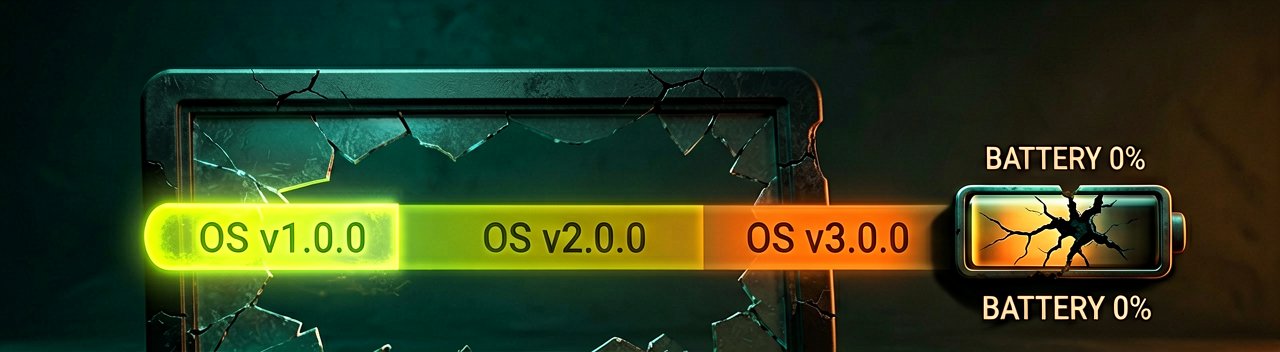
Reading Between the Lines: Samsung’s promise of six years of major OS upgrades for a mid-range phone sounds like a massive win for consumer longevity, but it introduces a glaring hardware-software paradox. While the Snapdragon 6 Gen 3 is a highly capable chip for 2026, forcing it to run a complex, feature-heavy Android 22 operating system in the year 2032 strains credulity. Operating systems grow exponentially heavier over time, demanding more RAM and advanced neural processing power. There is a very real risk that these future software updates will eventually bloat the device, trading today’s smooth 120Hz performance for tomorrow’s sluggish system stutter.
Furthermore, this aggressive update strategy directly contradicts the physical realities of modern smartphone hardware. Silicon and software can be patched indefinitely, but Lithium-ion batteries obey the unyielding laws of chemistry. By year three or four, the phone's 5,000mAh cell will inevitably degrade, leaving users with a device that possesses cutting-edge software but can barely survive a morning commute without a charger. Because Samsung has not paired this long-term software commitment with affordable, standardized battery replacement programs, the six-year promise may ultimately serve more as an attractive marketing bullet point than a practical reality for the average consumer.
This push also reveals a quiet admission regarding the current state of mobile artificial intelligence. By trickling Galaxy AI down to the A-series, Samsung is acknowledging that basic AI photo editing and text summaries are quickly becoming commoditized, entry-level features rather than premium selling points. To keep consumers buying the more expensive Galaxy S-series, the company will have to gatekeep its truly revolutionary, resource-heavy AI breakthroughs behind a steep paywall. The Galaxy A27 5G proves that while premium features are democratizing faster than ever, the gap between the budget tier and the flagship experience will simply be redefined by what happens in the cloud, rather than what is on the spec sheet.
Purchasing a mid-range phone with a six-year software guarantee is a bit like buying a budget sedan with a lifetime engine warranty; it is comforting to know the software will keep running smoothly into the next decade, even if the plastic buttons have worn off and the battery requires a permanent umbilical cord to the nearest wall outlet.
Artūras Malašauskas is an AI Systems Integrator with 20+ years of production-grade web engineering experience. He has designed, shipped, and scaled enterprise Python/PHP systems for logistics, SaaS, and public-sector clients. For the past year, he has focused exclusively on AI integrations: deploying open-source LLMs, building generative media pipelines (image, audio, video), and engineering multi-agent workflows for real production environments. His standard: reproducibility, security, cost-efficient inference—no vaporware. He documents and evaluates emerging AI tooling, separating verified capabilities from marketing noise. Technical editor at: muza-ai.eu, ai-verslas.lt, ai-naujinos.lt Connect on LinkedIn
Comments